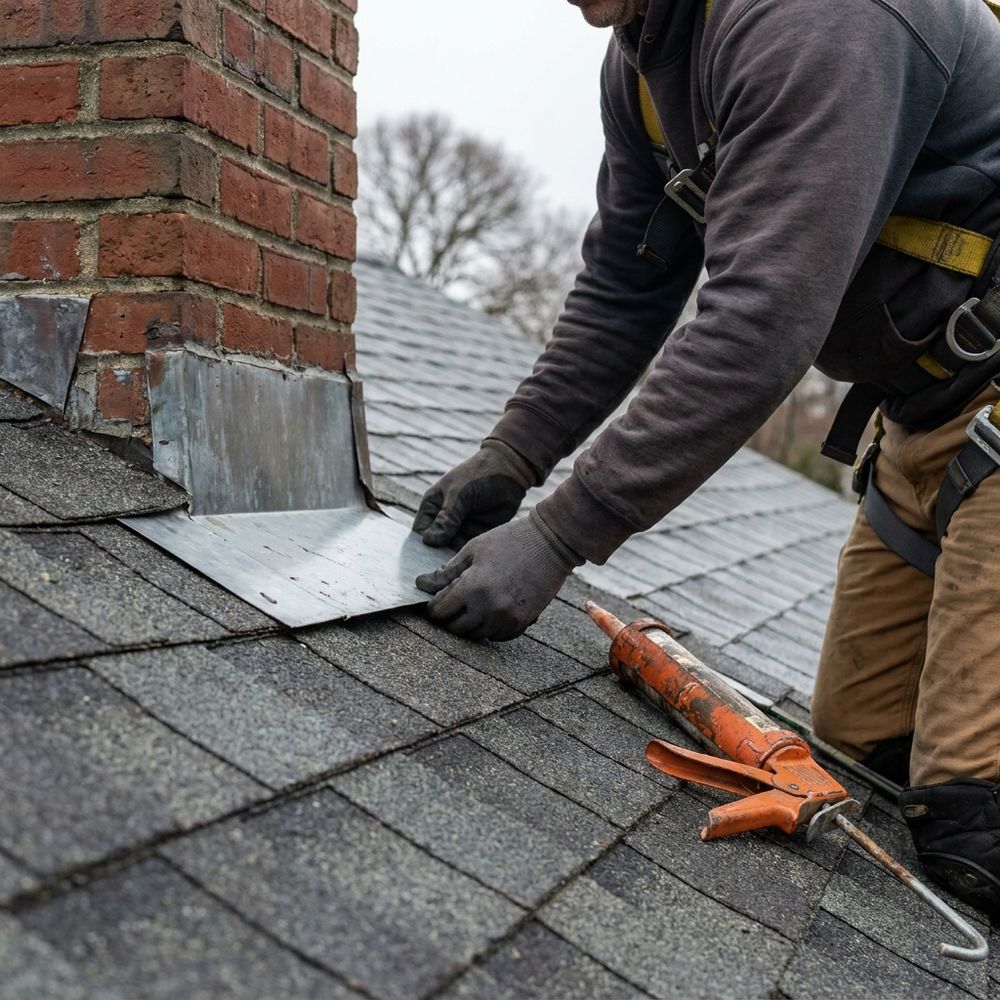
Most roof leaks aren’t a roof problem — they’re a flashing problem, a valley problem, or a ventilation problem wearing a roof problem’s coat. We repair roofs across Boston and the northern suburbs, and we diagnose before we quote, because the honest answer is often a few hundred dollars of work rather than a five-figure replacement.
When the only thing you sell is a new roof, every leak looks like a new roof. We do both, so the recommendation you get is the one the roof needs. If yours has ten good years left, we’ll say so and fix the leak. Water coming in now? Call (617) 721-1814.
The stain is almost never above the leak
Water gets in at one point, lands on the underside of the decking, then travels — down the sheathing, along a rafter, across a ceiling joist — and drops through the drywall wherever it finds a seam, a light fixture or a nail hole. By the time it’s a brown ring on your bedroom ceiling, it may have moved eight or ten feet from where it got in.
So we don’t quote a repair from a photo of your ceiling. We get on the roof, we get in the attic, and we work backwards from the stain to the entry point. In an unfinished attic you can read the trail on the underside of the deck: dark staining, rust rings around nail shanks, mineral deposit where meltwater has run. A contractor who just replaces the shingles above a stain risks leaving the real leak untouched — and then you’ve paid twice and still have a wet ceiling.
Where roof leaks around Boston actually start
After ten years on New England roofs, a short list accounts for most of what we’re called out to. The open field of shingles is rarely the culprit. Leaks happen where the roof stops being a simple slope.
Flashing at chimneys and sidewalls
The number one leak source on the older housing stock north of Boston, and it isn’t close. Where a roof meets a brick chimney or the side wall of a dormer, the waterproofing is metal — step flashing woven into each shingle course, counterflashing let into the mortar joints. Both fail with age. Mortar erodes and the counterflashing pulls loose. Step flashing corrodes, or was reused from the last roof and is a decade older than the shingles around it. Someone caulks it, the caulk cracks in two freeze-thaw cycles, and the water is back. Roofing cement over a flashing joint is a symptom, not a repair.
Valleys
Where two roof planes meet and dump their combined water into one channel. On a colonial or gambrel with dormers, that’s an enormous volume. Rusted-through valley metal, shingles cut too tight to the center line, or debris pushing water sideways under the courses all leak — and because of the volume, valley leaks tend to be big ones.
Pipe boots and roof penetrations
Every plumbing vent is sealed with a rubber collar over a metal flange. That rubber has a shorter life than the shingles around it and typically splits around the fifteen-year mark — one of the cheapest repairs on this list and one of the most commonly missed. Bath fan vents and abandoned antenna holes are the same story.
Ice dam backup
The New England special. Heat escaping into the attic melts the snow pack, the meltwater refreezes into a ridge of ice at the cold eave, and every later thaw ponds behind it. That standing water works backwards under the shingle courses — shingles shed running water, they don’t hold back standing water. The leak is real, the roof may be fine, and re-shingling won’t fix it. The fix is ice & water shield at the eaves plus correcting the ventilation. More in our guide to why ice dams wreck Boston roofs.
Nail pops, lifted tabs and worn detail
Nails back out over years of thermal cycling and push a dome up under the shingle above, which splits and exposes the hole. Nor’easter wind breaks the sealant strip and lifts tabs that never re-seal. Skylights leak at the head flashing and the perished gasket far more often than through the glass, and a missing drip edge lets water curl back under the first course and rot the sheathing edge. Individually these are small, cheap fixes — spread across the whole roof they’re a message about the age of the field, which is the roof replacement conversation.
What a roof repair costs — and what it costs not to do it
We won’t give you a single number over the phone — a pipe boot and a rebuilt chimney flashing aren’t the same job. But you deserve a real range, so here’s the honest shape of it on a typical single-family home here.
| Repair | Typical range | What moves it |
|---|---|---|
| Pipe boot replacement | $300 – $600 | Number of boots, pitch and access |
| Missing or wind-lifted shingles | $400 – $900 | Area involved, matching an aged shingle |
| Step flashing at a sidewall or dormer | $800 – $2,000 | Run length, whether siding comes off |
| Chimney flashing and counterflashing rebuild | $1,200 – $3,000 | Chimney size, mortar condition |
| Valley repair or re-lining | $1,000 – $2,800 | Valley length, shingle condition either side |
| Ice dam damage plus ice & water shield at the eaves | $1,500 – $3,500 | Linear feet of eave, ventilation corrected too |
Most repairs we do land between $800 and $3,500. A full architectural shingle replacement on a comparable house is generally $12,000 to $18,000, and more on a large or complicated roof. That gap is the whole reason a second opinion is worth a phone call. For the detail see how much roof repair costs in Massachusetts, and for the other side, roof replacement cost in Massachusetts.
- Pitch and access move every price here — a walkable ranch roof is cheaper than a third-floor two-family that needs staging.
- Rot found under the leak is the usual surprise. You hear about it the same hour, with a price.
When we’ll tell you to repair — and when we won’t
A repair is the right call when the surface is still doing its job and the failure is at a specific detail: one flashing, one valley, one boot, a few shingles. We’ll tell you to plan a replacement instead when we find one of these, and we’ll show you why on the roof:
- Leaks in three or more unrelated places. One leak is a repair. Three entry points means the field has given up.
- Widespread granule loss. Bald patches and gutters full of grit mean the mat is exposed. New flashing on a spent surface is money in a hole.
- Brittle shingles that crack when lifted. If we can’t lift a course to slide flashing under it, the repair does more damage than good.
- Extensive wet or delaminated decking. Localized rot is a repair. Soft sheathing across a whole plane is not.
- A roof past 25 years with an active leak. Spend $2,000 on it and you’ll likely spend it again in two winters.
- A sagging roof line. Structural — worth looking at promptly regardless of the shingles.
Our repair or replace decision guide follows the same logic — including the outcome where the answer is “your roof is fine, leave it alone.” That outcome exists, and we put it in writing when it applies.
How a repair visit runs
- You describe what you’re seeing. Where the stain is, and whether it tracks with heavy rain, wind direction or a thaw. A leak that only shows up in February is an ice dam until proven otherwise.
- We get on the roof and into the attic. Both. A repair diagnosed from the ground is a guess.
- You get a written scope and price — what failed, what we’ll do, and whether you should be planning a replacement. Free, no obligation either way.
- We do the work and clean up. Most repairs run a few hours to a day, with a magnet sweep for nails and a walk-through before we leave.
If water is coming in right now, don’t wait for a scheduled estimate — that’s what emergency roof leak repair is for. If a storm just came through, start with storm damage roof repair or read how to tell if your roof has storm damage. If nothing is leaking, a roof inspection gets you a written condition report — or just request a free estimate.
Roof repair questions we get asked
Can you find a leak if it only happens in heavy rain?
Usually — the fact that it’s rain-dependent is itself a clue. Leaks that only appear in driving rain from one direction point to sidewall flashing. Leaks in any sustained rain point to a valley, a boot or a chimney. Leaks during a thaw with no rain are ice dams. If we can’t confirm it visually we run water on the roof section by section, someone watching inside.
Is it worth repairing a 20-year-old roof?
It depends on the shingles, not the number. We’ve repaired well-ventilated 22-year-old roofs that had years left, and told people with 16-year-old roofs that a repair was throwing good money after bad. The test: can we lift a course without cracking it, and is there still granule coverage? If both are yes, a targeted repair is worth doing. If the shingles snap, patching just moves the problem.
Will a repair match the rest of my roof?
Close, but not invisible, and we’d rather say that up front. Shingle colors weather and blends change, so new shingles on an aged roof read as newer. On a rear or side plane most people never notice; on a front elevation it’s worth knowing first.
My roof leaks every February but is fine the rest of the year. What is that?
That’s an ice dam — the most common winter call we get across Medford, Melrose and Stoneham. Re-shingling doesn’t fix it, because the cause is heat, not the shingles. The durable fix is ice & water shield along the eaves plus air sealing and balanced attic ventilation — intake at the soffits, exhaust at the ridge.
Should I file an insurance claim for a roof repair?
Sudden, identifiable damage is often covered; age and long-term wear generally aren’t. Many repairs also land near or below a typical deductible, so a claim isn’t always in your favor. More detail in what homeowners insurance actually covers. We’ll document what we find for your insurer, but we won’t call a worn-out roof storm damage.
Roof repair across Boston and the north suburbs
We repair roofs in Boston, Somerville, Medford, Melrose, Stoneham, Woburn, Wakefield, Burlington and Wilmington.