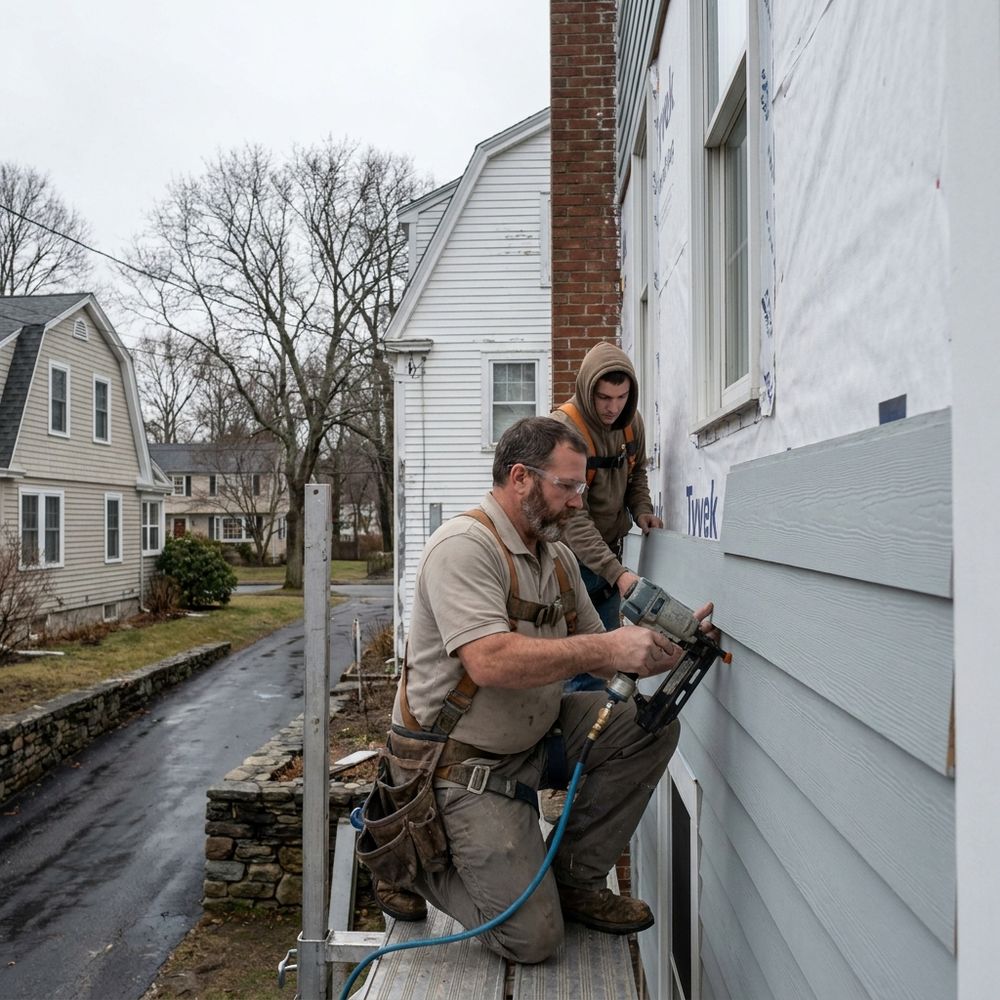
We replace siding on colonials, capes and two-families across Boston’s northern suburbs, in vinyl and in fiber cement. This page covers what most siding quotes skip: why siding fails here, what has to happen behind it, and what both materials really cost installed in Massachusetts.
Almost no siding job here is really a siding job. Water that shows up as rot behind a clapboard got in somewhere else first — failed roof-to-wall flashing, a window head with no head flashing, a gutter that’s been overflowing for six winters. New siding over an unfixed water path is expensive wallpaper. We look at the roof and the flashing before we quote the walls, and if the source is up top we’ll say so instead of selling you siding.
Why siding fails on New England houses
Siding doesn’t wear out the way a roof does. A roof takes direct sun and weather for 25 years and finishes on schedule; a wall gets far less of both. So when siding fails here there’s usually a reason, and nine times out of ten it’s water arriving from somewhere it shouldn’t. What we see most often on houses in Medford, Melrose and Somerville:
- Roof-to-wall flashing that was never right. Where a lower roof dies into a taller wall — a porch roof, a dormer cheek, an ell — you need step flashing plus a kickout to throw water into the gutter. Miss the kickout and every rainstorm sends water down inside the wall.
- No head flashing over windows and doors. Caulk is not flashing. Caulk lasts a few years; the metal above a window head should last as long as the wall.
- Gutters that overflow. A clogged or undersized gutter dumps a sheet of water down the wall. Do that every storm for a decade and the sheathing gives up.
- Ice dams. Meltwater backing up under the shingles doesn’t only stain ceilings — it runs down inside the wall cavity and rots sheathing behind perfectly good-looking siding. If you’ve had repeat ice damming, read what’s actually causing it before you re-side anything.
- Freeze-thaw on the material itself. Older vinyl gets brittle and cracks when a ladder or snow shovel touches it. Old hardboard swells and delaminates once the paint film breaks.
- No drainage plane. Plenty of houses here were sided over old shingles with felt paper and hope. Modern practice is a water-resistive barrier that lets whatever gets in drain back out.
That last point decides whether your siding lasts 15 years or 40, and it’s invisible once the job is done — which is why it’s the easiest place for a cheap quote to save money.
What goes on behind the siding
Siding is a rain screen, not a seal. Wind-driven rain gets past any lap siding ever made — the assembly’s job is to catch it and send it back outside before it reaches wood. Here’s the order it goes on, and every line appears on your estimate.
Tear-off and a look at the sheathing
Old siding comes off so we can see the wall — soft or black sheathing, rot at the sill and around openings, missing or reversed flashing, daylight where there shouldn’t be any. Bad sheathing gets replaced. If we find more than we allowed for, you hear about it the same hour with a price, not at the end in an invoice.
House wrap, lapped the right way
A water-resistive barrier over the full sheathing, lapped shingle-style so upper courses cover lower ones, taped at the seams, and — the part that gets skipped — integrated with the window flashing rather than run past it. Get the laps backwards and the wrap becomes a funnel pointed at your framing.
Window and door flashing
Flexible flashing at the sill pan, jamb flashing lapped over it, head flashing over that and under the wrap. Water gets handed down to the layer below it. Nothing structural depends on sealant.
Roof-to-wall and kickout flashing
Every place a roof plane meets a wall gets step flashing and a kickout at the eave end. This is roofing work happening inside a siding job, and it’s the biggest reason we do both trades — the wall guys and the roof guys aren’t pointing at each other, because they’re the same person. If the roof needs attention too, that’s roof repair or a full replacement, and doing both at once saves a second staging setup.
Trim, corners and the siding itself
Corner boards, casings, frieze and rake trim, then the siding courses with correct fastening and expansion allowance. Vinyl has to be hung, not nailed tight — it moves a lot between a February morning and an August afternoon, and face-nailing is why you see wavy walls on 15-year-old jobs.
Vinyl or fiber cement?
We install both and we don’t have a favorite. They fail differently, they cost differently, and the answer usually comes down to how long you’re staying and how much maintenance you’ll do. Full breakdown in our siding options compared guide — this is the short version.
| Vinyl | Fiber cement | |
|---|---|---|
| Installed cost (MA) | Roughly $4–$14 per sq ft | Roughly $9–$26 per sq ft |
| Weight and labor | Light, fast, one crew | Heavy, slower, more cutting, dust control |
| Maintenance | Wash it. No painting, ever. | Repaint every 10–15 years unless factory-finished |
| Cold-weather behavior | Gets brittle; impact cracks in deep cold | Dimensionally stable; won’t crack from cold alone |
| Fire and impact | Melts near heat; dents and cracks | Non-combustible; shrugs off hail and branches |
| Look | Insulated profiles look good; thin panels look thin | Deep shadow line, reads like painted wood |
| Repairs | Individual panels swap out cheaply | Piece replacement is harder; color matching on repaints |
| Typical service life here | Around 25–40 years | Around 40–50 years with paint kept up |
Choose vinyl if
You want the lowest lifetime maintenance, the budget is real, or you’re selling inside ten years. Insulated vinyl is worth looking at on a drafty 1950s cape — a little R-value, and a rigid backing that keeps the courses flat. More on vinyl siding installation.
Choose fiber cement if
You want the look of painted clapboard, you’re keeping the house, or the street’s architecture makes thin vinyl obvious. It’s the tougher material by a distance and holds a paint film beautifully — you’re trading money and a repaint cycle for that. More on fiber cement siding installation.
What siding replacement costs around Boston
Anyone quoting a house they haven’t measured is guessing. But you deserve a real range instead of “it depends,” so: vinyl generally lands around $4 to $14 per square foot installed, fiber cement around $9 to $26 per square foot installed. Those are wide on purpose — the spread inside them is where the decisions live.
| What drives the price | Why it moves the number |
|---|---|
| Wall area and number of stories | The base of the estimate. A three-story two-family needs staging a ranch never will. |
| Product grade | Builder-grade vinyl to insulated premium profiles is most of that $4–$14 spread. |
| Sheathing condition | The real unknown until the siding is off. Rot repair is time and materials. |
| Trim detail | Corner boards, casings, frieze, rake and soffit. On fiber cement this is a large share of the labor. |
| Number of openings | Every window and door is a flashing detail and a set of cuts. |
| Flashing corrections | Adding kickouts and head flashing that were never there. Small line, huge consequence. |
| Access | Tight lots, no driveway, a fence three feet off the wall — all slow the job down. |
Partial jobs are fair game. If one elevation takes all the weather and the other three are fine, we’ll say so — same logic as repairing a roof instead of replacing it. You pay for the work the house needs.
Siding questions we get asked
Can you side over the existing siding?
Physically yes, and we don’t. Going over old siding means you never see the sheathing, you can’t install a proper drainage plane, and rot that’s already started keeps going in the dark. It also builds the wall out past the casings, which is why those jobs look thick and wrong. Tear-off costs more on day one and it’s the only version we’ll put our name on.
How long does a siding replacement take?
A typical single-family house runs roughly a week, give or take. Fiber cement takes longer than vinyl — heavier, slower cuts, dust control to manage. Three-story two-families and houses with a lot of trim detail run longer. Rot found at tear-off adds time, which is another reason we’d rather find it at the estimate.
Will new siding fix my water problem?
Only if the water is getting in through the siding, and usually it isn’t. Interior staining and hidden rot most often trace back to roof-to-wall flashing, a missing kickout, an unflashed window head, or an overflowing gutter. New siding over an unfixed source hides the problem instead of solving it — a roof inspection is often the right first step.
Is fiber cement worth the extra money over vinyl?
Depends on how long you’re staying. It’s the tougher material — non-combustible, won’t crack in the cold, takes a branch strike without complaint, and reads like painted wood from the sidewalk. But you’ll repaint every decade or so unless it came factory-finished, and it costs meaningfully more to install. Selling in five years? Vinyl. Staying put? Fiber cement usually wins.
Can siding be installed in winter here?
Fiber cement, generally yes — it doesn’t care much about temperature. Vinyl is different: it contracts in the cold and gets brittle enough that handling and cutting need care, and installed at 20°F without the right expansion allowance it’ll buckle come July. We do install vinyl in cold weather when there’s a reason to, and we’ll say honestly when waiting for spring is the better call.
Do you replace the trim and gutters too?
Trim, yes — corner boards, casings, frieze and rake are part of the job, and rotted trim gets replaced rather than covered. Gutters come off for the siding work and go back on, and if they’re undersized or pitched wrong we’ll flag it, because an overflowing gutter is a leading reason a wall rots out.
Siding replacement across the north-of-Boston corridor
We side houses in Boston, Somerville, Medford, Melrose, Stoneham, Woburn, Wakefield, Burlington and Wilmington. Thiago walks the property himself, and the estimate is free either way — including the version where the siding is fine and the flashing isn’t. Ask for an estimate or call (617) 721-1814.