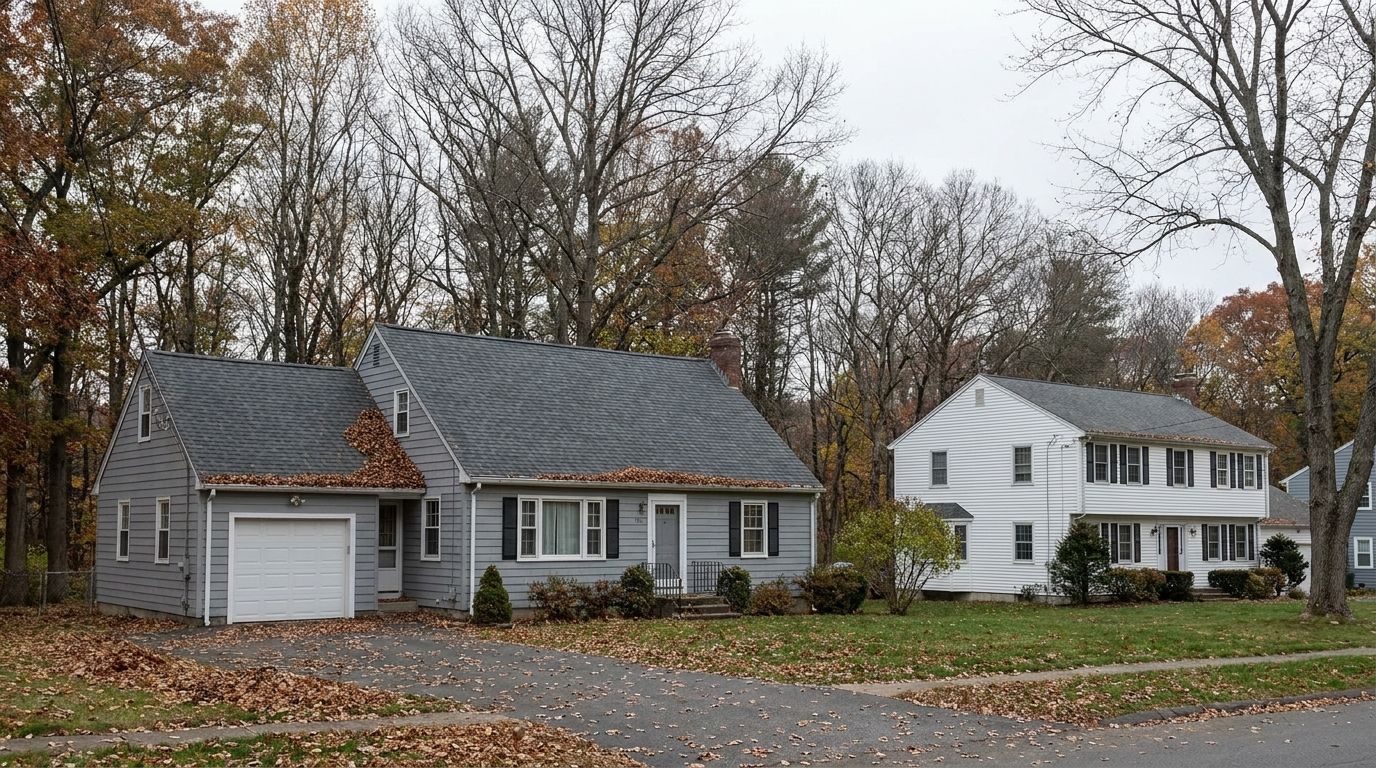
Stoneham sits against the Middlesex Fells, and the woods don’t stop at the reservation line — they run through the neighborhoods. Most roofs here live under mature hardwood canopy, and canopy is what wears them out. We do replacement, repair and siding across town, and in Stoneham the honest first question is usually about getting water off the roof, not about the shingles.
A fair share of the “your roof is shot” verdicts we get called in behind on these streets turn out to be a valley packed with wet leaves and a gutter that hasn’t drained in three autumns. That’s a few hundred dollars of work, not twenty thousand. Call Thiago on (617) 721-1814 and describe what you see.
Tree canopy is the story here
Every town in our service area has trees. Stoneham has them differently — big oaks and maples arching directly over the roof plane rather than standing off at the edge of the lot. A roof under that cover ages on a different schedule than the same roof in an open subdivision, and it fails in different places.
- Leaf litter packs the valleys. A valley is where two roof planes dump their water into one channel. Fill it with wet leaves and you’ve built a sponge in the fastest-moving part of the roof — water stops running, wicks sideways under the shingle courses, and works on the valley metal and the deck.
- Gutters clog and overflow at the eave. Backed-up water gets behind the drip edge and into the fascia and soffit — which is why so much Stoneham rot shows up as soft trim and peeling paint long before a ceiling stain.
- Moss takes the shaded slopes. Algae streaking is cosmetic. Moss isn’t — it holds moisture against the shingle and lifts the edges. We regularly see Stoneham roofs where the sunny slope has ten years left and the north one is finished.
- Debris hides the real condition. You can’t judge granule loss or a lifted course through leaf mulch. Plenty of inspections here start with clearing the roof.
Drainage matters more here than almost anywhere we work
We’re a roofing company, not a gutter company, but on Stoneham houses the two aren’t separable. The eave is the junction — where the roof stops, the gutter starts, the drip edge and fascia live, and ice forms in January.
The chain is the same every winter. Canopy drops leaves, leaves fill the gutter, the gutter stops draining, and the water it holds freezes into a plug at the coldest edge of the roof. Meltwater running down from a warm attic hits that plug and backs up under the shingles. The root cause is still attic ventilation and insulation — we explain why here — but in Stoneham the gutter is what turns a manageable winter into a stained bedroom ceiling.
So on a Stoneham replacement we’re specific about the first three feet: ice & water shield running well up the slope from the eave, new drip edge over it, and a gutter with real fall on it. A quote that says nothing about the eave detail isn’t finished for this town.
Shaded roofs dry slowly and stay cold
An open roof in Wakefield sheds a wet snow and dries in a day. A shaded Stoneham roof stays cold, holds snow longer, and gives freeze-thaw more cycles to work on flashing seams and nail holes. That’s why ventilation isn’t optional here — balanced soffit intake and ridge exhaust keeps the deck nearer outside air temperature, which is the real defense against ice damming. Our New England lifespan guide covers how much shade moves the number.
Limbs come down — this is a real storm-damage market
With mature hardwoods over the roof, a nor’easter or a heavy wet snow is a limb event, not just a wind event. Stoneham generates real storm damage repair work: punctured shingles, a cracked deck board, a broken ridge cap, a gutter torn off its hangers, sometimes a whole limb across a slope.
Limb damage is almost always localized: one area is wrecked, the rest of the roof is as good as it was the day before. That’s a repair. Anyone who prices a full replacement after a storm without separating what the tree hit from what was already worn out is selling, not diagnosing.
The housing stock, and why the job goes easier here
Stoneham runs mostly to mid-century capes, ranches and colonials, with older homes nearer the town center. Compared to Melrose, where turrets, bays and four dormers a house drive the labor, these roofs are straightforward — walkable pitches, one or two main planes, few valleys.
Access is the other advantage. Nearly every house has a driveway and the lots have room, so there’s no street-occupancy negotiation the way there is in Somerville or Boston. Dumpster in the drive, material staged on the ground, crew working off ladders. That’s real money, and it should show in your estimate.
| Stoneham condition | What it costs you |
|---|---|
| Valleys and gutters holding wet leaf litter | Premature shingle wear in the valleys, rotted fascia and soffit, ice dams at the eave |
| Shaded north slope | Moss, slow drying, more freeze-thaw — that slope can wear out years before the sunny one |
| Mature limbs over the roof plane | Localized puncture and impact damage after storms — usually a repair, not a replacement |
| Cape or ranch with original attic ventilation | Low pitch plus a cold, shaded deck is the ice dam combination — ventilation belongs in the scope |
What each service looks like in Stoneham
Replacement. Full tear-off to bare deck, soft decking replaced, ice & water shield at the eaves and every valley — non-negotiable on a canopy roof — synthetic underlayment, new drip edge, new valley metal and flashing, architectural asphalt shingles, balanced ridge-and-soffit ventilation. We’ll flag the trees while we’re up there, because a new roof under an unpruned limb starts aging immediately. Price comes down to size, pitch, layers coming off, decking and ventilation — our Massachusetts cost guide gives real ranges.
Repair. Limb strikes, valley leaks, chimney flashing that finally gave up, ice dam damage at one eave, rotted fascia behind an overflowing gutter. A lot of these are drainage repairs in a roofing costume, and we price them as what they are.
Siding. Vinyl and fiber cement. Shade and constant leaf contact are hard on siding too — the north elevation of a Stoneham house often shows mildew and soft trim long before the sunny sides do. Fiber cement holds up better there, and we’ll walk you through the trade-offs.
Stoneham roofing questions
My valleys fill with leaves every fall. Is that actually damaging the roof?
Yes — it’s the most common avoidable problem we see in Stoneham. Wet debris keeps the fastest-draining part of the roof permanently damp and corrodes the valley metal. Clear valleys and gutters twice each fall — mid-season and after the last leaves drop — and you’ll add years to the roof. If a valley has gone soft or is staining the ceiling below, that’s a repair.
There’s green moss on my back slope. Do I need a new roof?
Not necessarily. Moss on a shaded slope is normal under this canopy, and caught early it’s a cleaning and pruning job. What decides it is underneath — if the shingle edges are curling where the moss sat, or the granules are gone, that slope may be finished while the sunny side has years left. We assess slopes separately, and sometimes the answer is that nothing needs doing yet.
A limb came down on my roof. Repair or replace?
Almost always repair. We open up what the limb hit, replace damaged decking and shingles, and re-flash anything disturbed. The exception is a roof already at end of life, in which case we’ll say so rather than repair something you’ll replace next year.
Why are my ice dams worse than my friend’s in Woburn with the same house?
Shade and drainage. A roof under heavy canopy stays colder and holds snow longer, so meltwater has more chance to refreeze at the eave — and if the gutters are packed with leaves, a frozen plug is already waiting there. Against an open-lot house in Woburn, the difference is usually exposure plus attic ventilation, not the shingles.