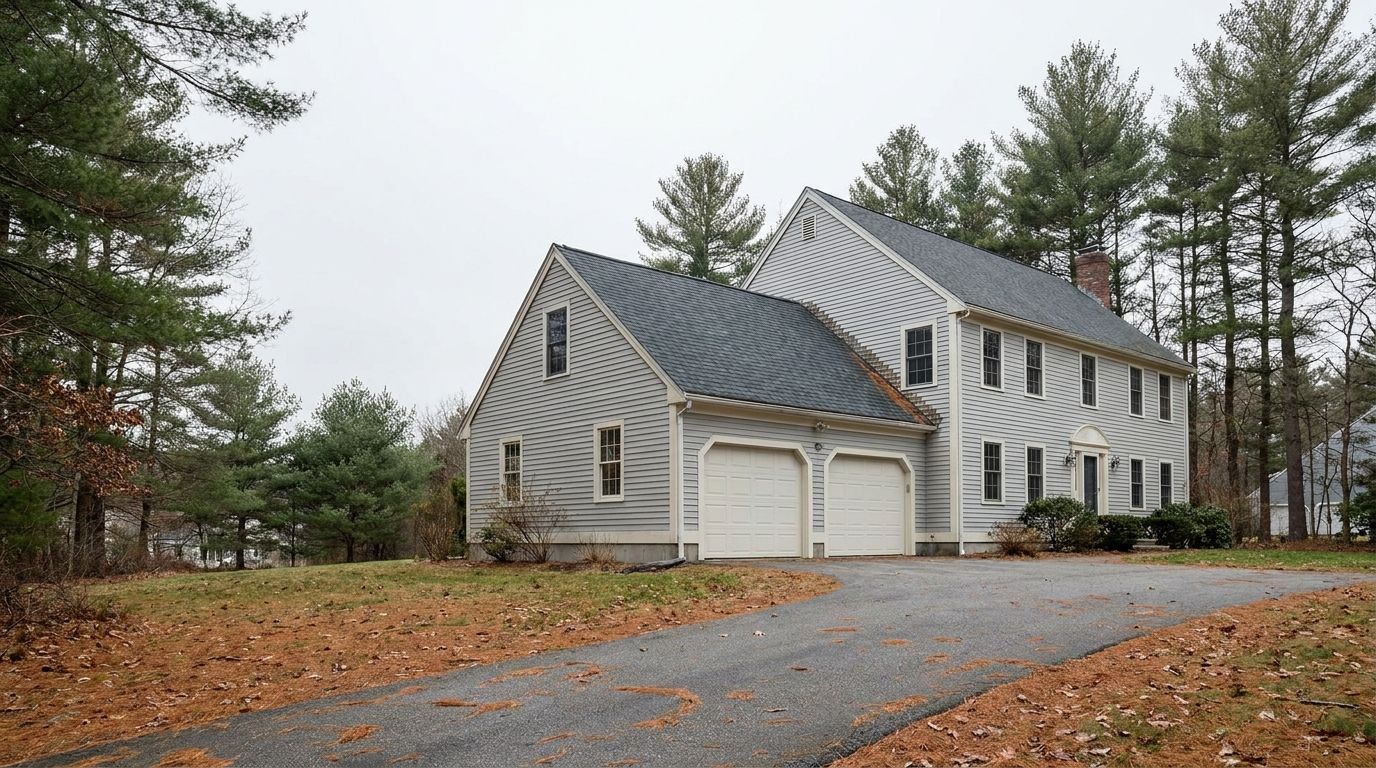
Wilmington is the outer edge of our service area and the most spread out town in it — big lots, long driveways, pines instead of maples. The housing is mixed: post-war capes and ranches, a big wave of 1980s through 2000s colonials with attached garages, and newer construction past those. We do replacement, repair and siding out here regularly, and the detail we find missing most often is a piece of metal that costs about as much as lunch.
It’s the most common leak we find in Wilmington’s newer housing, it hides for years behind siding, and you can check for it from the ground in about ten seconds. Call Thiago on (617) 721-1814 if you want a second set of eyes on it.
What’s actually out here
Wilmington built in two clear waves, and they roof very differently.
The post-war capes and ranches. Simple plans, shallow pitch, walkable, few valleys — the least expensive roofs to replace anywhere in our area, because there’s almost no flashing labor. Most are on their second or third roof, so what’s under the shingles is the open question until we tear off. Shallow-pitch ice dams apply here too, though that’s the dominant story one town over in Burlington, and the ice dam guide covers the mechanism.
The 1980s–2000s colonials. The bigger share of Wilmington, and where the interesting work is. Larger footprints, cut-up rooflines, more valleys, and almost always an attached two-car garage — very often with a finished room above it. These houses have more linear feet of roof-to-wall junction than anything in the older stock, and that junction is where roofs leak.
The bonus room over the garage
If you have one, you already know it’s the coldest room in the house in January and the hottest in August. There are real reasons, and only some are roofing.
- The floor sits over an unheated garage. Cold air on all sides of it, and the insulation between those joists is often thin, sagging or missing.
- Kneewalls and sloped ceilings are hard to insulate. Builders often stopped short where the ceiling meets the kneewall, leaving an uninsulated triangle open to the space behind.
- The vent path dead-ends. The garage roof has soffit vents at the eave, but the finished ceiling blocks the run to the ridge. Intake with nowhere to exhaust does nothing.
- So that roof deck runs warm. Warm deck, snow melts, water freezes at the cold overhang. Bonus-room roofs ice-dam when the rest of the house doesn’t.
The fix is a clear scope: air-seal and insulate at the kneewalls and ceiling, and build a real vent channel from eave to ridge before the new shingles go down. It costs more than shingling straight over the problem, and it’s the difference between a usable room and a storage room.
Kickout flashing — the small part nobody checks
Where the garage roof slope dies into the main house wall, the water running down that roof edge has to get out somewhere. Step flashing — individual metal pieces woven in course by course behind the siding — carries it down the junction. At the bottom, where the roof edge reaches the gutter, there has to be one last piece bent out at an angle: a kickout. Its only job is to throw water sideways into the gutter instead of letting it run off the end of the flashing and down behind the siding.
It’s a small piece of metal, and it gets left off constantly — by production crews in the 90s, by re-siding crews who took it off and never put it back, by roofers who caulked the corner and called it done. When it’s missing, nothing happens where you can see it: water sheets down the back of the siding onto the wall sheathing, year after year. By the time a stain shows on the bonus room ceiling or the siding at that corner feels soft, that sheathing has been wet a long time.
Stand at the corner where the garage roof meets the house wall and look at the very bottom of that roof edge, right where it reaches the gutter. You want a small metal flap angled out toward the gutter, roughly the height of the shingle courses. Shingles running straight into the wall with a bead of caulk and no metal means you have the problem. It’s a repair, not a replacement — but the siding at that corner has to come off to do it right.
This is why roofing and siding sit under one name here. The fix lives in both trades: the flashing is roofing, the wall it’s draining behind is siding. A company that only does one has a reason to stop at the edge of its trade.
Pines, needles and valleys
Wilmington lots carry a lot of mature white pine, and needle litter behaves nothing like leaf litter. Leaves blow off or break down in a season. Needles interlock into a dense mat in valleys and gutters, hold water like a sponge, are mildly acidic, and take years to break down. On a cut-up colonial roofline, that mat keeps the valley wet through every freeze-thaw cycle of the winter. Clear valleys and gutters more often than someone two towns closer in — and on any Wilmington roof past fifteen years old, the valleys are the first thing we check on a roof inspection.
Access, and the distance question answered straight
Wilmington is the farthest town we cover, and there’s no point pretending otherwise. What makes it work is the sites. Big driveways take a dumpster with room to spare, setbacks leave room for ladders on all four sides, and staging doesn’t involve a travel lane. In Somerville or the dense parts of Boston, staging is a conversation before roofing is a conversation. Out here it isn’t — which shows up as fewer days on site, not a surcharge for the drive.
What each service looks like in Wilmington
| Wilmington house | Relative cost per square foot | Where the money actually goes |
|---|---|---|
| Post-war cape or ranch | Lowest | Decking condition, and correcting attic intake and exhaust |
| 1980s–2000s colonial, attached garage | Middle to high | Valleys, step flashing and kickouts at every roof-to-wall junction |
| Same house, finished room over the garage | Highest | All of the above, plus insulation and a vent channel in that slope |
Replacement. Tear-off to bare deck, soft decking replaced and shown to you before it’s covered, ice & water shield at eaves and valleys, synthetic underlayment, new drip edge, new step and counterflashing at every wall junction — kickouts included, not optional — architectural asphalt shingles, balanced ridge-and-soffit ventilation.
Repair. A missing kickout, one failed valley, ice dam damage at a single eave, lifted shingles after a nor’easter. Those are repairs and we price them as repairs. A 15-year-old colonial roof with one bad flashing detail doesn’t need replacing, and you’ll hear that.
Siding. Old material off, a look at what’s underneath, house wrap, then new vinyl or fiber cement. The roof-to-wall junction gets rebuilt while the wall is open — the one time it’s easy.
Wilmington roofing questions
The room over my garage is freezing in winter. Will a new roof fix it?
Not on its own. The cold comes from a floor sitting over an unheated garage, kneewalls and a sloped ceiling that were under-insulated when the house was built, and a vent path that dead-ends behind that finished ceiling. A new roof over all of that is a new roof over the same cold room. What helps is doing the insulation and vent channel work while the deck is open during a replacement — you’re already paying for the access. Ask for it as its own line item.
There’s a stain on the wall where my garage roof meets the house. Is that the roof?
Usually it’s the flashing at that junction, and usually it’s a missing kickout at the bottom of it — water that should have gone into the gutter has been running behind the siding instead. Expect us to open the bottom courses of siding at that corner to see how far it went. Sometimes the sheathing is fine; sometimes there’s rot to cut out. Either way it’s a repair, not a reason to replace the roof.
Do you charge more because Wilmington is farther out?
No. We work here regularly and the sites are easy — a dumpster fits in the driveway and there’s room to stage on every side, which saves more time than the drive costs. What moves the price in Wilmington is the roof itself: valleys, wall junctions, and whether there’s a finished room in the garage slope.
Pine needles pack into my valleys. Is that actually damaging anything?
Over time, yes. A packed needle mat holds water against the valley instead of letting it run, so that section stays wet through the winter’s freeze-thaw cycles. In heavy rain it also dams water back under the shingle edges. Clearing valleys and gutters once or twice a year is cheap. A rotted valley is not.