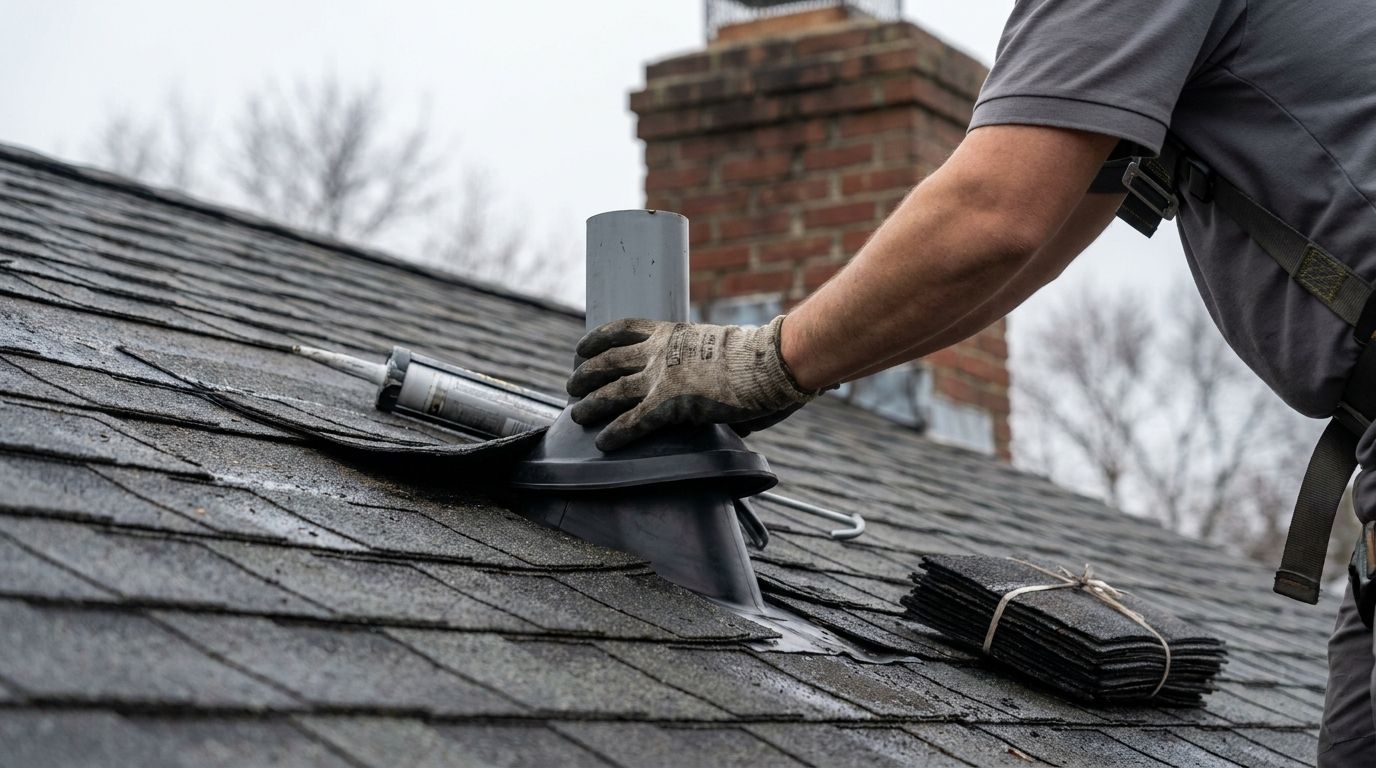
Most roof repairs in the Boston area run roughly $800 to $3,500, depending on what failed and how hard it is to reach. Small, isolated fixes come in under that; extensive damage across several areas moves toward replacement territory. Here’s the breakdown by type, and where repair stops making sense.
Two houses can need the same chimney flashing repair and be $1,400 apart. The repair is identical; the roof around it isn’t. We put a number in writing after we’ve been on the roof — free, either way.
What each repair actually costs
Installed prices on a typical single- or two-family home here. Read them as bands, not quotes: access and pitch move every row, and the same repair on a steep third-floor slope can cost double what it does on a walkable ranch.
| Repair | Typical range | What moves it |
|---|---|---|
| Emergency stabilization / tarping | $400 – $900 | Lowest here because it’s temporary — a dry ceiling until the real repair |
| Cracked or failed rubber pipe boot | $300 – $600 | The most common real failure, and the cheapest fix. Boots, pitch, access |
| Nail pops | $350 – $800 | How many, how scattered. Hundreds of them is a message about the field’s age |
| A few missing or wind-lifted shingles | $400 – $900 | Area involved, and whether aged shingles lift without cracking |
| Localized decking replacement | $500 – $1,500 | Per sheet of sheathing, plus re-shingling above. Usually found under another repair |
| Skylight flashing | $600 – $1,800 | Head flashing and perished gasket, not the glass. A rotted curb pushes it up |
| Step flashing at a wall or chimney | $800 – $2,000 | Courses must be lifted — sometimes siding too — to weave new metal in |
| Chimney counterflashing | $900 – $2,400 | New metal let into the mortar joints; chimney size, repointing |
| Valley repair or re-lining | $1,000 – $2,800 | Linear feet of valley, condition of the courses cut back either side |
| Ice dam damage repair | $1,500 – $3,500+ | The most variable line — the damage usually isn’t only the roof |
Ice dams need the caveat: the eave membrane is the roof part, but the ventilation that caused the dam — and the interior damage — often aren’t. See why ice dams wreck Boston roofs. And a leak left running two winters usually means two rows, not one.
What moves the price inside any of those bands
- Access. A third-storey Somerville two-family with no driveway is a different day’s work from a walkable Burlington ranch. Same boot, different price.
- Pitch and fall protection. Past roughly 7/12 a roof stops being walkable: roof jacks, staging, anchors — and nobody up there without them.
- How much roof has to be disturbed. The failure may be small, but reaching it properly can mean re-laying courses well beyond it — the honest reason step flashing costs multiples of a boot.
- Whether the cause is obvious or has to be found. A split boot is one visit. A stain with no visible source means an attic inspection and sometimes a water test.
- Material match on an older roof. A repair on a twenty-year-old roof will not color-match perfectly. Blends change, granules fade, new shingles read as newer. On a rear slope nobody notices; on a street-facing plane, know first.
When a repair stops being worth doing
The part most roofing sites leave out. If a repair approaches roughly half the cost of a replacement, or if you’re repairing the same roof over and over, you’re buying time — not solving the problem.
Replacement here typically runs $12,000 to $18,000 (detail in our Massachusetts roof replacement cost guide). So $1,200 of flashing work on a roof with a decade left is good money. Six thousand of patchwork on a 24-year-old roof with brittle shingles isn’t — you’ll spend it again, then spend the $15,000 anyway.
Buying time is a legitimate choice. If you’re selling in eighteen months, a repair that gets you through two more winters is exactly right. What isn’t right is spending that money believing you fixed it. We say which of the two it is, in writing.
The signals that push us toward replacement are in our repair or replace guide: leaks in three unrelated places, widespread granule loss, shingles that crack when lifted, or an active leak on a roof past 25 years.
Why nobody can price your repair over the phone
Because the three things that set the price are invisible from a phone call: what failed, how much roof has to come apart to fix it, and what the decking is doing. A ceiling stain tells you where the water landed, not where it got in.
That’s why the inspection is free. We’d rather spend an hour on the roof and in the attic than quote a guess and revise it upward on the day — and sometimes that hour ends with us saying it’s a $450 boot and the roof is fine. That’s the whole reason we do repairs alongside replacements. Water coming in now? Call (617) 721-1814 and start with emergency roof leak repair.
Common questions about repair costs
What’s the cheapest roof repair you actually do?
A rubber pipe boot replacement, usually $300 to $600 — a real fix, not a patch. Be careful with anyone quoting well under that: roofing cement smeared over a failed flashing joint is cheap because it isn’t a repair. It’s back in two winters.
Why does flashing cost so much more than replacing a few shingles?
Because of what has to come apart. Step flashing is woven into each shingle course as the roof is laid, so replacing it means lifting and re-laying those courses — sometimes pulling siding — then weaving new metal in. Counterflashing is let into mortar joints that may need repointing first. Shingles are surface work; flashing is structure.
At what point should I stop repairing and replace the roof?
When it approaches roughly half of a replacement, or when it’s the third repair on the same roof. With replacements typically $12,000 to $18,000 here, that’s a repair north of about $6,000 — or any repair on a 25-year-old roof with brittle shingles.
Is an inspection worth it if nothing is leaking?
Ours is free, so yes. A written condition report catches a perished boot at $400 instead of $2,500 with wet decking under it, and tells you how many years the roof has left.
Pricing across our service area
These bands hold from Boston and Medford out to Wilmington. Tell us the street and the roof’s age and we can usually say which end you’re in.