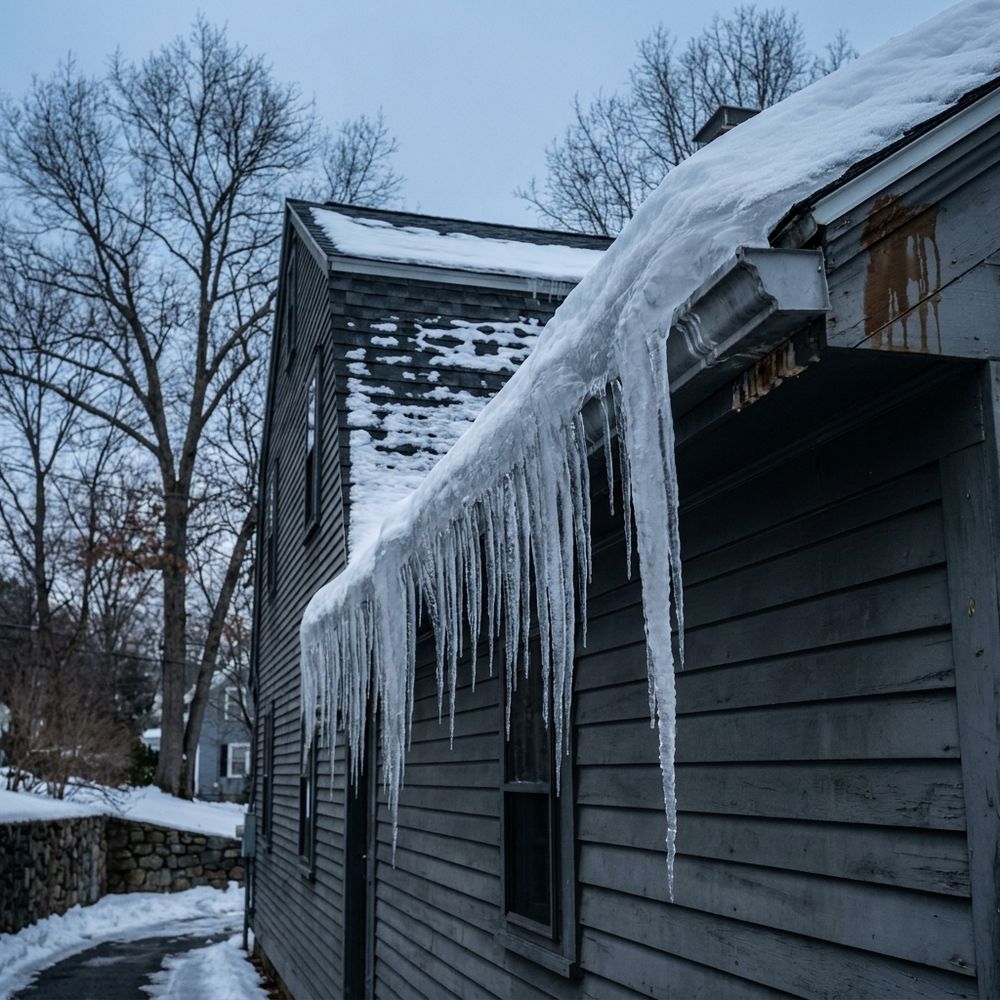
An ice dam is a ridge of ice that builds along the cold edge of your roof and stops meltwater draining. The water backs up, gets under the shingles, and ends up in your ceiling. Here is what most homeowners are never told: an ice dam is almost never a defect in the roof surface. It is heat leaking out of the house, and you fix it in the attic.
Air seal the attic floor, insulate it properly, then make sure the roof breathes at the soffits and the ridge. Do those three, in that order, and the dams mostly go away. Do only the insulation and you will be back next winter.
How an ice dam actually forms
It takes three ingredients: snow on the roof, a roof surface above freezing in the middle, and a roof edge below freezing. New England supplies all three, several times a winter.
- Warm air escapes into the attic — not through the insulation, around it. Recessed lights, the attic hatch, bath fan housings, plumbing stacks, interior wall top plates, the chase behind a chimney.
- That warm air heats the roof deck. The plywood over the heated part of the house climbs above freezing, even at 22°F outside.
- Snow melts from underneath. Not from the sun — from your heating bill.
- It hits the eave, and the eave is cold. The last foot or two of roof overhangs the wall with no heated room under it, so it sits at outdoor temperature. The water freezes there.
- The ice builds and water pools behind it. Each melt cycle adds a layer. Standing water then finds the seams between shingle courses and wicks up under them.
That last point matters: a perfectly installed asphalt roof will still leak under an ice dam. Shingles shed running water — they were never designed to hold back a pond.
What the damage actually looks like
The damage is sneaky, because water rarely appears where it got in. It runs along a rafter or across the ceiling drywall before finding a low point.
- Ceiling stains nowhere near the leak. A brown ring in a bedroom ceiling often comes from water that got in eight feet away at the eave.
- Wet insulation that then works worse. Damp fiberglass loses most of its R-value, which means more heat at the deck, more melting, a bigger dam — a feedback loop that worsens every year you ignore it.
- Peeling paint and stained trim from water sitting in the wall cavity, weeks later.
- Gutters torn off the fascia. A gutter packed with a full ice load pulls fasteners straight out of the board.
- Mold in the attic and wall cavities, and rotted eave sheathing after several winters — usually only found during a tear-off.
If you are looking at a fresh stain right now: the leak stops when the ice does. Not a reason to wait it out, but it does mean this is a diagnosis job rather than a panic job. Start with a proper roof and attic inspection.
The real fix is three things, in this order
Every genuine fix is about keeping the roof deck cold. Three levers, all working together — and the order matters, because doing the later ones without the earlier ones wastes money.
1. Air sealing the attic floor — the step that matters most
This is the one almost nobody starts with, and the most important. Insulation slows heat moving by conduction; it does very little about heat riding on moving air. Warm air leaking up around a recessed light carries a startling amount of energy straight to the underside of your roof — through a foot of perfectly good insulation.
Air sealing means closing the bypasses: hatch weatherstripped, recessed cans sealed or swapped for airtight fixtures, penetrations foamed, bath fans ducted all the way outside, top plates sealed. Unglamorous, cheap relative to a roof, and it does more for ice dams than anything else here.
2. Enough insulation on the attic floor
With the air leaks closed, insulation does its job. The Massachusetts range is roughly R-49 to R-60. Much of the housing stock north of Boston — capes, older colonials, Somerville and Medford two-families — sits at R-19 or R-30, because that was normal when the house was built.
One detail matters enormously: insulation must not be pushed into the soffits. Blown-in shoved out to the eave blocks the intake vents, and blocked intake is the most common reason a roof with a ridge vent still gets ice dams. Baffles hold it back and keep the channel open from soffit to ridge.
3. Balanced ventilation — intake at the soffits, exhaust at the ridge
Ventilation is the step that gets skipped. Its job is to flush the heat that still gets through, so the deck stays close to outdoor temperature. The word that matters is balanced: air comes in low at the soffits and leaves high at the ridge. A ridge vent with no working intake does essentially nothing — there is no air to exhaust. That is why we get into your attic before quoting. On a full roof replacement, a continuous ridge vent and proper soffit intake are a normal part of the job.
| Fix | What it does | What happens if you skip it |
|---|---|---|
| Air sealing the attic floor | Stops warm air reaching the deck at all | Heat bypasses even deep insulation |
| Insulation to R-49–R-60 | Slows the heat that remains | Deck warms all winter; higher heating bills |
| Soffit intake + ridge exhaust | Flushes residual heat off the deck | Warm pocket under the roof; dams on cold nights |
| Ice & water shield at the eaves | Limits damage when a dam forms anyway | Backed-up water goes through to the ceiling |
Why insulation alone will not stop ice dams
This is the most common misconception we run into, and it costs homeowners real money: somebody blows another foot of cellulose into the attic, then is surprised when the icicles come back in January. It fails alone for two reasons. Insulation does nothing about air leakage, which is usually the bigger share of the heat reaching your deck. And badly installed insulation often makes ventilation worse by burying the soffit intake — so you spend money and end up with a warmer deck. Insulation is the second of three steps, and it works when the other two are done.
Ice & water shield: what limits the damage
Massachusetts building code requires a self-adhering ice barrier membrane at the eave edges of a new roof, for exactly this reason. It bonds directly to the sheathing and seals around every nail driven through it. Standard underlayment sheds running water; this holds back standing water. It runs from the roof edge up past the interior wall line, so the section most likely to sit under a dam is sealed, not just covered.
On a typical single-family replacement it adds roughly $300 to $600, depending on the linear footage of eave and how far up the slope it runs. It is one of the first lines a cheap quote quietly trims, and the last one you should let anybody cut here. Be clear on what it does, though: it does not prevent ice dams. It contains the consequences when one forms.
Hammers, chisels, hatchets, ice picks. We see the results every spring: gouged shingles, torn membrane, punctured deck, a roof that now leaks in summer too. If ice has to come off in an emergency, steam is the only method that does not damage the roof.
Honest warnings about the DIY remedies
- Roof raking — sound in principle, easy to get wrong. Clearing the bottom three or four feet removes the dam’s fuel. But cold asphalt is brittle, and an aluminum-edged rake dragged across it scrapes off granules and tears tabs. Use rollers or a plastic blade, pull straight down, leave an inch of snow rather than scraping to the shingle, and never work off a ladder in icy conditions.
- Ice melt in a stocking — mildly effective at opening a drainage channel, and calcium chloride is hard on gutters, fasteners and the plants below. A stopgap at best.
- Heat cables — they treat the symptom, not the cause. They can keep a path open where an attic genuinely cannot be fixed, but they run on your electric bill all winter and do nothing about the warm deck making the meltwater. We would rather spend that money on air sealing.
An ice dam is often not a reason to replace the roof
This is the honest-assessment part, and it is why this page exists. If a contractor sees your stains and immediately quotes a full replacement, ask what they found in your attic. If the answer is vague, get a second opinion. A twelve-year-old roof with good shingles and bad ventilation does not need new shingles. It needs air sealing, insulation and intake vents — and new shingles over the same attic problem will produce the same dams next winter, for twenty thousand dollars more.
Replacement genuinely is the answer when the shingles are near the end of their life anyway, when the eave sheathing has rotted, when there is no ice barrier at the eaves and repeated leaks are damaging the interior, or when ventilation needs rebuilding in a way that only makes sense with the roof off. Then you are replacing for roof reasons.
Not sure which camp you are in? Our repair or replace decision guide walks through it, and how long a roof lasts in New England gives the honest lifespan picture. If it is a targeted fix — flashing, a section of eave, a few courses of shingles — that is roof repair work.
Ice dam questions we get every winter
Will a new roof stop my ice dams?
On its own, usually not. A new roof gives you a proper ice barrier at the eaves, which limits the damage when a dam forms, and rebuilding the ventilation at the same time helps. But the heat creating the dam comes from inside your house, and that gets fixed on the attic floor, not on the shingles. If somebody is selling a replacement purely as an ice dam cure, be skeptical.
Is the water coming through my ceiling covered by insurance?
Sudden interior water damage is covered by a lot of Massachusetts policies; long-term wear and the underlying insulation and ventilation work generally are not. We are roofers rather than public adjusters, so what we give you is a written assessment with photographs, and your carrier decides the rest. More detail: does homeowners insurance cover a roof?
How much does it cost to fix the cause rather than the symptom?
It depends on the attic’s size and access, but here is the useful comparison: air sealing and insulation costs a small fraction of a replacement, and it lowers your heating bill every month afterward. Soffit intake and a ridge vent added during a replacement is a modest line item on a much bigger job. Nobody can quote it honestly without going into your attic first.
Do gutters cause ice dams?
No. Gutters fill with ice and look like the culprit, but the dam forms at the roof edge whether a gutter is there or not. Clogged gutters do make the ice mass worse and raise the odds the gutter gets torn off, so clean them in the fall. Removing them will not stop ice dams.
There is water coming in right now. What do I do tonight?
Contain it inside first. If the ceiling is bulging, a small hole poked at the low point with a screwdriver drains it in a controlled way instead of letting the drywall let go all at once. Then, if you can do it safely from the ground, rake the snow off the lower few feet of roof. Do not get on the roof, and do not chip at the ice. Call (617) 721-1814 and we will talk you through it.
Ice dam work across the north-of-Boston corridor
Ice dams are a regional specialty here, not a curiosity. We see them on triple-deckers in Somerville, capes in Stoneham, colonials in Medford, and everything in between across Boston. Want somebody to look in your attic and say honestly what is causing yours? That is a free estimate and a straight answer either way — call (617) 721-1814.