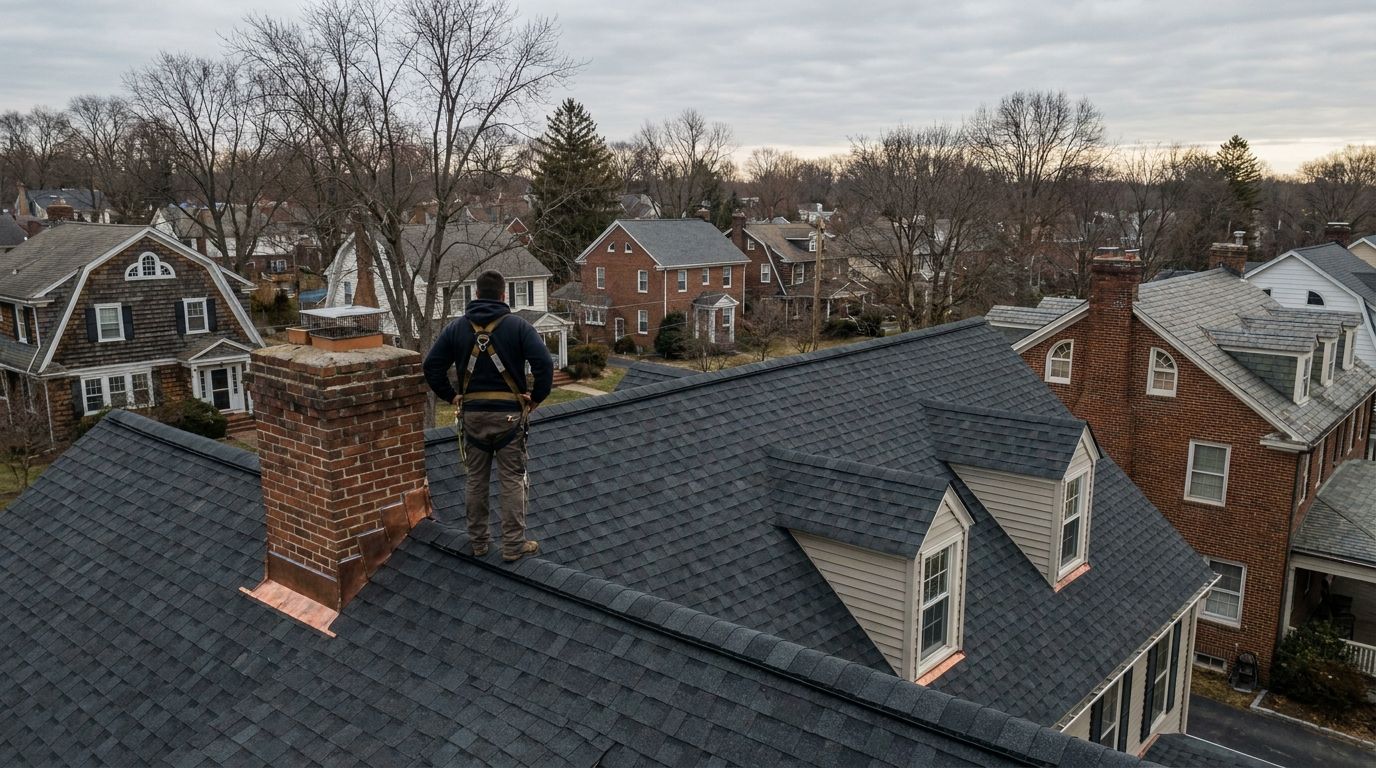
Most single-family roof replacements in Massachusetts land somewhere around $12,000 to $18,000, with the full market spread running roughly $9,000 to $25,000. That gap is not vagueness — it is the difference between a walkable ranch roof with one layer on it and a steep three-story colonial with four dormers, two valleys and rotted decking underneath. This page explains exactly which of those you are, and how to read a quote well enough to know whether the number in front of you is fair.
Every figure on this page is a range, and it stays a range until someone has been on your roof and in your attic. Anyone who gives you a firm price over the phone is either guessing or planning to change it later. We give you a written number after we look — free, and with a straight answer either way.
The 2026 numbers for a Massachusetts roof
Here is where real jobs in the Boston area actually land. These are installed prices — materials, labor, tear-off, disposal, permit — not material-only figures.
| What you’re pricing | Typical Massachusetts range | What puts you at each end |
|---|---|---|
| Most single-family replacements | $12,000 – $18,000 | The middle of the market. One layer coming off, average pitch, sound decking. |
| Full spread across the market | $9,000 – $25,000 | $9k is a small, simple, low-pitch roof. $25k is large, steep, complex, or a multi-family. |
| Architectural asphalt shingles, installed | $450 – $750 per square | A “square” is 100 sq ft of roof surface. Pitch, height, access and complexity move this per-square rate. |
| A typical 2,000 sq ft home | $15,000 – $22,000 | Roughly 22–30 squares of roof once pitch and overhangs are counted. |
| Ice & water shield at the eaves | +$300 – $600 | Required by Massachusetts code. Not an upgrade, not optional, and not a line you should let anyone delete. |
| Roof repair instead of replacement | $800 – $3,500 | For comparison. If your roof has years left, this is the honest answer — see what roof repair costs here. |
If those bands feel wide, that is the point. Two houses on the same street in Medford can be $8,000 apart, and the reason is almost never the shingle. It is the surface area, the pitch, the number of layers coming off and what the deck looks like underneath.
How roofers actually measure and price a roof
The single most useful thing you can learn before reading an estimate: roofers do not price by the square footage of your house. They price by squares of roof surface, and one square is 100 square feet of actual roof plane.
Your 2,000 sq ft home almost certainly does not have 2,000 sq ft of roof. It usually has more. Two reasons:
- Pitch adds surface. A roof is a slope, not a floor. A moderate 6/12 pitch adds about 12% to the footprint. A steep 12/12 adds over 40%. The steeper the roof, the more shingle it takes to cover the same house.
- Overhangs, dormers and additions add more. Eaves project past the walls. Dormers have their own little roofs and cheek walls. A rear addition or an attached garage is roof too, even though nobody counts it when they say “my house is 2,000 square feet.”
So a 2,000 sq ft two-story colonial has roughly 1,000 sq ft of footprint under the roof, plus pitch, plus overhangs, plus dormers — and lands somewhere around 22 to 30 squares once measured. At $450 to $750 a square installed, that is the $15,000 to $22,000 band in the table above. Now you can see where the number comes from instead of taking it on faith.
“How many squares did you measure, and what pitch?” A roofer who has genuinely measured your roof answers instantly. One who eyeballed it from the driveway hesitates. It is the cheapest quality check you will ever run, and it costs you one sentence.
Every cost driver, and what each one does to the number
These are the variables. When two quotes are far apart, the difference is hiding in this table somewhere.
| Driver | Effect on price | Why |
|---|---|---|
| Roof size (squares) | The base of everything | Directly multiplies the per-square rate. Everything else adjusts around it. |
| Pitch / steepness | Moderate to large increase | Anything over about 7/12 stops being walkable. That means roof jacks, staging and slower, more careful work — plus more shingle for the same footprint. |
| Height / number of stories | Moderate increase | A third-story Somerville two-family needs more staging, longer material handling and more fall protection than a single-story ranch. |
| Layers being torn off | Add roughly $75–$150 per square for each extra layer | Two or three old layers means twice or three times the tear-off labor and a much bigger dumpster. Disposal is by weight. |
| Decking condition | The real unknown — often $500–$3,000 | Soft, delaminated or water-stained sheathing has to be replaced, and nobody sees all of it until the roof is open. |
| Complexity | Can add 10–25% | Dormers, valleys, skylights, chimneys and multiple roof planes are all flashing work — slow, skilled, and where leaks actually start. |
| Ventilation corrections | Several hundred to low thousands | Adding continuous ridge vent, or opening blocked soffit intake. Skipping it is why some brand-new roofs still get ice dams. |
| Access and staging | Moderate increase | A narrow driveway with no dumpster space and a neighbor’s fence six feet off the eave is a genuinely different job from an open suburban lot. |
| Ice & water shield coverage | +$300–$600 minimum | Code-required at the eaves in Massachusetts. Wider coverage, valleys and penetrations push it higher — correctly. |
The Massachusetts line nobody outside New England has to think about
Massachusetts building code requires ice & water shield at all eave edges. This is not a regional preference or an upsell. It is a code requirement driven by the fact that our roofs spend February with a snow load on them and a freeze-thaw cycle running through it.
Ice & water shield is a self-adhering rubberized membrane that bonds directly to the decking and seals itself around every nail driven through it. When an ice dam forms at your eave — snow melting higher up the roof, refreezing at the cold overhang, backing meltwater up under the shingles — that membrane is the only thing standing between the water and your bedroom ceiling. Shingles shed water going downhill. They do nothing at all against water being pushed uphill by a dam. Here is the full explanation of how ice dams actually work.
Practically, it adds roughly $300 to $600 to a typical replacement, and more if it is carried further up the roof or run through the valleys as well. That figure should appear on your estimate. If it does not appear anywhere — not as a line, not in the specification paragraph — the quote is either incomplete or the roof is not being built to code. Both are worth a direct question before you sign anything.
How to compare two quotes line by line
Homeowners usually get three estimates and then compare the only thing that is easy to compare: the total. That is exactly backwards. Put the quotes side by side and check these nine lines instead. A cheaper quote that is missing four of them is not cheaper — it is a smaller job wearing the same name.
| Line to check | What a complete quote says | What a thin quote says |
|---|---|---|
| Tear-off vs overlay | Full tear-off to bare decking, all layers removed | Silent, or “install over existing” — see why an overlay costs more in the long run |
| Number of squares | An actual measured figure, e.g. “26 squares” | No number at all, or “approx.” |
| Ice & water shield | Named, with coverage stated (eaves, valleys, penetrations) | Not mentioned, or “as required” |
| Underlayment | Synthetic underlayment across the full deck | Felt paper, or unspecified |
| Flashing | New step flashing, new counterflashing, new valley metal, new pipe boots | “Reuse existing flashing” or no mention |
| Drip edge | New metal drip edge at every eave and rake | Omitted |
| Ventilation | Ridge vent specified, intake ventilation assessed in the attic | Nothing — the most commonly skipped item on the list |
| Decking allowance | A stated per-sheet price and how you’ll be told | No allowance, which means it becomes a surprise later |
| Cleanup, disposal, permit | Included and stated: dumpster, magnet sweep, permit pulled | Not listed, then billed as “extras” |
Print that. Take it to the next estimator. A contractor who is proud of their specification will happily walk you through every row. One who gets impatient at row three has told you something useful for free.
What a suspiciously cheap quote is leaving out
When one number comes in $5,000 under the other two, it is rarely because that company found some efficiency the others missed. It is almost always one or more of these:
- An overlay instead of a tear-off. Saves a day of labor and a dumpster. Hides rotted decking, adds weight the frame wasn’t designed for, and makes proper eave ice & water shield impossible.
- Reused flashing. New shingles around twenty-year-old step flashing and cracked chimney counterflashing. Looks perfect from the street, leaks in two winters, in exactly the same place it did before.
- Reduced or omitted ice & water shield. The invisible layer, so the easiest one to quietly shrink — and in Massachusetts a code issue, not just a quality one.
- No ventilation work. Ridge vent skipped, soffit intake never checked. The new roof gets the same ice dams the old one did.
- No decking allowance. The quote is low precisely because the bad wood isn’t in it. It arrives later as a change order, at whatever price gets decided on the day, when the roof is open and you have no leverage.
- Three-tab instead of architectural shingles. Flatter, lower wind rating, shorter life. Fine as a choice you made — not fine as a substitution you weren’t told about.
Cheap and expensive is the wrong axis. The question is whether the two quotes describe the same roof. Usually they don’t.
Why nobody can give you a firm price without seeing the roof
Three of the biggest variables are invisible from the ground. Nobody knows how many layers are up there until they lift a shingle at the eave. Nobody knows the state of the decking until the old roof is off, though an attic inspection narrows it enormously. Nobody knows whether your soffit intake is blocked with insulation without going up there and looking. So an estimate from a company that never got on the roof, never went in the attic and never gave you a square count isn’t really an estimate — it’s a number chosen to be attractive, with room built in to move later.
Our process is the opposite: on the roof, in the attic, at the flashing and the ventilation, then a written specification with the price and a stated decking allowance before anything starts. That’s why our replacement page lists the specification layer by layer.
We do repairs as well as replacements, which means we can afford to tell you your roof has seven good years left. If you’re not sure which side of that line you’re on, start with repair or replace — how to actually tell rather than with a price.
Cost questions we get asked
How much does a roof replacement cost in Massachusetts in 2026?
Most single-family replacements land roughly between $12,000 and $18,000, with the full spread across the market running about $9,000 to $25,000. Architectural asphalt shingles run roughly $450 to $750 per square installed, where a square is 100 sq ft of roof surface. A typical 2,000 sq ft home commonly comes in around $15,000 to $22,000. Where you fall inside those bands depends on your roof’s size, pitch, height, complexity, how many layers are coming off, and what the decking looks like underneath.
What is a “square,” and why isn’t my roof the same size as my house?
A square is 100 square feet of roof surface, and it’s the unit every roofing estimate is built on. Your roof is bigger than your home’s floor area because it’s sloped — a 6/12 pitch adds around 12% over the footprint, a 12/12 adds more than 40% — and because eaves overhang the walls while dormers, additions and garages all carry their own roof. A 2,000 sq ft colonial usually works out to around 22 to 30 squares.
Is ice & water shield really required in Massachusetts?
Yes. Massachusetts building code requires ice & water shield at all eave edges. It’s a self-adhering rubberized membrane that seals around the nails driven through it and stops meltwater backed up by an ice dam from getting into the house. Budget roughly $300 to $600 on a typical replacement, more if it’s carried further up the roof or run through the valleys. If it isn’t named anywhere on an estimate, ask why before you sign.
Why is one of my three quotes thousands of dollars cheaper?
Nearly always because it’s a smaller job. Check for an overlay instead of a full tear-off, reused flashing, reduced or missing ice & water shield, no ventilation work, no stated decking allowance, or three-tab shingles substituted for architectural. Compare the specification line by line — quotes that describe different roofs can’t be compared on price at all.
What happens to the price if you find rotted decking?
Bad sheathing typically adds somewhere between $500 and $3,000 depending on how much there is. We check your attic before quoting so we usually have a good idea in advance, and the estimate states a per-sheet price up front. If we find more than we allowed for, you get told the same hour with a number — not at the end of the job in an invoice you weren’t expecting.
Would a repair be cheaper than a replacement?
Far cheaper — a typical roof repair runs roughly $800 to $3,500 against $12,000 to $18,000 for a replacement. Whether it’s the right answer depends on whether the roof surface itself is finished or you have one localized failure. One leak in one spot is usually a repair. Leaks in three unrelated places, widespread curling and granule loss, or a roof past 25 years generally isn’t.
Costs across the north-of-Boston corridor
The ranges above hold across our whole service area, but the mix shifts by town. Dense triple-deckers in Somerville bring access and staging costs that an open lot in Wilmington simply doesn’t have, and older housing stock in Boston and Medford more often means multiple layers coming off. Tell us the street and we can usually tell you which of those you’re in for before we even arrive.