Most homeowners asking this question have already been given the answer by somebody who only sells one of the two. This page hands you the framework we use on the roof, so you can work out for yourself whether you are looking at an $1,800 repair, a $15,000 replacement, or a roof that needs nothing at all this year.
We do repairs and we do replacements, so we get paid either way and have no reason to steer you toward the bigger job. Work through the sections in order and you will land in one of three places: fix it, replace it, or leave it alone and look again next spring. All three are real outcomes, and we give the third more often than you would expect.
Start here: isolated or widespread?
If you take one thing from this page, take this. It settles more repair-or-replace arguments than every other test combined.
Isolated damage has a cause you can point at. A branch broke six shingles. Step flashing at the dormer pulled away. A pipe boot cracked — they always crack, the rubber has maybe fifteen years in it and the shingles have thirty. Counterflashing loosened at the chimney in the freeze-thaw. In every one of those cases the rest of the roof is doing its job. Fix the failed part and the roof carries on for another decade.
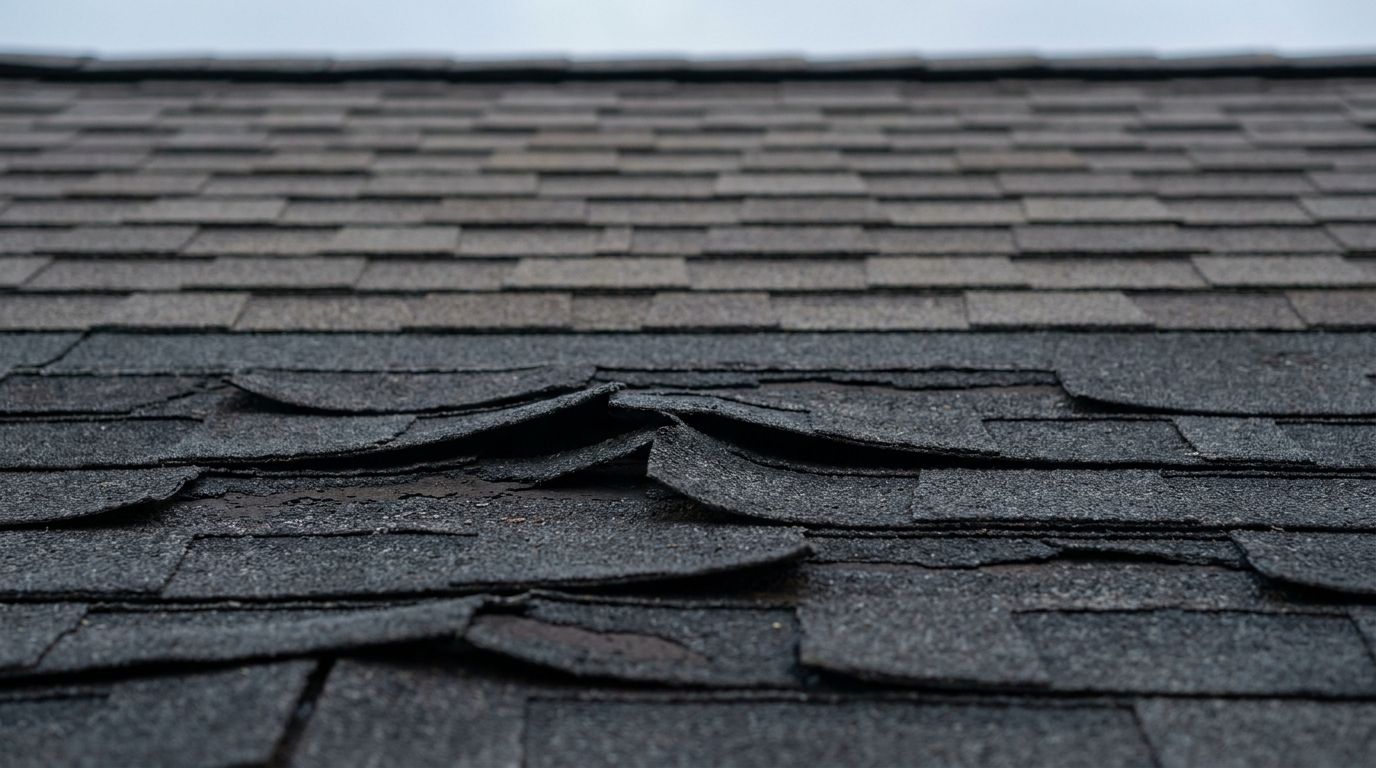
Widespread damage has no single cause, because the cause is time. Shingles curling across the whole south slope, not one corner. Granule loss even across every plane rather than concentrated under one tree. Wind taking tabs off in three places instead of one exposed edge. That is not a damaged roof, it is a finished roof, and repairing one section just moves the next leak somewhere else.
Stand at the end of the driveway and look at each roof plane in turn, then do the same from the back yard. Can you draw a circle around the problem? Repair. Does the problem look like the general condition of the roof? Replacement. If you cannot see it from the ground, shoot photos from an upstairs window and zoom in — do not get on the roof yourself.
Age tells you less than you think
Everyone starts with age, and age is the weakest signal on this page. An architectural asphalt roof in New England generally gives you somewhere in the region of 20 to 30 years, but the spread inside that range is huge, and it is driven mostly by ventilation.
A well-ventilated 22-year-old roof on a shaded north slope can be perfectly sound — flat, sealed, granules intact, no reason to touch it. A badly ventilated 14-year-old roof on a full-sun southern exposure, where the attic cooks all summer because the soffit intake is packed solid with insulation, can be brittle, curled and finished. Age puts a roof on the watch list. Condition decides.
Age matters at the two ends. Under about 10 years, a leaking roof almost always has a flashing or installation defect rather than a worn-out surface — a repair. Over about 25 years, plan replacement on your own timeline even if nothing is wrong yet, because a chosen September beats an emergency February. More in how long a roof actually lasts in New England.
The quick read: if you see this, it’s probably that
| What you are seeing | What it usually means |
|---|---|
| One leak, one stain, one location | Repair. Almost always flashing, a pipe boot, or a valley — not the shingles. |
| Leaks in three unrelated places | Replacement. The field has lost its water-shedding ability. |
| Missing shingles in one wind-exposed corner | Repair. Normal after a nor’easter, even on a young roof. |
| Tabs lifted or blown off across several planes | Replacement. The sealant strips have failed everywhere. |
| Granules in a new roof’s gutters, first year only | Nothing. Manufacturing excess washing off. |
| Granules every year, plus bald patches | Replacement is coming — start planning. |
| Shingle corners curling or cupping across a whole slope | Replacement. Often a ventilation story as much as an age story. |
| Cracked or crumbling rubber pipe boots | Repair. Cheap, common, and a very frequent leak source. |
| Water stain that only appears in February | Ice dam. Usually ventilation and insulation, not a new roof. |
| Daylight visible through the deck in the attic | Get it looked at now. Direction depends on how much and where. |
| A visible dip or wave in the roof line | Structural. Different category — see below. |
Reading the shingle surface
Four things, in rough order of how much they should worry you.
- Granule loss. The colored grit is the shingle’s sunscreen. Once it is gone the asphalt mat is exposed and UV finishes it fast. Look for bald dark patches, and for grit collecting at the bottom of downspouts. Even, widespread loss is an end-of-life signal.
- Curling and cupping. Curling is the edges lifting; cupping is the middle rising while the corners stay down. Both mean the mat has dried out, and both usually point at a hot attic. Once a slope is curling, individual repairs stop bonding to their neighbors.
- Cracking. Fine crazing or straight splits across the tab face, from thermal cycling — freeze-thaw here is brutal on an old mat. Isolated cracks are repairable; a slope full of them is not.
- Nail pops. A few are ordinary and get sealed on a repair visit. Widespread pops mean the deck is moving or the fasteners have lost their grip — a tear-off conversation.
What the attic tells you that the roof won’t
The attic is the most under-used diagnostic in roofing, and it costs a flashlight and twenty minutes. Go up on a bright day and turn the light off first.
- Daylight through the deck. Pinpoints around nails are usually nothing. Visible gaps at the sheathing joints, or light where a fastener tore through, means water has a path.
- Dark staining or damp on the underside of the sheathing. Map it. Under a valley or beside the chimney points to flashing — a repair. Scattered across a whole plane points at the field, or at condensation from poor ventilation.
- Delaminated plywood. Spongy sheathing or separating plies means that section gets replaced whichever way you go.
- Wet or compressed insulation. Wet insulation stops insulating, which makes the ice dam worse, which makes the wet worse. That loop breaks at the ventilation end, not the shingles.
- Blocked soffit intake. Look along the eaves. Insulation jammed against the deck with no gap means your ridge vent is doing nothing.
If you would rather someone else did this properly, that is what a roof inspection is for — roof, attic, flashing and ventilation, with a written finding either way.
The money test: the 50% rule
Once you know what the roof needs, the decision is arithmetic rather than opinion. In our service area a genuine repair typically runs $800 to $3,500 — flashing, a valley, a pipe boot, a section of blown-off shingles, a small area of decking. A full tear-off and replacement on a typical single-family home lands around $12,000 to $18,000, with size, pitch, complexity and access moving it in both directions.
The rule we use: if the repair quote approaches half the cost of replacing the roof, replace it. A $6,000 repair on a $14,000 roof is money spent on something that gets torn off anyway. Below about a quarter, repairing is almost always the better call. In between, age decides — the same $4,000 repair is sensible on a 9-year-old roof and questionable on a 24-year-old one.
Full breakdowns: roof repair costs in Massachusetts and roof replacement costs in Massachusetts.
Count the leaks, then map them
Number matters, pattern matters more. One active leak is a repair, essentially always, and the source is far more often flashing, a valley or a boot than the shingles. Two leaks sharing a cause — both ends of the same valley — are still one repair. Three leaks in three unrelated locations is where it turns: you are no longer fixing a defect, you are chasing a surface that has stopped shedding water. When someone tells us the same roof has been patched three times in four years, we stop patching it.
Repeated ice dam damage is usually not a roof problem
This is where honest and dishonest roofing companies separate most visibly. If your ceiling stains every February and stays dry the rest of the year, a new roof may not fix it. Ice dams come from heat escaping into the attic, melting snow on the warm upper roof, and that meltwater refreezing at the cold eave. Put a new roof on a house with a hot attic and you get new ice dams next winter.
The real fixes are usually air sealing, insulation, and balanced intake and exhaust ventilation. Where replacement genuinely helps is the ice & water shield at the eaves, which stops backed-up meltwater reaching your ceiling — a good reason to replace a roof already near its end, and not a reason to replace a sound one. Full story in why ice dams wreck Boston roofs.
One exception: structural sag
If the ridge line dips, a slope looks wavy against the sky, or the deck feels soft underfoot, that is structure rather than surface — rot in the rafters or sheathing, or a framing problem. Everything else here can wait a few weeks for a considered decision. This should be looked at promptly, because the failure mode is not a stain on a ceiling.
The third answer: your roof is fine
No active leaks and no ceiling staining. Shingles flat, granules intact, no bald patches. Flashing and pipe boots sound. Attic dry, sheathing clean, soffit intake clear. Under about 20 years old. That roof needs nothing from anyone. Clean the gutters, keep tree limbs off it, look again after the next big storm, and spend the money on something else.
We say a version of that regularly. It is not a soft close — there is no follow-up call. A roof with ten good years left is worth more to you on the house than it is to us in a contract.
Common questions
My roof is 20 years old. Does it need replacing?
Not on those grounds alone. Twenty years puts an asphalt roof on the watch list, not on the schedule. If it is flat, holding its granules, dry in the attic and free of leaks, it has years left. If it is curling across a whole slope and dropping grit into the gutters, twenty years is about when that roof is done. Age tells you when to look properly; condition tells you what to do.
Can you repair just one section of an old roof?
Physically yes, and sometimes it is the right call — if you need two more winters before you can fund a replacement, we will patch it and say plainly that it is a bridge, not a fix. Two honest limitations: new shingles will not color-match a weathered roof, and on a brittle slope the surrounding shingles crack when we lift them, so the repair area grows.
How do I know whether a contractor is being straight with me?
Ask three questions. Did you go in the attic? What specifically failed, and can you show me a photo? What would the repair cost, and why isn’t that the right answer here? Anyone who inspected properly answers all three in plain language. A company that never went inside the house, cannot name the failed component, and has no repair number to compare against is selling, not diagnosing.
Does a leak always mean the shingles have failed?
No. The large majority of leaks we trace start at a penetration or a transition — chimney counterflashing, step flashing where a wall meets the roof, a valley, a skylight, a cracked pipe boot — not in the open field of shingles. Those are all repairs, and they happen on roofs of every age. A leak on a 12-year-old roof is a flashing problem until proven otherwise.