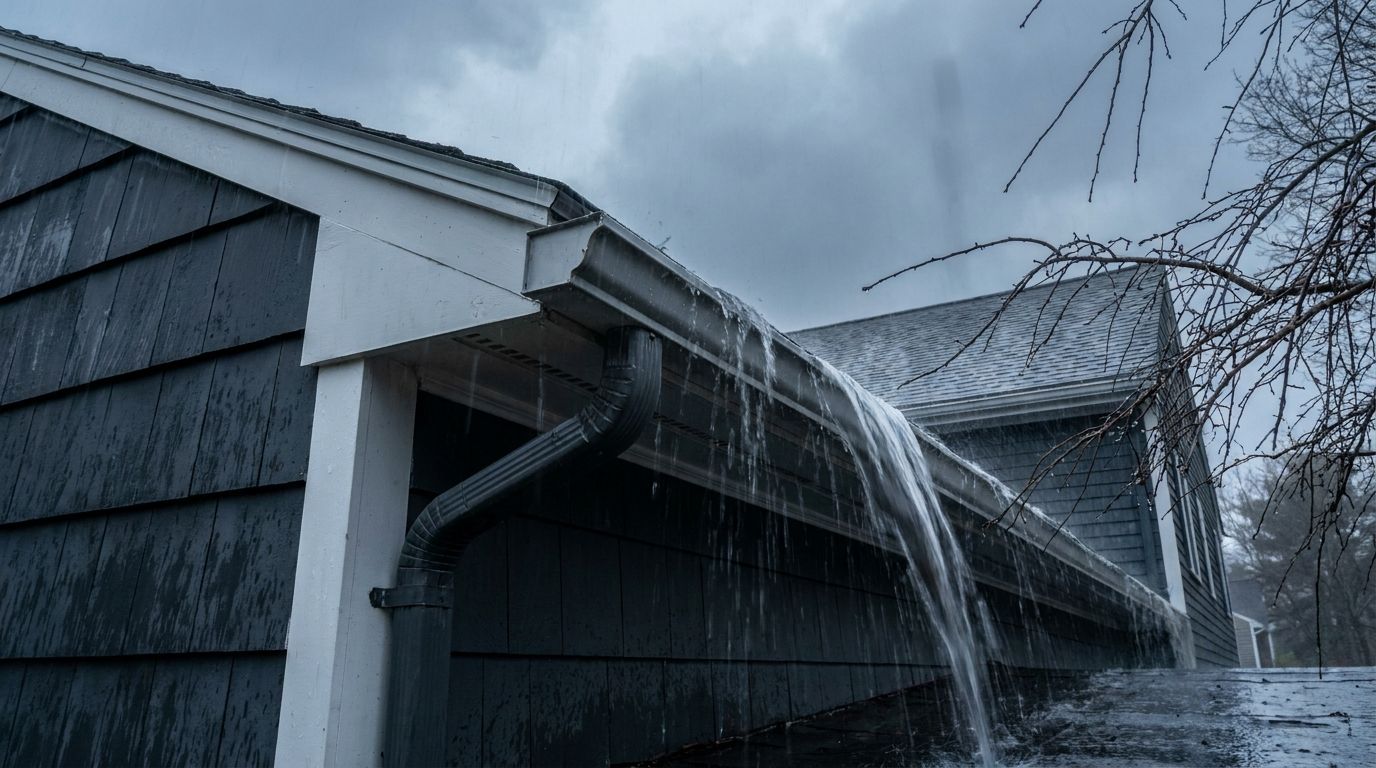
Water coming in right now? The first job isn’t finding the leak — it’s protecting what’s underneath it and staying off the roof. Here’s what to do in the next ten minutes. Then call (617) 721-1814. Free estimate, fast response, and a straight answer on whether this is a repair or something bigger.
1. Contain the water. Buckets, storage bins, a roasting pan — anything under the drip, with old towels around the base to stop splash-back. Swap a bucket before it overflows.
2. If a ceiling is bulging, drain it deliberately. A sagging, heavy bulge means water is pooling above it, and a pooled ceiling can let go all at once. Put a bucket underneath, push a small hole through the lowest point with a screwdriver, and let it drain in a controlled stream. A patched screwdriver hole is a cheap repair. A collapsed ceiling is not.
3. Move what matters. Furniture, rugs, electronics, paperwork, anything with a cord. Water spreads sideways faster than people expect.
4. Kill the power if water is anywhere near electrics. If it’s near a light fixture, a ceiling fan, an outlet or the panel itself, shut those circuits off at the breaker. Don’t stand in water to do it — if you can’t reach the panel safely, call your utility.
5. Photograph everything before you clean up. Wide shots of the room, close shots of the stain and any damaged belongings, plus the date and the weather. Insurers ask for this, and it’s hard to reconstruct later.
6. Do not go up on the roof. Not in rain, not in wind, not on snow or ice, not to “just look.” Wet shingles are genuinely slick, and most serious injuries in this trade happen to homeowners on ladders in bad weather.
Then call us
Once the water is contained, call (617) 721-1814. You’ll get Thiago DeSouza or someone who works directly with him — not a call center, not a lead broker who sells your address to three contractors. Four things speed it up: where the water is showing, whether it started with rain, wind or a thaw, roughly how old the roof is, and whether the attic is accessible. If things are stable and you’d rather not be on the phone, send us the details and a photo.
The stain is almost never directly under the hole
Water gets in at one point, hits the underside of the sheathing, then travels — down the deck, along a rafter, across a ceiling joist — until it finds a seam, a nail hole or a light fixture and drops through. By the time it’s a brown ring on your ceiling, the entry point can be ten feet away and a full roof plane over. Re-shingling above a stain is how people pay twice and still have a wet ceiling.
So we work backwards, on the roof and in the attic. In an unfinished attic the trail is readable: dark staining on the deck, rust rings around nail shanks, mineral deposits where meltwater has run. After ten years on New England roofs, most emergency calls trace back to a short list.
- Failed step or counterflashing at a chimney or sidewall — the most common source on the older housing stock north of Boston. Mortar erodes, the flashing pulls loose, someone caulks it, and the caulk cracks in two freeze-thaw cycles.
- Valley failure — rusted valley metal, or debris pushing water sideways under the courses. Two planes dump into one channel, so valley leaks are big ones.
- Cracked pipe-boot rubber. The collar around a plumbing vent splits with UV long before the shingles wear out. Common, cheap to fix.
- Nail pops — a nail backs out, tents the shingle, and rain runs down the shank into the deck.
- Missing or lifted shingles after wind. Classic nor’easter damage — see storm damage roof repair.
- Ice dam backup — winter only, and through a roof with no hole in it at all.
What we do on an emergency call
- Find the actual source. Roof and attic. If the entry point isn’t obvious we isolate it — running water on the roof section by section with someone watching inside is unglamorous, and it works.
- Make it watertight. Depending on what failed and what the weather’s doing, that’s either a targeted repair or stabilization — sealing the entry point, replacing the failed component, or covering the section securely so the house stays dry until a permanent fix is possible. We’ll tell you plainly which you’re getting.
- Assess what the permanent fix really is — then say it out loud. Sometimes it’s a $900 flashing repair on a roof with twelve good years left; sometimes the leak is the fourth symptom of a roof that’s finished. We do repairs and replacements both, so we’ve no reason to steer you toward the bigger job. Our repair-or-replace guide lays out the same logic.
Once things are dry, a roof inspection with a written condition report is worth doing. An emergency call answers “why is water coming in today”; an inspection answers “what else is close to failing.”
Winter leaks and ice dams
If your ceiling only leaks during a February thaw, or after snow followed by a cold snap, you’re probably not looking at a hole in the roof at all — you’re looking at an ice dam. Heat escaping the living space warms the roof deck. Snow melts on the warm upper roof, runs to the cold overhang, and refreezes into a ridge of ice at the eave. The next meltwater hits that dam, backs up under the shingle courses, and finds the deck. Asphalt shingles shed water running downhill; they were never built to hold back a standing pool of it.
Contain the water inside as above. A roof rake used from the ground — the ground only, never a ladder in snow — can slow the backup. Don’t chip at the ice with an axe or hammer; you’ll take shingles off with it. And re-shingling won’t fix it, because the cause is heat and airflow, not the shingles.
The durable fix is ice & water shield along the eaves and valleys, plus air sealing and balanced attic ventilation — intake low at the soffits, exhaust high at the ridge. A ridge vent with insulation blocking the intake does nothing. More in why ice dams wreck Boston roofs — a call we take constantly across Medford, Melrose and Stoneham.
What an emergency leak repair is likely to cost
Anyone quoting a firm number over the phone is guessing, but you deserve a real range rather than “it depends.” Roof repairs here typically run somewhere in the region of $800 to $3,500, and emergency stabilization usually sits at the lower end — you’re paying to make one failure watertight, not rebuild a roof section. What moves you along that range:
| Driver | Effect on the number |
|---|---|
| What actually failed | A split pipe boot sits at the bottom; rebuilding chimney counterflashing into the mortar joints, or replacing valley metal, sits at the top. |
| Access and pitch | A walkable ranch roof is the cheapest surface there is; a steep third-storey slope on a narrow lot needs staging. |
| Wet or rotted decking | If the leak has run a while, the sheathing under it may need cutting out and replacing. Diagnosis also takes longer with a finished attic. |
| Weather at the time | Sometimes the call is stabilize now, repair properly in a dry window — two visits, but a dry house tonight. |
Interior repairs — drywall, paint, insulation — are separate from the roof work, and usually where an insurance claim comes in. Fuller breakdown: how much roof repair costs in Massachusetts.
Emergency leak questions we get asked
Should I put a tarp on my roof myself?
No. Tarping means standing on a wet slope in bad weather fastening something that catches wind like a sail, and a badly fixed tarp can drive water further in by lifting shingle courses. Contain it inside; let us handle anything above the gutter line.
Is it really OK to poke a hole in my own ceiling?
When the drywall is visibly bulging and heavy with trapped water, yes — a small hole at the lowest point, bucket underneath. You’re choosing a patch-and-paint repair over a ceiling that may come down in one piece and take a light fixture with it. Cut power to that circuit first if the bulge is near one.
Will my homeowners insurance cover this?
Sudden, identifiable damage — a nor’easter tearing shingles off, a limb through the roof — is often covered, and the interior damage with it. Age and ordinary wear generally aren’t, and many repairs land near or below a typical deductible. We’ll document what we find in writing for your insurer, but we won’t call a worn-out roof storm damage.
My ceiling leaked once and then stopped. Do I still need someone out?
Yes. A leak that stops just means the rain stopped, or the ice dam refroze. The path is still there, and water is now sitting in insulation and against sheathing, where it grows mold and rots the deck.
Do I need a whole new roof because of one leak?
Usually not. One leak is a repair — almost always flashing, a valley, a boot or a handful of shingles. What changes the answer is leaks in several unrelated places, shingles that crack when you lift a course, or bare mat with no granules left. We’ll tell you which you’ve got, in writing — that’s the whole reason we do roof repair as well as replacement.
Emergency leak calls across Boston and the north suburbs
We take leak calls in Boston, Somerville, Medford, Melrose, Stoneham, Woburn, Wakefield, Burlington and Wilmington. Call (617) 721-1814.