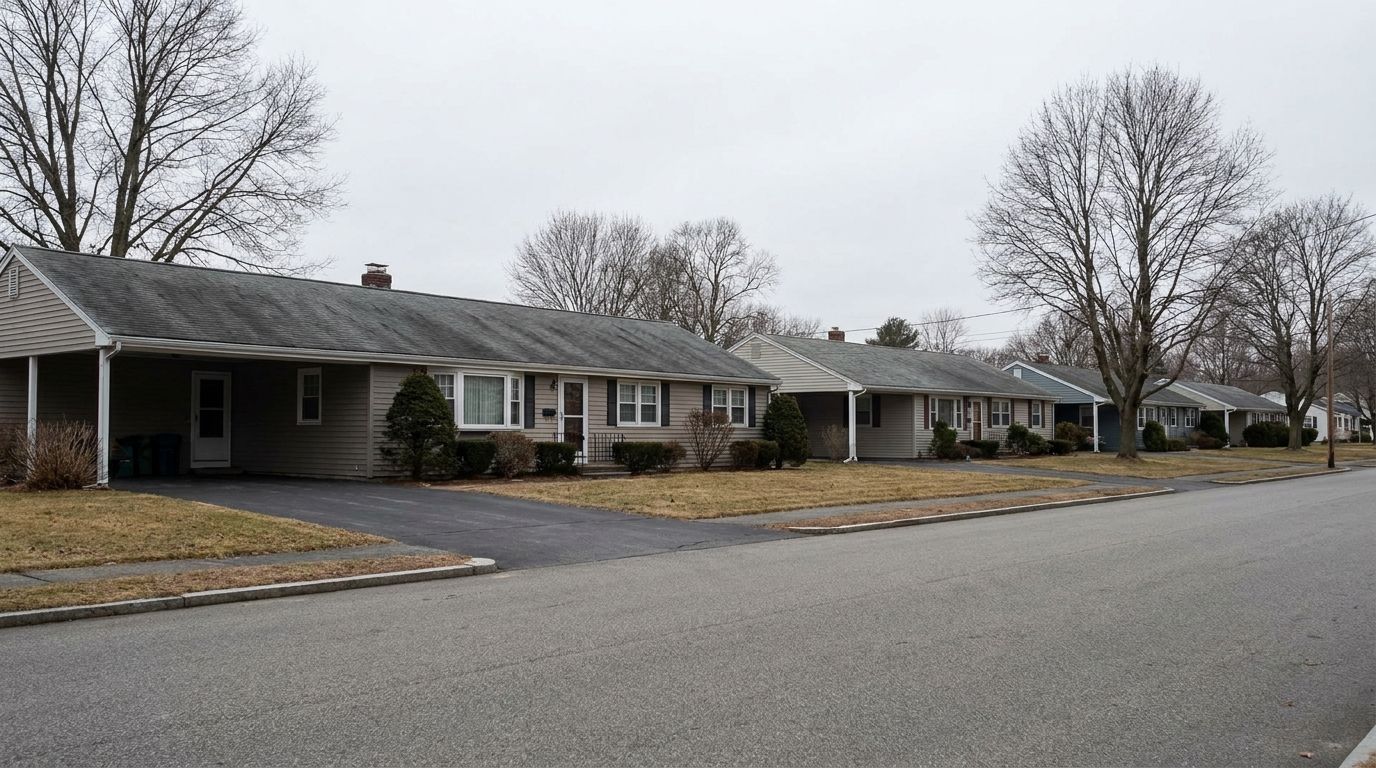
Most of Burlington is post-war suburb — ranches, split-levels and garrison colonials on long, low-pitch roofs. We do replacement, repair and siding across town, and here almost every conversation ends in the same place: pitch, and the attic under it.
If you’ve had ice dams two winters running on a low ranch roof, a new roof by itself won’t fix them. Ask every estimator what they plan to do about your soffit intake. If they don’t have an answer, they haven’t been in your attic. Call Thiago on (617) 721-1814 and ask us the same thing.
Low pitch is the whole story here
Pitch is the rise over a twelve-inch run. A steep Victorian in Melrose might be 10/12. A Burlington ranch is often 4/12 or shallower, and that one number changes almost everything about how the roof behaves.
A steep roof is a water slide — snow lets go, rain is gone in a hurry. A low-pitch roof holds. Snow sits for weeks, melts slowly from underneath where the attic is warm, and refreezes at the cold eave. That’s an ice dam, and it’s why Burlington’s neat, simple streets produce more ice dam calls than the complicated old rooflines a few towns over.
Pitch also changes how water moves sideways. Shingles aren’t waterproof — they’re overlapping courses that shed water downhill. On a shallow slope a driving nor’easter can push rain back up under the course above before gravity clears it. So underlayment and ice & water shield coverage matter more on a low-pitch roof, not less — and they’re the first thing a cheap Burlington quote quietly trims.
- Ice & water shield well past the eave — further up the slope than the single course a minimum-spec quote allows, because a dam on a shallow pitch backs water further before it finds a way in.
- Full synthetic underlayment across the whole deck, not just a strip at the bottom.
- New drip edge and new flashing — reused metal on a low pitch fails sooner, because water lingers on it.
Blocked soffit intake — the fixable root cause
Here’s the part that actually solves the problem, and it often has nothing to do with the shingles. An attic needs balanced airflow: cold outside air in low at the soffits, warm air out high at the ridge. Keep the underside of the deck near outside temperature and the snow on top doesn’t melt from below. No meltwater, no refreeze, no dam.
Burlington’s housing stock was built before that was standard practice. Plenty of these houses have a few small round soffit vents, or no real intake at all. Then, over fifty years of energy upgrades, insulation got blown into the attic — and on a low-pitch roof the space where the rafter meets the top plate is only a few inches tall. Insulation goes right out to the eave and buries whatever intake was there. From outside the soffit looks fine. Inside the attic it’s packed solid.
What we find over and over: a ridge vent installed on the last roof, working perfectly, pulling from nothing. Exhaust with no intake doesn’t move air — it pulls conditioned air up out of the house through every ceiling gap, which makes the deck warmer and the dam worse.
Clearing buried intake, fitting baffles at each rafter bay so insulation can’t creep back, and adding continuous soffit venting is a comparatively small job. On a roof with life left in it, that’s the honest recommendation — and it’s the one we make. Our ice dam guide covers the physics.
Simple roofs, easy access — and it should show in the price
The good news about a Burlington roof built in the 1950s–70s boom is real. These are long, simple runs: two main planes, few valleys, maybe a dormer and a chimney. Less flashing detail means fewer places to leak and fewer hours of slow per-piece work, and the pitch is walkable, so a crew works off the roof rather than off staging.
Access is just as good. Nearly every house has a wide driveway and a real yard — room for the dumpster, room to stage bundles, no street occupancy to negotiate the way there is in Boston. That’s genuine money saved, and a straight estimate reflects it.
So per square, a Burlington ranch is one of the least expensive roofs we do — cheaper than the same footage in Woburn’s older sections. What moves the number here isn’t complexity. It’s what’s underneath.
| Burlington condition | What it means for the job |
|---|---|
| 4/12 or shallower pitch | Walkable and fast, but needs extended ice & water shield and full underlayment. Cheap on labor, not a place to cut spec. |
| Two or three layers of old shingle | Common on 1950s–60s stock now on its third roof. More tear-off labor and a bigger dumpster. |
| Original or buried soffit intake | Ventilation correction belongs in the scope. Without it you’re buying the same February again. |
| Long simple planes, few valleys | Predictable per-square pricing, with far less quote-to-quote variance than an older, cut-up roof. |
| Newer subdivision colonial | Steeper, more planes, bonus room over the garage. Prices closer to Wilmington’s newer stock. |
What each service looks like in Burlington
Replacement. Full tear-off to bare deck, soft boards replaced and shown to you, ice & water shield run generously at the eaves and through any valleys, synthetic underlayment, new drip edge, new flashing, architectural asphalt shingles — and, the part that matters most here, intake and exhaust brought into balance before we close it up. Ranges and what moves them are in our Massachusetts cost guide.
Repair. Ice dam damage at one eave, chimney flashing that finally gave up, wind-lifted tabs after a nor’easter, a vent boot cracked by UV. On a walkable roof a targeted repair is often exactly right, and a real inspection — attic included — tells you which it is. We’d rather sell you a ventilation fix than a roof you don’t need yet.
Siding. A lot of Burlington houses wear their first replacement siding from the 1980s or 90s, now at end of life — chalky, brittle, faded on the south elevation, cracking when a ladder touches it. We do vinyl and fiber cement, and on a long low ranch the trim and corner detail decides whether it looks considered or just wrapped.
Burlington roofing questions
Why do I get ice dams on a ranch when my roof isn’t even steep?
Because it isn’t steep. A shallow roof holds snow instead of shedding it, so there’s a blanket up there for weeks. Warm air escaping into the attic melts it from below, the meltwater refreezes at the cold overhang, and the next round backs up behind that ridge of ice and gets under the shingles. Steep roofs dump the snow first. The fix isn’t a better shingle — it’s stopping the deck getting warm.
We had insulation blown into the attic and the ice dams got worse. How?
We see this every winter here. On a low-pitch roof there are only a few inches of clearance where the rafters meet the exterior wall, and blown insulation packs straight into it, sealing off the intake. More insulation should help — but with the intake buried, the ridge vent has nothing to pull from and heat and moisture build under the deck. Baffles in every rafter bay restore the airflow without giving back the insulation.
Is a Burlington roof cheaper than one in Melrose or Boston?
Usually yes, for the same square footage. A walkable low-pitch roof with few valleys needs no staging and far less hand-detailed flashing, and a wide driveway means the dumpster goes where it belongs. The two things that close the gap are old layers coming off and a ventilation correction — both worth doing.
Can I put a second layer over my existing shingles to save money?
We don’t do it, and on a low-pitch roof it’s a particularly poor trade. An overlay makes it impossible to install ice & water shield properly at the eaves — on a shallow slope, the one layer standing between an ice dam and your ceiling. It also hides whatever the decking is doing. It saves money on day one only.