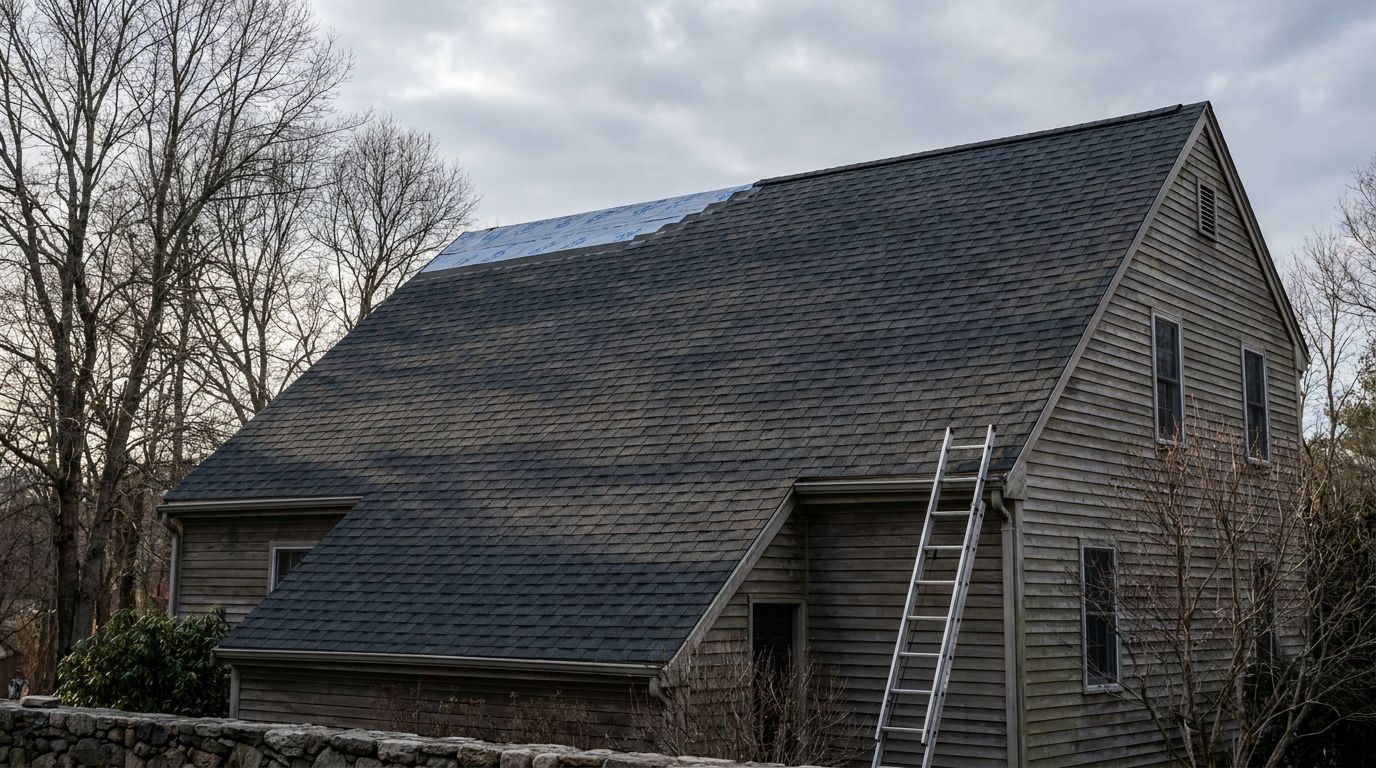
Most single-family homes in the Boston area take one to two days once work starts. Larger, steeper or more complex roofs can run to three. The tear-off and the new roof both happen inside that window — but the project around it starts earlier, and that distinction is where the confusion lives.
One to two days of work on a typical colonial or cape. Up to three on a big, steep or access-limited roof. We never leave a roof open overnight, so a bad forecast moves the start date rather than dragging out the job.
How long by house type
Duration tracks the roof, not the house’s square footage — a sprawling ranch with one plane beats a compact Victorian with five. These are the ranges we see across Medford, Stoneham, Melrose and the rest of the northern corridor.
| House | Typical duration | What decides it |
|---|---|---|
| Simple walkable ranch or cape | Often one day | Low pitch, few penetrations, one or two planes |
| Standard single-family colonial | One to two days | Two stories, a chimney, some valleys |
| Larger colonial with dormers and multiple planes | Two to three days | Valley count, dormer flashing, more cut-in detail |
| Boston or Somerville two- or three-family, low-slope rear, no driveway | Two to three days | Access and staging, not size — plus a separate rear roof system |
| Steep Victorian with a complex roofline | Three days or more | Pitch requiring staging, many planes, heavy flashing work |
What actually drives the number
These are what we count when we walk a roof before quoting. A contractor who gives you a duration over the phone is guessing at all seven.
- Size in squares. Roofers measure in squares — 100 square feet of surface. A 20-square roof and a 40-square roof are not the same day.
- Pitch and walkability. On a walkable pitch the work moves freely. Past a certain steepness we set staging and roof jacks, and everything slows down for good reason.
- Layers to tear off. Two layers is close to double the removal work and double the disposal. See why we never add a layer instead.
- Decking found once it is open. Soft or delaminated sheathing gets replaced, not covered — unknowable until the old roof is off, which is why we quote it as a per-sheet rate up front.
- Complexity and flashing count. Chimneys, skylights, dormers, valleys, sidewalls and pipe boots are the slow, careful part of the job. Field shingles go fast; flashing does not.
- Access and staging. A driveway for the dumpster and a lawn to land material on is the fast case. A dense street in Somerville or Boston, where the dumpster needs a street permit and material gets carried, genuinely changes the timeline.
- Crew scheduling. A two-day roof sometimes runs across a gap when weather splits the week. The work hours are the same; the calendar looks longer.
The weather rule
We will not tear off more roof than we can make watertight the same day. Underlayment and ice & water shield go down as the tear-off progresses, not at the end of it, and no roof of ours sits open overnight.
So a bad forecast moves the start date rather than stretching the job. That is a feature, not a delay — the alternative is a contractor who opens your roof on a maybe and hands you a ceiling repair. Timing across the year is covered in the best time of year to replace a roof in Massachusetts.
Two days of work is not two days from your phone call
The job duration and the project timeline are different numbers. The one to three days above is time on the roof. Ahead of it sit the estimate visit, scheduling, material ordering and delivery, and the building permit — every city handles permitting its own way, and it happens before day one, never during. Pricing sits in there too: see roof replacement cost in Massachusetts.
So read “two days” as two days of work, once the project reaches its start date. We tell you where you sit in the schedule when we hand you the estimate, and we will not invent a date to win the job. Start with a free estimate.
We work outside and do not need access to the inside of the house, so most homeowners go to work as normal. Move the cars out of the driveway the night before and we can run the job without you. If you would rather be there, that is fine too.
What happens if it rains mid-job
Work stops. The exposed section is already dried in with underlayment, so the house is protected, and the site gets secured before anyone leaves. When it clears we come back and pick up where we stopped.
A rain day pushes the finish, not the price — a fixed-scope estimate does not grow because the sky opened. The one thing that legitimately moves the number is decking we find and replace, at the rate agreed before we start. What the day is like from inside your house is covered in what to expect on install day.
Common questions
Can a roof be replaced in one day?
Often, yes — a walkable ranch, cape or straightforward colonial with one layer to strip and clean access is regularly a one-day job. Steepness, a second layer, multiple planes or hard staging are what push it to two or three.
How long does the whole project take, not just the work?
Longer than the install, and it varies. The estimate, your decision, scheduling, material delivery and the permit all happen before day one. We give you a realistic start window with the estimate rather than a date we cannot hold.
Will finding bad decking add days?
Usually hours, not days — a handful of sheets gets cut in as the tear-off moves. Widespread rot across a slope is different: we stop, show you, and talk through scope and cost before going further.
How do I get a real duration for my roof?
Someone has to look at it. Pitch, layers, planes, flashing count and access are assessed on site, and the estimate names the expected duration. Call (617) 721-1814 and Thiago will come out and walk it.