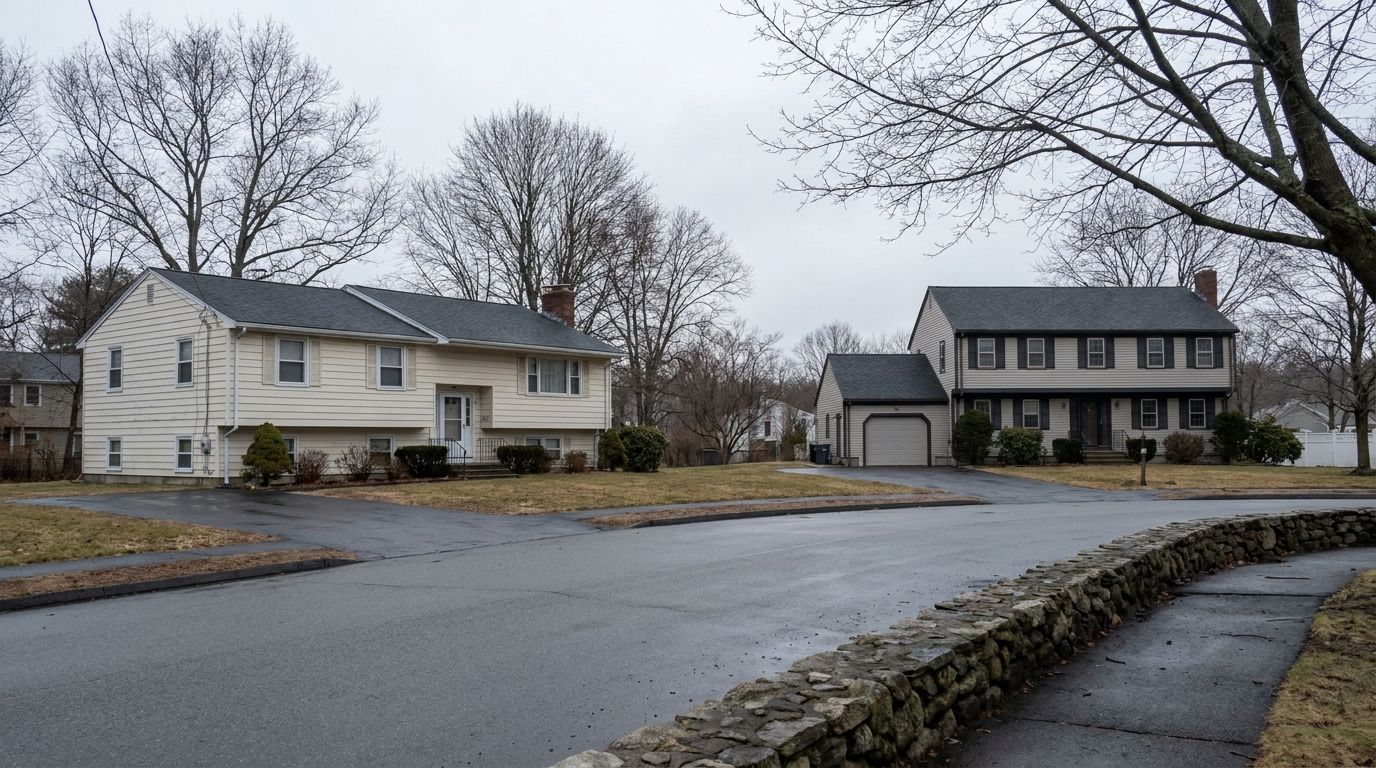
Woburn has the widest spread of house ages of anywhere we work — Victorians near the center, a big post-war belt of ranches, capes, split-levels and garrison colonials, then newer subdivisions past those. It’s also our strongest siding town: the aluminum and early vinyl that went up in the 1980s and 90s is all reaching end of life at once. We do replacement, repair and siding here, and the siding half isn’t an afterthought.
Do them in one trip. Same staging, same dumpster, same days on site — and the drip edge, gutter apron and top course of siding meet in one place, so that junction gets built once instead of twice. Call Thiago on (617) 721-1814. If only one needs doing, you’ll hear that.
Four eras of house, one city
Most towns in our service area have one dominant housing type. Woburn has four, and which one you’re in changes the estimate.
The older center
Around Woburn Center there’s real 19th and early 20th century housing — steep pitches, dormers, porch roofs, valleys running several directions. The field of the roof is the cheap part; the money goes into valley metal, chimney flashing and dormer detailing, exactly where a low bid finds its savings.
The post-war belt, and what came after
The bulk of the city: built roughly 1950 to 1975, simple plans, low pitch, walkable roofs, the cheapest kind to replace here. Two things complicate them. The pitch — a shallow mid-century roof sheds snow poorly, so snow sits, melts from below and refreezes at the cold eave. That’s an ice dam, and it’s a ventilation problem far more often than a roof defect (here’s why). And most are on their second or third roof, so what’s under the shingles is the real question. Past those, the post-1985 subdivisions bring more valleys and bonus rooms over attached garages — another known ice dam spot.
Split-levels
Split-levels roof like two houses stitched together — two or three planes at different heights, and between them a roof-to-wall junction where the lower plane dies into the upper story’s sidewall. That needs step flashing woven in course by course plus a kickout at the bottom, not a bead of caulk. Every one of those transitions is a leak point.
Garrison colonials and the overhang
Woburn has a lot of garrisons — the two-story colonial where the second floor juts out about a foot past the first. That overhang creates a horizontal band across the house: a flat soffit, a trim board, and a joint where the upper wall’s siding stops and the lower wall’s begins. It’s the most common water-entry detail on the style.
Rain sheeting down the upper wall in a nor’easter hits the overhang and gets pushed sideways into that joint instead of dripping clear. Done right, flashing behind the band kicks it out over the siding below. Done wrong — and on a 1960s house re-sided in 1990 it often is — the water goes into the band joist. It’s also where siding damage shows first: swelling, staining and soft trim along that line while the rest of the wall looks fine.
Why Woburn is a siding town
A large share of the post-war housing was re-sided in the 1980s and 90s — first aluminum, then early vinyl. That material is now 30 to 45 years old and failing predictably.
- Chalking. Rub aluminum siding, get white powder on your palm — the painted finish breaking down.
- Fading. Early vinyl pigment wasn’t UV-stable. South and west walls drift shades past the north wall, and no replacement panel will match.
- Brittleness. Old vinyl loses flexibility. In a February cold snap it cracks from a thrown stone or a ladder foot, and the crack runs.
- Dents. Aluminum dents permanently from hail, ladders and lawn equipment; long runs oil-can in the sun.
- Nothing behind it. Much of that era’s work went straight over old wood siding with no house wrap. Once panels open up, there’s no weather barrier at all.
At that stage replacement beats repair — matching a discontinued profile in a faded color is a losing game. We install vinyl for the best cost per square foot, and fiber cement when you want the depth and shadow line of real wood and accept repainting eventually. Our comparison guide covers the trade-offs; the Woburn siding replacement page has the local detail.
Access — the quiet reason Woburn jobs cost less
Woburn is easy to work in, and that’s in your favor. Most houses have a driveway with room for a dumpster on the property, streets are wide enough to stage material without occupying a travel lane, and setbacks leave room for ladders. Over in Somerville or the dense parts of Boston, dumpster placement and street occupancy are a permit conversation before they’re a roofing conversation, and that time is in the price. Here it usually isn’t — same crew, same standards, fewer days and less setup.
What each service looks like here
| Woburn house | Relative cost per square foot | Where the money actually goes |
|---|---|---|
| Ranch, cape, split-level | Lowest | Decking, ventilation, and on splits the roof-to-wall flashing |
| Garrison colonial | Middle | Two stories of staging, plus the overhang band where roof, siding and framing meet |
| Older colonial or Victorian | Highest | Steep pitch, dormers, valleys, porch roofs — flashing labor, not field area |
Replacement. Tear-off to bare deck, soft decking replaced and shown to you, ice & water shield at eaves and valleys, synthetic underlayment, new drip edge, new step and counterflashing at every wall junction, architectural asphalt shingles, balanced ridge-and-soffit ventilation. On low-pitch roofs the ventilation correction is usually what stops the ice dams.
Repair. A chimney flashing leak, a failed roof-to-wall junction on a split-level, ice dam damage at one eave, lifted shingles after a nor’easter — those are repairs and we price them as repairs. A 14-year-old ranch roof with one bad flashing detail doesn’t need replacing, and we’ll say so.
Siding. Old aluminum or vinyl off, a look at what’s underneath, house wrap, then new vinyl or fiber cement with proper trim at corners, windows and — on a garrison — the overhang band.
Woburn roofing and siding questions
My aluminum siding chalks on my hand. Can it be painted instead of replaced?
It can. If the panels are straight, tight and dent-free, paint buys five to ten more years for a fraction of the cost. Just be clear about what you’re buying: 40-year-old panels that probably have no house wrap behind them, and a repaint down the road. If they’re dented, loose or opening at the seams, paint is money spent on a wall that still needs replacing. We’ll tell you which one you have.
Water is staining the wall under my garrison’s second-floor overhang. Is that the roof?
Almost never. That band needs flashing behind the trim to kick water out over the siding below. When that’s missing or got covered during a re-side, wind-driven rain runs down the upper wall into the band joist — staining, soft trim and swelling along one horizontal line while the roof above is fine. The fix is opening the band up, seeing what the framing looks like, and rebuilding the detail properly.
My split-level leaks where the low roof meets the upper wall. What’s wrong?
Nine times out of ten, the step flashing. That junction needs individual metal pieces woven in with each shingle course and lapped behind the wall’s housewrap, plus a kickout at the bottom so water exits into the gutter instead of behind the siding. What we usually find is one long bent piece of metal, or caulk over the shingles. It’s a repair, not a replacement — but it does mean opening the bottom siding courses at that wall.
Why do my neighbors get ice dams and I don’t, on the same street?
Because it’s the attic, not the street. Two identical Woburn ranches behave differently depending on insulation depth on the attic floor, whether the soffit intake vents are buried under it, and whether the ridge vent works. A roof replacement that doesn’t correct intake and exhaust will produce the same ice dam next February.