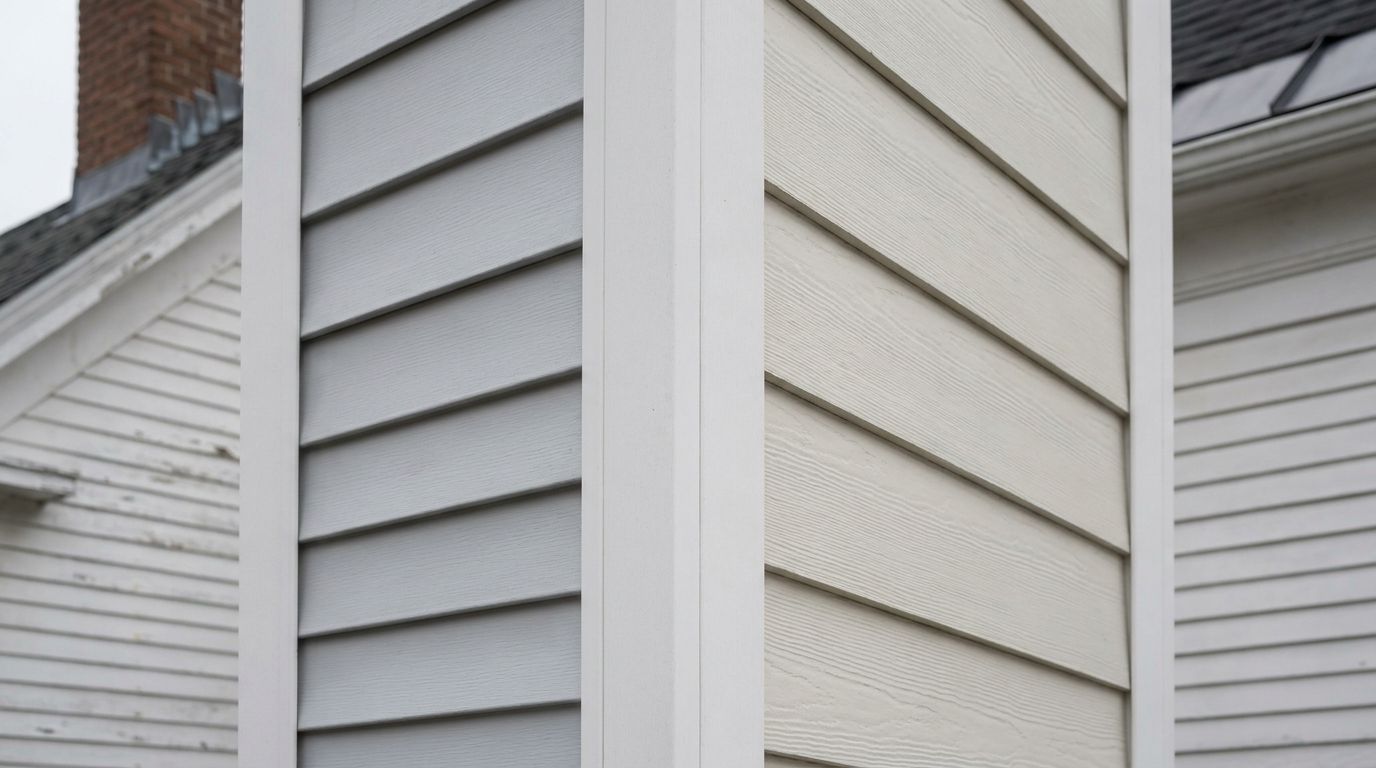
Vinyl installed in Massachusetts runs roughly $4 to $14 per square foot and gives you 20 to 30 years. Fiber cement runs roughly $9 to $26 and gives you 30 to 50. That’s the whole argument in two lines — the rest of this page is about which set of numbers applies to your house. We install both, and there are good houses for both answers.
Staying long-term in a house with some architectural character worth honoring? Fiber cement. Budget is the binding constraint, it’s a rental, you’re selling inside five to seven years, or the house is a simple rectangle with no trim detail? Vinyl — and that’s not a consolation prize. The wrong answer isn’t picking the cheaper material. It’s paying for the expensive one on a house that was never going to collect the benefit.
The side-by-side that actually matters
Ten things separate these materials on a New England wall. Nine are in this table. The tenth — how long you’re staying — isn’t a property of the siding at all, and it decides more than the other nine combined.
| Vinyl | Fiber cement | |
|---|---|---|
| Installed cost in MA | ~$4–$14 / sq ft. Builder-grade at the bottom, insulated profiles roughly $6–$11. | ~$9–$26 / sq ft. Product line, trim detail and factory finish drive the spread. |
| Realistic service life here | 20–30 years. Ends on appearance — fading, chalking, cracked panels. | 30–50 years. The board outlasts the paint by a wide margin. |
| Fire behavior | Melts and burns. A grill too close or sun bouncing off a low-E window next door will deform it. | Non-combustible. Won’t ignite, won’t melt, won’t warp from a heat source. |
| Impact resistance | Poor in deep cold. Below about 20°F, ice off a roof or a shovel handle cracks a panel that would have bounced in July. | Strong, year-round. Dents about as readily as masonry does. |
| Cold-weather stability | Moves. A 12-foot panel grows and shrinks most of a half inch between February and August. | Stable. Same length at 5°F as at 85°F, so courses stay straight and butt joints stay tight. |
| Maintenance | Wash it once a year. That’s the list. | Wash it, and watch the paint film on the south and west walls. |
| Repainting | Not realistically an option. Paint rarely holds and generally voids the warranty. The color you pick is the color you own. | Required eventually, at long intervals — roughly 10–15 years field-painted, longer factory-finished. Any color, changeable. |
| Appearance and shadow line | Shallow shadow line. Insulated profiles look good; thin panels look thin and ripple in low sun. | Deep shadow line, real board thickness at the butt edge. Reads like painted clapboard. |
| Weight and install difficulty | Light and fast. A typical house is a week or less. | Two to three times the weight. Two people per plank, dust-controlled cutting — that’s the labor line. |
| Repairability | Good. A zip tool unlocks the course above and a cracked panel slides out. The catch is matching faded color. | Harder — you can’t pop one board out cleanly. But it’s paintable, so a repair disappears into a repaint. |
What the cost spread actually means on your house
Per-square-foot numbers mean nothing until you multiply them. A 1,600–2,000 sq ft colonial around here typically has 1,500 to 2,200 square feet of wall once the windows and doors come out. Run the middle of each range against 1,800 sq ft and you get roughly $13,000–$16,000 in vinyl against roughly $27,000–$32,000 in fiber cement. Same house, same crew, same week of work behind the walls. That gap is the decision.
Two things widen it further. Trim detail — corner boards, casings, frieze, rake — is where fiber cement’s premium compounds hardest, because every piece is heavier and slower to cut. And access: a three-story two-family in Somerville with a fence three feet off the wall needs staging a ranch never will. Driver-by-driver breakdown on the siding replacement page, with cost tables on both material pages: vinyl and fiber cement.
The total-cost-of-ownership question, worked honestly
The pitch you’ll hear is “buy once, cry once” — fiber cement costs two to three times more but lasts twice as long, so it’s cheaper in the end. Let’s do that math instead of asserting it. Same 1,800 sq ft wall, 50-year horizon, today’s dollars:
| 50-year path | Vinyl | Fiber cement |
|---|---|---|
| First install | ~$14,000 | ~$29,000 |
| Replacement at ~year 25 | ~$14,000 (second full tear-off) | None |
| Repaint cycles | None | 2–4 repaints, roughly $4,000–$9,000 each |
| Rough 50-year total | ~$28,000 | ~$40,000–$50,000 |
So fiber cement usually does not win on pure dollars. The longer life is real, but repainting eats most of what the second vinyl install would have cost. Anyone telling you the expensive material pays for itself is skipping the paint line.
What fiber cement buys is what the spreadsheet doesn’t hold: one week of tear-off and dumpsters in 50 years instead of two, a finish you can change in year 12 with a paintbrush, and performance you collect every winter rather than at the end of the wall’s life. The honest flip side — that second vinyl tear-off is also a second chance to see the sheathing and correct flashing, and there’s real value in opening a wall up once a generation. Neither answer is obviously smarter, which is why the decision below is about your situation, not the materials.
Choose vinyl if
- Budget is the binding constraint. Not “we’d rather spend less” — actually binding. A properly installed vinyl wall with a real drainage plane behind it beats fiber cement you cut corners to afford. What’s behind the siding matters more than the siding.
- It’s a rental or an investment property. You’re buying low maintenance and no repaint cycle. No tenant ever called a landlord about a paint film.
- You’re selling within five to seven years. You won’t recover the fiber cement premium at closing. A clean vinyl wall shows well and passes inspection — that’s the job it needs to do.
- The house is a simple shape. A ranch, a plain colonial, a mid-century cape with minimal trim. No architectural detail for the heavier material to honor, so you’re paying for a shadow line nobody notices.
- You want the lowest lifetime maintenance effort. Vinyl’s real win, and it gets undersold. Wash it once a year and walk away for two decades. No painter, no staging, no color matching.
If that’s you, read the vinyl siding installation page — particularly the nailing section, because a bad vinyl install is far more common than bad vinyl.
Choose fiber cement if
- This is your long-term home. Ten-plus years, no plans to move. You’ll actually collect on the longer life instead of handing it to the next owner.
- The house has architectural character worth honoring. A Victorian, a period colonial, a two-family with real corner boards and casings. Thin vinyl on a house like that is visible from the sidewalk, and it’s the one aesthetic mistake that can’t be undone cheaply.
- The elevation takes heavy weather or direct sun. An exposed south or west wall, a corner lot with nothing between you and a nor’easter, a wall under a roof that sheds ice every February.
- Fire resistance matters. On the tight lots around here — plenty of Somerville and Boston streets have houses twelve feet apart — a non-combustible wall is a real advantage, not a theoretical one.
- You want a finish you can change. If being locked into one color for 25 years bothers you, that’s a legitimate reason on its own. Paintable is a feature.
The fiber cement siding page covers what a correct install looks like — weight handling, dust control, fastening, clearance above grade. On this material the install is even more of the product than it is with vinyl.
Can you mix the two?
Yes, and on a budget it’s sometimes the smartest money on the job — fiber cement on the street-facing elevation and the weather side, vinyl on the sheltered sides, so you buy the appearance and the durability exactly where they pay off. Two cautions: profiles and colors have to be close enough that the transition reads as intentional, and the change has to land on a real corner. Done badly it looks like you ran out of money on the third wall. We’ll tell you at the estimate whether your house has the corners for it.
Three things that should not decide this
- Warranty length. Both carry long paper warranties, and neither covers what actually kills walls here — water in through a missing kickout or an unflashed window head. Read what goes behind the siding instead.
- Energy savings. Insulated vinyl adds a genuine but modest R-2 to R-3. On most houses in Medford or Stoneham, air sealing and attic insulation return far more per dollar. Buy it because it keeps the wall flat and takes a hit, not for the heating bill.
- Resale percentages. National cost-recouped figures are country-wide averages that say nothing about your street. What moves a buyer here is a wall that looks maintained and a clean inspection.
Questions homeowners ask us during this decision
Is fiber cement always the better material?
It’s the tougher material — that’s not in dispute. It’s not always the better decision. On a rental, a plain-shape house, or a house you’re selling in four years, the extra $13,000 to $16,000 buys performance you’ll never collect on. We say that out loud because we install both and don’t earn more by steering you.
Can I paint vinyl siding if I get tired of the color?
Practically, no. Vinyl-safe coatings exist, but the paint film has to survive a panel that grows and shrinks most of a half inch every year, and it usually doesn’t. It generally voids the warranty too, and going darker makes the panel absorb more heat and warp. Treat the color you choose as permanent — and if that bothers you, that’s a real argument for fiber cement.
Which one holds up better to ice sliding off the roof?
Fiber cement, clearly. Ice coming off a roof plane in February hits a vinyl panel at its most brittle, and cracked panels below a roof edge are one of the most common things we get called about. Worth saying though: if ice sheets off that roof every winter, the siding is a symptom. That’s a ventilation and ice-dam problem to look at before you spend money on the wall.
How much does the repaint on fiber cement really cost?
Budget it as a real number, not a footnote — a full exterior repaint here is thousands of dollars, and it’s the line that undoes the “cheaper in the long run” argument. Two things soften it: intervals are long, often 10 to 15 years field-painted and longer factory-finished, and the south and west walls go first, so a partial repaint is often the honest answer.
Will new siding fix the water stain in my ceiling?
Almost certainly not. Interior staining and hidden rot most often trace back to roof-to-wall flashing, a missing kickout, an unflashed window head, or a gutter that’s overflowed every storm for six winters. New siding over an unfixed water path is expensive wallpaper. We look at the roof before we quote the walls, and if the source is up top we’ll say so — that’s roof repair, at a fraction of the money. Same reasoning as repairing a roof instead of replacing it.
Get a straight read on your house
This gets easier once someone has walked the walls, measured the real square footage, and looked at what the roof above them is doing. Thiago does that in Woburn, Medford, Somerville, Boston and across the northern suburbs — ten years of it — and the estimate is free either way, including the version where your siding has years left. Ask for an estimate or call (617) 721-1814.