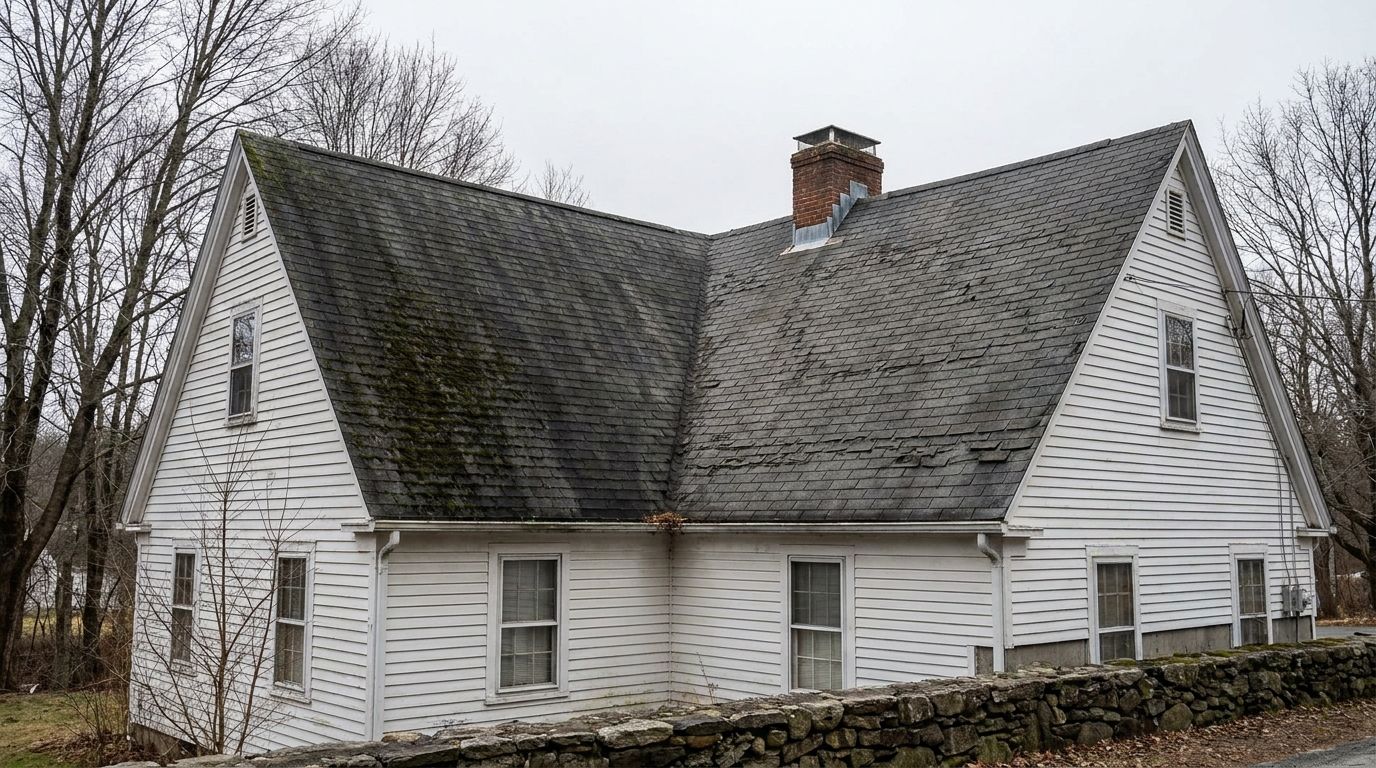
An architectural asphalt roof in New England generally gives you somewhere around 20 to 30 years. Older three-tab shingles run shorter — roughly 15 to 20. Where your roof lands inside that spread is decided mostly by one thing homeowners never think about: whether the attic underneath it can breathe.
Ten years of tear-offs across Medford, Melrose, Somerville and Boston have made the pattern hard to miss. We pull 17-year-old roofs off houses where the soffits were packed solid with insulation, and we walk away from 26-year-old roofs that are flat, sealed and fine. Same shingle, same weather, nine years apart. Here’s what causes that gap.
The real numbers, and the number on the wrapper
When a shingle is sold as “lifetime” or “50-year,” that figure comes from a warranty document and a laboratory. It assumes ideal installation, correct ventilation and a moderate climate, and it is prorated so heavily that by year 25 the coverage is worth very little in real money. It is not a forecast of how long the roof will keep water out of your house in Massachusetts. What we actually see on roofs here:
| Material | Realistic New England service life | Notes |
|---|---|---|
| Architectural / laminated asphalt | 20–30 years | The standard today. Thicker mat, better wind and freeze-thaw tolerance. |
| Three-tab asphalt | 15–20 years | Thin, single-layer, mostly found on roofs installed before roughly 2005. |
| Asphalt installed as an overlay | Knock 3–7 years off either range | Runs hotter, hides deck problems, harder to nail correctly. |
| Slate | 75–150 years | Different trade, different budget. The flashing and fasteners usually fail first. |
| Cedar shakes | 20–30 years | Needs upkeep here; moss and shade are hard on it. |
Two roofs of the same material, installed the same week on the same street, can finish six or eight years apart. The rest of this page is why.
What actually decides where your roof lands
1. Attic ventilation — the biggest single factor
Nothing else on this list comes close. Asphalt dries out and gets brittle when it’s cooked, and a poorly ventilated attic in July is an oven baking the underside of the deck all summer, every summer. The shingle loses its oils, the mat stiffens, the corners curl, the granules let go. That’s a roof aging from underneath — the weather is only half the story.
The same failure runs the other way in winter. Warm house air leaking into an unvented attic melts snow on the upper roof, that meltwater runs down to the cold overhang and refreezes into an ice dam, and water backs up under the shingles. Same root cause, opposite season.
Intake at the soffits, low down at the eaves, and exhaust at the ridge. Air has to come in at the bottom and leave at the top. A ridge vent with the soffits blocked by insulation is a chimney with the door shut — it does almost nothing. This is the single most common defect we find, and it is usually cheap to correct while the roof is off.
Check it yourself: go up on a bright day, look along the eaves where the roof meets the outside wall, and you want to see a clear gap or a baffle holding insulation back off the deck. Insulation jammed tight against the sheathing means your roof is aging faster than it should be.
2. Overlay versus full tear-off
A second layer of shingles laid over the first traps heat between the layers, so the new shingles run hotter and fail sooner. It also hides whatever the deck was doing — soft plywood, old leaks, delaminated sheathing — and makes correct nail penetration harder. Overlays are usually legal and cheaper on the day, and more expensive over the life of the roof. Full trade-off in can you put a new roof over an old roof?
3. Sun exposure, plane by plane
Your roof doesn’t age as one object. It ages as a set of separate planes, and the south- and west-facing slopes take far more UV and far more thermal cycling than the north side of the same house. That’s why one slope can look finished while another on the identical roof still looks respectable — not a defect, not bad luck, just the sun. On a house with a big southern exposure, that slope calls the timing for the whole roof.
4. Freeze-thaw cycling and ice dams
Greater Boston runs through dozens of freeze-thaw cycles a season. Water gets into a hairline crack in a tab or a flashing seam, freezes, expands, opens the crack wider, thaws, gets deeper, repeats. Slow and relentless, and it’s why a shingle that would last 30 years in a mild climate doesn’t last 30 here. Ice dams add a second mechanism — standing meltwater under the lower courses, which no shingle is designed to hold back. Detail in why ice dams wreck Boston roofs.
5. Tree cover and debris
Shade cuts UV, which sounds good, but a shaded slope stays wet far longer after rain and snow. That’s what grows moss and the black algae streaking on so many north slopes around here, and moss holds water against the shingle and lifts the edges as it grows. Leaves and needles pack into valleys, sit wet, and rot the mat from the top. Overhanging limbs scrub granules off every time it blows. Cutting limbs back and keeping valleys and gutters clear is one of the cheapest years you can buy.
6. Wind and open exposure
Nor’easters test the sealant strip that bonds each shingle course to the one below. A house on an exposed ridge, a corner lot with a long fetch, or anything nearer the coast takes more of that than a sheltered mid-block street. Once a tab has been lifted and re-laid a few times it stops re-sealing — that’s where the wind starts taking shingles.
7. Installation quality
Last by frequency, first by frustration, because it’s entirely avoidable. Nails driven above the nail line, overdriven through the mat, or left proud. A missing or reversed starter course at the eaves. Flashing reused when it should have been replaced, or caulk where step flashing belonged. None of it shows on handover day; all of it shows in year twelve. It’s why we do asphalt shingle replacement as a tear-off with the deck inspected, not as a cover-up.
How to work out how old your roof is
Plenty of homeowners genuinely don’t know, especially if the roof was done before they bought. Four ways to find out, most reliable first.
- Your closing documents. The seller’s disclosure and the home inspection report from your purchase usually state the roof’s age or its condition at the time. Fastest place to look, and most people still have the file.
- The town’s building department. Re-roofs generally require a permit, and most building departments in our service area will look up permit history on a property — some have it online. That gives you an actual date.
- Long-standing neighbors. On streets built out at the same time, roofs get replaced in clusters — one goes first after a storm and three more follow within two years. Someone nearby remembers the trucks.
- Have it dated from wear. Granule coverage, tab flexibility, sealant bond, the state of the flashing and pipe boots — all of it reads as a range. We can usually place a roof within about five years from the surface, and a roof inspection puts that in writing along with the condition.
One caveat: on some houses only part of the roof was replaced — a rear addition, a dormer, a garage — so “the roof” has two ages. Check whether the shingle color and profile actually match all the way round.
Age versus what to actually do
Find your roof’s age, do the thing in the middle column.
| Roof age | What to do | Why |
|---|---|---|
| 0–10 years | Monitor. Clear gutters and valleys twice a year, keep limbs cut back, and fix damage as it appears. | A leak at this age is nearly always flashing, a pipe boot or an install defect — a repair, not a replacement. |
| 10–15 years | Get your first real inspection, and specifically have the attic ventilation checked. | This is the window where fixing blocked soffit intake still buys you years. After year 20 it mostly doesn’t. |
| 15–20 years | Look at it every year and after every big storm. Start putting money aside. | Three-tab roofs are finishing here. Architectural roofs are usually fine, but planning now beats reacting later. |
| 20–25 years | Get a written assessment. Condition decides, not the number. | Plenty in this band have five good years left. Plenty are done. You can’t tell from the ground, so don’t guess. |
| 25+ years | Expect replacement and budget for it. Choose your own timing. | A planned September tear-off is cheaper, calmer and better-scheduled than an emergency in February with a tarp on the roof. |
| Any age, active leak | Get it looked at now, whatever the number says. | Water in the deck causes rot, and rot turns a shingle job into carpentry. |
Age puts a roof on the list. Condition takes it off.
Everything above is a starting point, not a verdict. We’ve declined work on 24-year-old roofs that were flat, sealed, holding their granules and dry in the attic — that homeowner didn’t need to spend $16,000 that year. We’ve also replaced 16-year-old roofs that were genuinely finished, because the attic had been cooking them since the day they went on.
Granules collecting at the bottom of the downspouts year after year. Bald dark patches in the shingle field. Curling or cupping across a whole slope rather than one corner. Cracking across tab faces. Staining on the underside of the sheathing in the attic. Repeated leaks in unrelated places. Any two of those on a 20-year-old roof mean more than the 20 does.
For the decision itself — repair, replace, or leave it alone for now — work through our repair-or-replace framework. Same one we use standing on the roof, and it has a genuine “your roof is fine” outcome. If you’d rather check the surface signals first, the signs you need a new roof is the shorter read.
A note on slate, and the older houses around here
Plenty of homes in Medford, Melrose and the older parts of Somerville still carry their original slate. Real slate can run a century or more, and when a slate roof “fails” it’s very often the flashing, fasteners or underlayment that went rather than the stone itself. Slate is a separate trade with separate skills and a budget several times that of asphalt — which is why converting slate to architectural asphalt is a common decision on these houses. It’s a legitimate one, and a permanent one that changes how the house looks. Get the slate assessed by someone who works on slate before you decide it’s finished. We’ll tell you plainly when a roof is outside what we do.
Common questions
My shingles say 50-year. Will my roof last 50 years?
No, and nobody in this trade expects it to. Those figures come from warranty documents based on ideal lab conditions, and the coverage is prorated down to very little by the time you’d need it. In New England, plan on 20 to 30 years from an architectural asphalt roof installed well over a properly ventilated attic. Anything past that is a bonus, not a plan.
Why does one side of my roof look so much worse than the other?
Almost always sun exposure. South- and west-facing planes take far more UV and heat cycling than the north slope, so they wear years faster on the same house. A north slope under trees often looks better but has its own problem — it stays damp, and that’s where moss and black algae streaking grow. Two problems, two sides of the same ridge.
Can I make my roof last longer?
Yes, and the biggest lever by far is ventilation. Clearing blocked soffit intake and getting proper ridge exhaust is the highest-value thing you can do to a mid-life roof. After that: keep gutters and valleys clear, cut tree limbs back off the roof, and fix flashing and pipe boots when they fail instead of waiting. None of it turns a 22-year roof into a 40-year roof, but it comfortably moves you from the bottom of the range toward the top.
My roof is 25 years old and doesn’t leak. Do I have to replace it?
You don’t have to do anything today. But at 25 you should be choosing the timing instead of letting the weather choose it. Get a written assessment, find out how much life is genuinely left, and if it’s a season or two, book the work for good weather. The worst version of this is a failure in January, when a tarp is the only option and everything costs more. See the best time of year to replace a roof in Massachusetts.
Does a new roof fix my ice dams?
Not by itself. Ice dams are driven by heat escaping into the attic and melting snow from below, so a new surface over the same hot attic gets you new ice dams next winter. What replacement does contribute is ice & water shield at the eaves, which stops backed-up meltwater reaching your ceiling. The real fix is air sealing, insulation and balanced ventilation — and the moment to do it is while the roof is off.