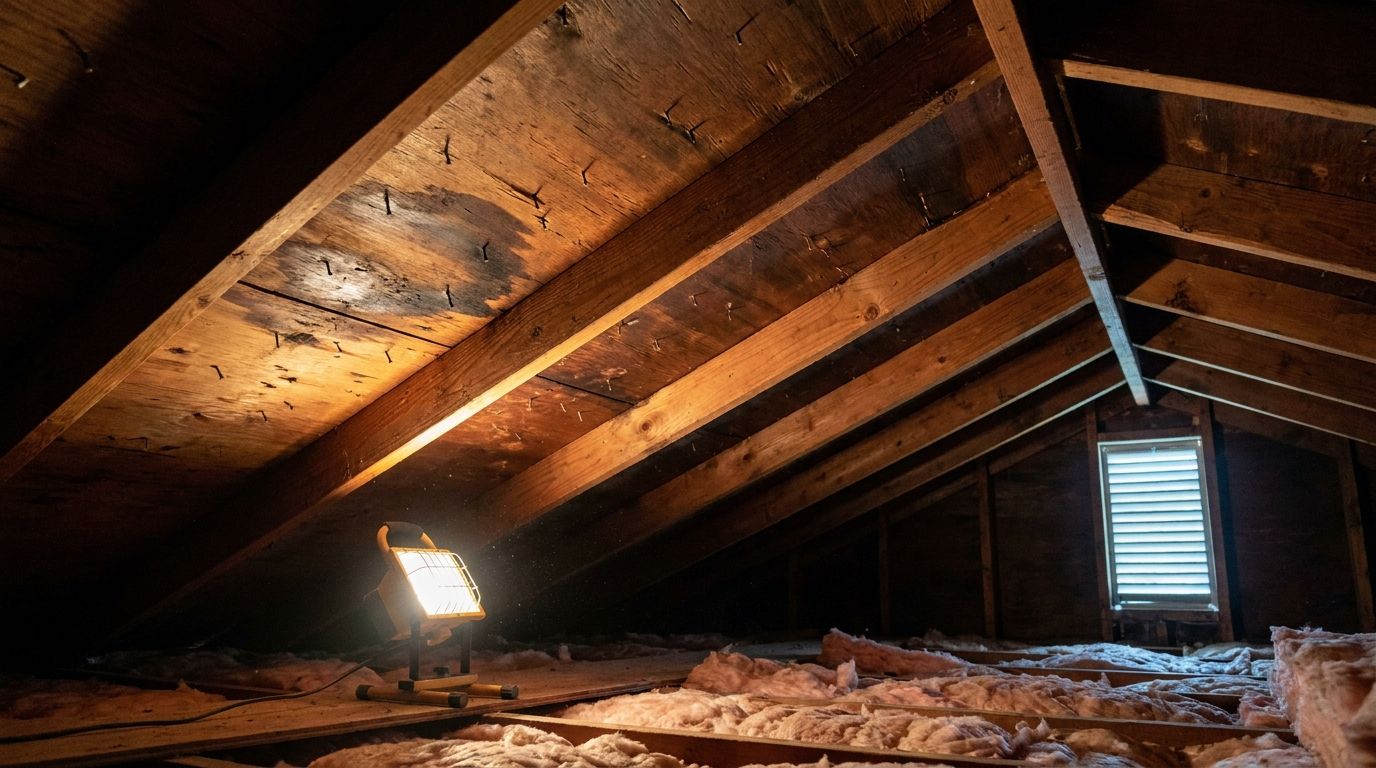
A roof inspection from us is free, and it’s two inspections — one on the roof and one in your attic. The attic half is the one almost nobody does, and it’s where the answers usually are. You get a written assessment at the end, including the verdict most companies won’t hand you: your roof is fine, leave it alone.
No charge, no obligation, no upsell attached. We do repair and replacement both, so we don’t need your roof to be dead. If it has ten good years left, that’s what the assessment says. Book one at (617) 721-1814.
Half one: what we check on the roof
We get on the roof — not the driveway, not a ladder at the gutter line — where you can see whether the shingles are still flexible and whether the flashing is doing its job.
- Shingle condition — curling and cupping at the tabs, granule loss down to the black mat, thermal cracking, and whether a course still lifts without snapping. That last one decides whether a repair is possible at all.
- Nail pops — nails backed out by years of freeze-thaw, doming the shingle above and splitting it. Cheap to fix; a lot of them at once says something about the age of the field.
- Ridge and hip caps — the most wind-exposed shingles on the house, and usually the first thing a nor’easter takes.
- Valleys — rusted-through metal, shingles cut too tight to the centerline, debris pushing water sideways under the courses. Valleys carry two planes’ worth of water, so valley leaks are big ones.
- Step and counterflashing at chimneys, dormers and sidewalls — the number one leak source on the older housing stock north of Boston. Eroded mortar joints, counterflashing pulling loose, corroded step flashing, and roofing cement smeared over the joint by whoever was here last. Tar is a symptom, not a repair.
- Pipe boots — the rubber collar around each plumbing vent typically splits around the fifteen-year mark. One of the cheapest fixes on any roof, and one of the most commonly missed.
- Skylights — head flashing and gasket, which is where they actually leak. Rarely the glass.
- Drip edge — is there any? Plenty of older roofs here have none, and without it water curls back under the first course and rots the deck edge.
- Gutters and downspouts — pitch, seams, and whether they’re full of granules. Grit in the gutter is the roof telling you its age.
- Exhaust ventilation — ridge, box or gable vents, and whether the ridge vent was actually cut through the sheathing or just nailed over solid deck. That happens more than you’d think.
Half two: the attic, and the check nobody does
Then we go inside and look at the same roof from underneath. The surface shows you the last few years; the deck shows you everything.
Lights off first, looking for daylight — pinholes at fasteners, gaps at the ridge, light around a penetration. Then a work light raked across the sheathing to read staining and delamination: dark patches, rust rings around nail shanks, mineral deposit where meltwater has run, plywood gone spongy and separating into plies. We check rafters for rot, splits and sag, and the insulation for depth and damp — wet insulation stops working and tells you where water has been.
A ridge vent does nothing on its own. Ventilation is a system — cold air enters low at the soffits and leaves high at the ridge. Block the intake and no air moves. What blocks it, constantly: blown-in or batt insulation shoved over the top plate and packed into the eave, painted-shut soffit panels, or a soffit that was never vented at all. We physically check the intake is open. Almost nobody does, and it’s the single best predictor of whether you’ll have ice dams this winter.
That’s the whole ice dam mechanism. Trapped warm air melts the snowpack from below, the meltwater freezes into a ridge of ice at the cold eave, and every later thaw ponds behind it and works backwards under the shingle courses. Shingles shed running water; they don’t hold back standing water. Re-roofing a house with buried soffit intake buys you a new roof with the same problem — see why ice dams wreck Boston roofs.
What you get at the end
A written assessment: what we found on the roof, what we found in the attic, what’s urgent, what can wait, and what it would cost as a range with the drivers named. If nothing needs doing, that’s in writing too.
| Verdict | What it means | What we recommend |
|---|---|---|
| Your roof is fine | Surface intact, flashing sound, deck dry, ventilation working | Nothing. Look again after a big storm. |
| Monitor it | Aging but functional — some curl, some granule loss, no failures | Budget a replacement window; fix nothing yet. |
| Targeted repair | One detail has failed — flashing, a valley, a boot, a few shingles | Repair it. The field still has life. See roof repair. |
| Ventilation or ice & water work | Roof is sound but the attic isn’t — blocked intake, damp deck | Fix the air, not the shingles. |
| Plan a replacement | Multiple unrelated leaks, brittle shingles, widespread wet decking | Start the roof replacement conversation on your timeline. |
Weighing the middle of that table? Our repair-or-replace guide walks the same logic, and the signs you need a new roof covers what you can spot yourself.
When to get one
- You’re buying a house. A general home inspector treats the roof as one line item among a hundred. A roofing-specific look tells you what you’re inheriting and what it’ll cost.
- You’re selling. Knowing the roof’s condition before the buyer’s inspector does puts you in a better negotiating position.
- After a nor’easter. A broken sealant strip looks like nothing from the ground until the next storm takes the tab. See storm damage roof repair.
- The roof is past 15 years old and has never been looked at properly.
- Before an insurance renewal, or if your carrier has started asking about roof age.
- Recurring ice dams. Two winters running means a ventilation problem, and it’s diagnosable.
- Any new ceiling stain, even a small one. Water travels along the deck and rafters before it drops through drywall, so the stain is almost never under the leak.
A drone flyover is not an inspection
Aerial photos are a useful supplement and a terrible substitute. A camera fifty feet up shows you a missing shingle. It can’t tell you whether the shingles are still flexible, whether the counterflashing is seated in the mortar or just leaning against it, whether the boot rubber has split, or whether the deck is dry. And it can’t see your attic, which is where half the information lives.
Same goes for a photo from the driveway, or a quote written from your description over the phone. Both are guesses. If someone says your roof needs replacing without going into the attic, they skipped the one check that tells you whether it’s the roof or the ventilation.
Roof inspection questions
Is the inspection really free, or is there a catch?
Really free, no obligation afterward. We can afford it because we do repairs as well as replacements — we don’t need every roof to be a big job. If yours is fine, we say so and go.
Do you need to get into the attic?
Strongly prefer to, so we’ll ask you to clear access to the hatch. If the attic is finished off or genuinely unreachable, the assessment says so — we won’t pretend we saw it. On a finished third floor we work with whatever an access panel or knee-wall opening gives us. Skipping it is how people end up re-roofing a ventilation problem.
Can you inspect a roof in winter?
The attic half, always — and in February that’s often the more informative half, because you can see exactly where heat is escaping and where meltwater has run. The surface depends on snow and ice cover; we won’t walk a slick roof, and we’ll come back for it once things clear.
What if the inspection finds nothing wrong?
Then that’s the assessment, in writing. It’s a common outcome, especially on properly installed roofs in the 10-to-18-year range. Homeowners who came to us after being told they needed a replacement have walked away with a “this roof is fine” and nothing to pay.
My home inspector already looked at the roof. Do I need this too?
A home inspection covers the whole house and often views the roof from a ladder or the ground. That’s the scope of the job, not a knock on home inspectors. If the report says something vague like “roof nearing end of life,” a roofing-specific look tells you what that means and what it costs.
Where we inspect
We inspect across Boston, Medford, Somerville, Melrose, Stoneham, Woburn, Wakefield, Burlington and Wilmington. Call (617) 721-1814 or request a free estimate and tell us what you’re seeing.