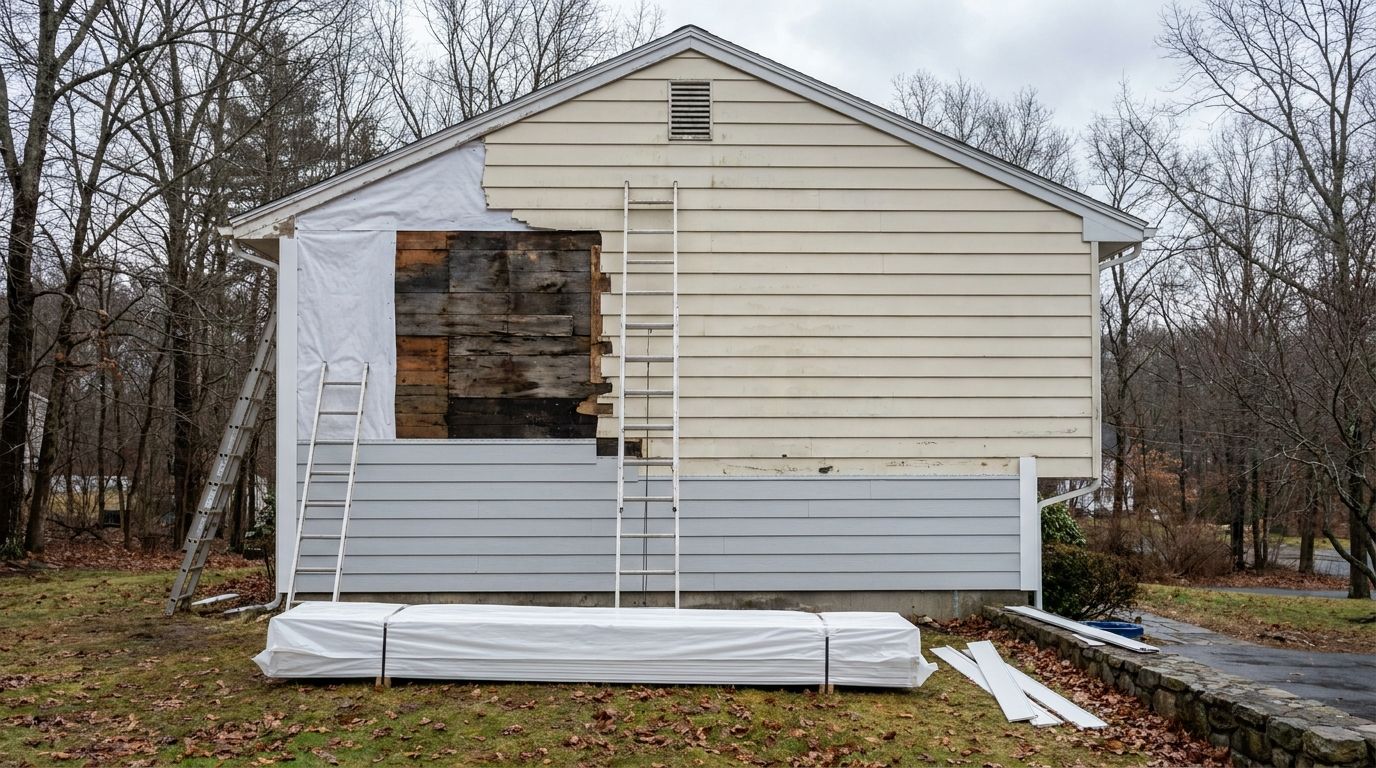
If your Woburn house still wears the aluminum or early vinyl that went on in the 1980s or 90s, it’s at end of life and it’s telling you so. This page covers that specific job: what the failure looks like, what we find once the old panels come off, and what a replacement runs here.
Thiago walks the walls himself, opens a corner where it matters, and tells you what’s behind it — sometimes that’s “one elevation, not four.” Call (617) 721-1814 or ask for an estimate. Free either way.
How end-of-life aluminum and early vinyl fail
Woburn is the strongest siding market we work in, and it isn’t close. The post-war ranches, capes and split-levels that make up most of the city were re-sided once already — aluminum first, then vinyl through the late 80s and 90s. That material is 30 to 45 years old now and failing on schedule. The signatures:
- Chalking. Run a hand down an aluminum wall and come away with white powder — the finish oxidizing off the metal. It doesn’t stop, and it streaks the trim and brick below.
- Fade that doesn’t match itself. Early vinyl pigment wasn’t UV-stable. South and west walls drift two or three shades past the north wall, so the house reads patchy and no new panel blends in.
- Cold cracking. Vinyl turns brittle with age. Below about 20°F a shovel handle or a ladder foot cracks a panel that would have flexed in July, and the crack runs.
- Dents you can’t undo. Aluminum dents permanently from hail, ladders and lawn equipment, and long runs oil-can so the wall ripples in low sun.
- Loose and waving panels. Nailing hems tear out and courses unlock, and once a section stands proud of the wall, wind-driven rain has an open path behind it.
On repainting: aluminum can be painted, and on tight, dent-free panels it buys five to ten years. But walls chalking this badly are usually dented or loose too, so paint is money spent on a wall you’ll still replace — and it does nothing about what’s behind it.
What we find when the old siding comes off
This is the part nobody shows you at the estimate. A 1980s or 90s re-side here was cosmetic — panels went over whatever was there, and the wall underneath was never touched. Four things turn up over and over.
- No house wrap at all. Much of that era’s work went straight over the original wood siding. No drainage plane — whatever gets past the panels sits on wood.
- Missing or improvised head flashing. Caulk over window and door heads where metal belongs, or coil stock bent on site and tucked the wrong way, channeling water in instead of out.
- No kickout where a roof edge meets a wall. The angled piece at the bottom of a step-flashed junction that throws water into the gutter. Missing on most houses of this vintage — so every storm for 35 years sent water down inside the wall.
- Localized sheathing rot at exactly those spots. A patch under a window head, a black triangle where a roof dies into the sidewall. The rot maps onto the missing metal.
So a siding job here is really a wall-system job, and new panels over an unfixed water path are expensive wallpaper. We tear off, replace soft sheathing, install a water-resistive barrier lapped shingle-style, flash the openings and roof-to-wall junctions, then side. Full assembly on our siding replacement page.
Two Woburn details that decide the job
The garrison overhang band. On the garrison colonials all over this city, the second floor juts about a foot past the first, creating a horizontal band — soffit, trim board, and the joint where the upper wall’s siding stops and the lower wall’s starts. It’s the classic water-entry point on the style, and where damage shows first: staining and soft trim along one line while the rest of the wall looks fine.
Split-level roof-to-wall junctions. A split-level stacks two or three roof planes at different heights, each dying into a sidewall. Every one needs step flashing woven course by course, lapped behind the wall’s barrier, with a kickout at the bottom — and a siding replacement is the only time in 30 years anyone can rebuild them. Both details are covered in depth on our Woburn roofing page.
Vinyl or fiber cement, for a Woburn house
We install both and don’t have a favorite. The Woburn version: post-war ranch and split-level stock is usually best served by good insulated vinyl — simple shapes with little trim detail for a heavier material to honor, and the insulated profiles stay flat while adding R-value to a drafty 1950s wall. A garrison colonial, or an older home near the center with real corner boards and casings, can justify fiber cement. The full argument, with the 50-year cost math, is in the vinyl vs fiber cement guide.
What siding replacement costs in Woburn
| Material | Installed, per square foot | What moves you inside the range |
|---|---|---|
| Vinyl | Roughly $4–$14 | Builder-grade to insulated premium profile is most of the spread; trim detail and openings do the rest. |
| Fiber cement | Roughly $9–$26 | Product line, factory finish versus field paint, and trim work — every piece is heavier and slower. |
Sheathing repair and flashing corrections sit outside those numbers — the real unknown until the wall is open.
One thing works in your favor: Woburn is easy to work in. Driveways with room to stage material and park a dumpster on the property, setbacks with room for ladders, space to rack planks off the wet ground. That keeps labor efficient, and labor is most of a siding number.
We do the roof too, which matters more than it sounds
Nearly every serious water problem behind Woburn siding starts at a roof-to-wall junction — a split-level’s lower plane, a porch roof, a dormer cheek. That detail is half roofing and half siding, and on most jobs it’s where two trades stand in the driveway pointing at each other. Here it’s one company: step flashing, kickout, housewrap lap and first siding course built as one assembly. If the water is coming from higher up, that’s roof repair, and you’ll hear it before you spend a dollar on the walls.
Woburn siding questions
Can I just replace the one wall that looks bad?
Sometimes, and we’ll say so when it’s true. On a Woburn split-level it’s often the west elevation that took 40 years of weather while the other three stayed tight. The catch is color: new siding won’t match 35-year-old faded panels beside it. A partial job is a water decision, not a cosmetic one.
How much rot should I expect under 1990s siding?
Usually less than people fear, and never zero. It’s almost always localized — under an unflashed window head, at the bottom of a roof-to-wall junction, along a sill under an overflowing gutter. Whole-wall rot is rare on this stock. We check the likely spots before quoting, and anything beyond the allowance gets priced and shown to you the same hour.
Why do my siding quotes differ by thousands on the same house?
Almost always because of what’s behind the wall. One quote includes tear-off, house wrap, window flashing, kickouts and a real sheathing allowance; the other assumes none of that and hangs panels over the old material. Both say “siding replacement.” Ask every bidder what happens at a window head and at a roof-to-wall junction — the answers will separate them fast.
Should I do the siding and the roof at the same time?
If both are near the end, yes — one staging setup, one dumpster, and the places where the two systems meet get built once instead of twice by two crews six months apart. Siding alone on a typical single-family here runs about a week.