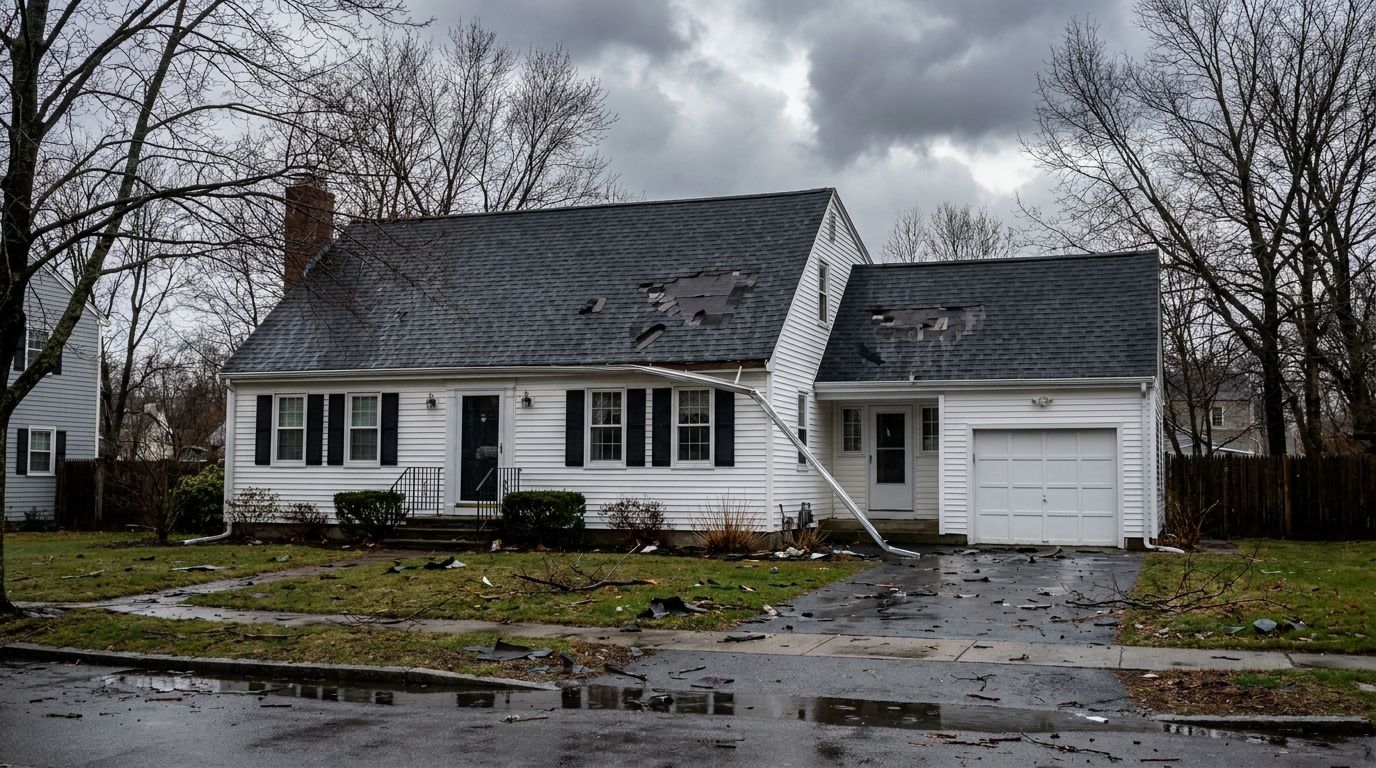
Most storm damage is visible from the ground if you know what to look for — missing or creased shingles, granules collecting at the downspouts, and displaced flashing. The damage that matters most, though, often shows up in the attic rather than on the roof.
You can do a genuinely useful check yourself in twenty minutes, no ladder needed. Here it is, in order.
Do not climb up to look, especially on a wet or damaged roof. Binoculars or a zoomed phone camera from the lawn tell you nearly everything. If water is coming in right now, call (617) 721-1814 and read what to do before we get there.
Step one: walk the perimeter
Start at the street, work around all four elevations, and photograph as you go.
- Missing shingles — gaps showing darker underlayment, usually along a rake edge, a ridge, or the windward slope.
- Creased or lifted tabs — a fold line across the face, or an edge standing proud of the course below. The most commonly missed storm damage; see below.
- Granules at the downspouts — coarse dark sand at a downspout base or on a splash block, scoured off the shingles above.
- Flashing and drip edge — check the chimney, wall junctions, valleys and eaves. Bent, torn or missing metal is where most storm leaks start.
- Gutters — sagging, dented, pulled off the fascia, or a downspout hanging loose.
- Ridge caps — the capping takes the worst of a crosswind. Look for pieces that slid or lifted.
- Debris and limb strikes — a branch dragging across a slope scrapes off granules and fractures shingles that still look whole. Punctures too.
- Shingle fragments in the yard — or the neighbor’s yard. One of the most reliable early signals there is.
Why a creased tab matters when nothing is missing
A shingle isn’t just nailed on. A factory sealant strip bonds it to the tab above, and that seal — not the nails — holds a roof together in high wind. When a gust folds a tab backwards the seal breaks, and the tab settles back looking normal.
It isn’t. It’s held by nails alone now, with a crease that cracks open as the asphalt flexes through freeze-thaw. That’s how a roof rides out a nor’easter untouched, then loses a whole section six weeks later in a milder storm.
Step two: the attic, the same week
This is where the damage that costs real money shows up first. Go up in daylight, flashlight on, attic light off.
- New daylight through the boards — pinholes at the deck, a valley, or around a vent. If light gets through, water does too.
- Fresh damp patches or active dripping — dark and damp under the sheathing is a live leak; a dry brown ring is an old one.
- Wet or matted insulation — batts gone flat, dark or heavy. Wet insulation stops insulating and sets up next winter’s ice dams.
- Water tracking along a rafter. Water travels before it lands, so the wet spot is rarely under the entry point — it can enter at a ridge and show on a ceiling fifteen feet away.
Step three: inside the house
Walk the top-floor ceilings, along exterior walls and around any chimney chase. Look for new stains, especially ones that grow after the next rain — that’s what separates an old dried mark from an active leak. Bubbling paint near the roof line counts too.
When to run this check
| Trigger | What it tends to do |
|---|---|
| Any nor’easter | Wind plus driven rain — lifted tabs, water pushed under a course |
| High sustained winds | Breaks sealant strips, creases tabs. Nothing leaks yet — which is why it gets missed |
| Heavy wet snow | Loads gutters and ridge, strains fasteners, sets up ice dams as it melts |
| A hail event | Bruises the mat, knocks granules loose — check gutters and vent caps, soft metal shows it first |
How to document what you find
- Photograph immediately, and from multiple angles — a wide of each elevation, then close-ups.
- Note the storm date and what the weather did. Timing is most of what an adjuster establishes.
- Keep the photos, and keep receipts for any emergency mitigation — tarps, temporary cover, extraction.
The honest insurance framing
Sudden, identifiable storm damage is often covered. Age and wear are not, and no paperwork changes that. We document what we find, hand you the report, and won’t call a worn-out roof storm damage. Detail: does homeowners insurance cover a roof replacement.
If a nor’easter took a shingle or two off an otherwise sound roof, that’s a repair — a small one. Get it sealed before winter and move on. Don’t let anyone panic you into a replacement. A finished roof shows the pattern on every slope, not one spot: the signs that actually mean a new roof.
What happens if you call us
We check every slope and flashing detail, then trace in the attic where water entered — see what a roof inspection covers. You get photographs and a written assessment either way. For the fix, read storm damage roof repair, or the wider range of roof repairs we handle. We work across Boston, Medford and the northern suburbs. Call (617) 721-1814 — you get Thiago, not a dispatcher.
Questions we get asked
My roof looks fine from the ground. Could it still be damaged?
Yes — that’s the normal case, not the exception. Broken sealant strips, creased tabs, lifted step flashing and scoured granules are all invisible from a driveway. The two checks that catch the most: granules at the splash block, and the attic with a flashlight.
How long before small damage becomes a real problem?
No deadline, but there is a season. Broken seals worsen with every wind, and a gap that was a simple October repair becomes an ice dam entry point in February. Weeks are fine; a whole winter is not.
A roofer knocked and said he spotted damage. Should I let him look?
Be careful. After every big storm, out-of-state crews work these streets with the same script: free inspection now, they’ll handle the insurance, sign today because they’re only here this week. Get your own assessment from someone who’ll be here next winter, and never sign same-day.
Should I tarp it myself?
No. Beyond the fall risk, a tarp nailed through sound shingles turns a small repair into a much larger one. Contain the water inside and call us.