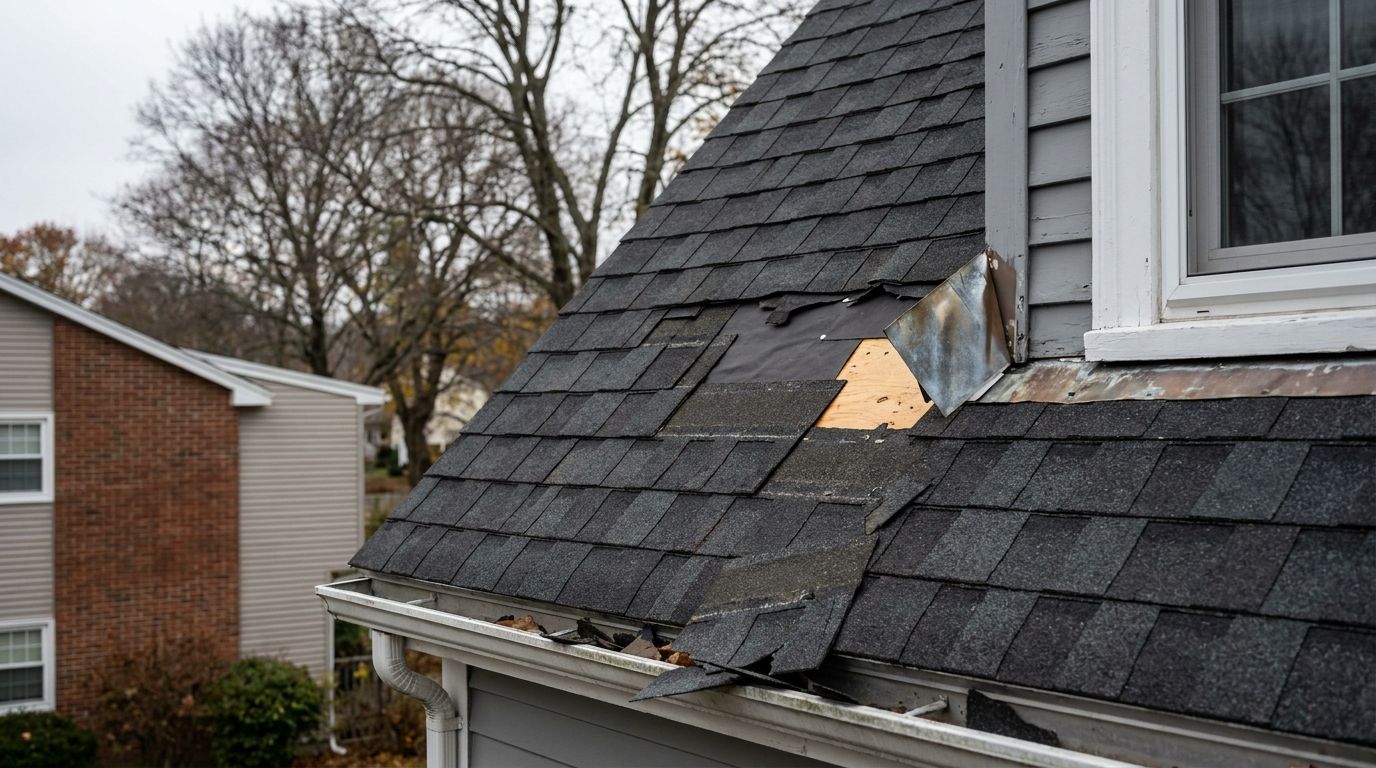
Sometimes. Sudden, identifiable damage from a covered peril — a nor’easter tearing shingles off, a tree limb coming through, hail — is often covered by a standard homeowners policy. Age, ordinary wear, deterioration and deferred maintenance are generally not, and no amount of paperwork changes that.
The rest comes down to which perils your policy names, whether you carry actual cash value or replacement cost coverage, how it treats roof age, and how well you document the damage. We are roofers, not insurance professionals — confirm details with your own carrier or agent.
Typically covered vs. typically not
Insurers draw one line, over and over: a sudden event on a specific date, or time?
| Typically covered | Typically not covered |
|---|---|
| Wind from a nor’easter — shingles torn off, tabs creased, ridge caps lifted | Age and ordinary wear — curling, cupping, granule loss on a 22-year-old roof |
| Falling trees and limbs, including a branch dragging a slope | Manufacturing defects (a warranty matter, not a claim) |
| Hail bruising and impact fractures | Gradual leaks and water damage that has run for several winters |
| Weight of ice, snow or sleet causing structural damage | Neglect — missing flashing nobody fixed, a repair you were warned about two years ago |
| Sudden accidental events — debris punching through the deck | Cosmetic-only damage — marks that do not affect how the roof sheds water, excluded on some policies |
ACV vs. RCV — the biggest factor, and most people don’t know which they have
Replacement Cost Value (RCV) pays what it costs to replace the roof today, usually less your deductible. Many policies pay in two parts: an initial check, then the withheld depreciation once the work is done and invoiced.
Actual Cash Value (ACV) pays the depreciated value of what you had. On an 18-year-old roof that can be dramatically less than the cost to replace it — depreciated over a 25-year schedule, you get a fraction of a new roof and cover the rest yourself. You can have an approved claim and still write a five-figure check.
Find your declarations page and check how loss to the roof is settled — replacement cost or actual cash value. Then look for a roof age schedule, and for a wind or hail deductible, which is often a percentage of the dwelling value rather than a flat figure. Five minutes now tells you what a claim is worth. Five minutes after a nor’easter tells you what you already lost.
Roof age schedules and surcharges
Carriers have tightened up on older roofs. At renewal, coverage can be quietly moved to actual cash value, a higher wind or hail deductible applied, a schedule imposed that cuts the settlement a set percentage per year, or renewal conditioned on replacing the roof. None of that surfaces during a claim — it is in the documents you were mailed. Past 15 years, check.
How to document damage properly
- Photograph immediately, from the ground. Each elevation wide, close-ups of anything wrong, debris in the yard, granules at the splash block. Do not climb up.
- Make sure the photos are dated, and note the storm date — timing is what an adjuster is trying to establish.
- Check the attic with a flashlight, daytime, light off. Damp sheathing, dark streaks and daylight are evidence.
- Photograph the inside before you clean up: ceiling stains, bubbled paint, wet insulation.
- Keep receipts for emergency mitigation. Tarps, a temporary cover, water extraction. Steps to prevent further damage are usually reimbursable, and most policies require them.
- Do not authorize permanent repairs before the adjuster has seen it, unless the property needs emergency protection. Stabilize, photograph it, wait on the rest.
The claims process, in outline
Report the loss and get a claim number. Get an independent roof inspection so you know what the damage is. The adjuster writes a scope of loss. The carrier settles, minus your deductible, holding back depreciation under replacement cost coverage. You pick the contractor, and the final invoice releases the rest.
We are roofers, not public adjusters
What we do: inspect the roof and the attic, photograph what we find, and give you a written assessment to hand straight to your insurer. We will be on the roof when the adjuster comes out, answering technical questions. We quote the repair the same way whether it is insured or not — see storm damage roof repair.
What we will not do is tell you a worn-out roof is storm damage. No honest contractor will. If a roofer offers to “get your roof paid for,” or to “work with your adjuster to make sure it gets approved,” be clear about what is being proposed: helping you submit a claim that is not true. That is insurance fraud. And the claim goes in under your name and your signature, not theirs. The contractor gets paid and drives away. You carry the consequence. Treat the offer as a straight answer about how that company does business, and call somebody else.
Questions we get asked
Will filing a claim raise my premium?
It can, and it can affect renewal. Ask your agent before you file, especially if the damage is close to your deductible — a paid repair sometimes costs less over time than a claim does. We will price the repair so you can do that math with real numbers.
My roof is 20 years old and a storm took shingles off. Will it be covered?
Possibly, but expect age to be central. An adjuster looking at a 20-year-old roof with curling and granule loss on every slope will often find the field was already finished, and pay the storm-caused portion only — or deny it as wear. We will tell you which side of that line your roof is on before you file. See repair or replace and spotting storm damage.
Can you meet my adjuster at the house?
Yes, gladly. We will walk the roof with them, point out what we found and explain the repair. We will not negotiate the claim or coach you on strategy — representing a homeowner is a licensed public adjuster role we do not hold.
The insurer approved less than the roof costs. What now?
Check first whether it is a depreciation holdback rather than a shortfall — under replacement cost coverage the balance is usually released once the work is invoiced. If it is a real gap: raise items missed in the scope with your carrier, bring in a licensed public adjuster, or pay the difference. We will not inflate an estimate to close it. See roof replacement costs in Massachusetts.
If a storm just came through, call (617) 721-1814. Free assessment, a written report for your insurer, and a straight answer either way — in Medford, Boston and across the northern suburbs.