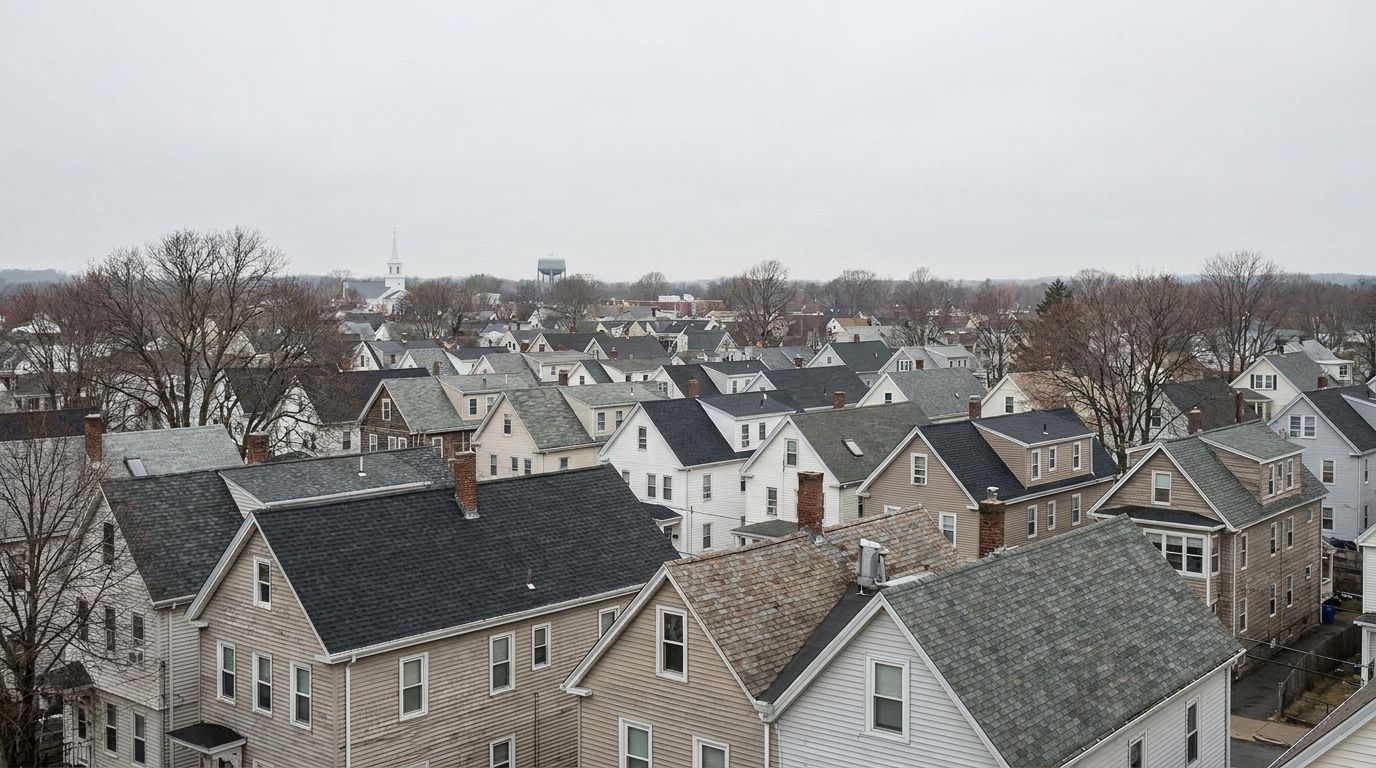
DeSouza Roofing works a tight corridor — Boston and eight cities and towns running north of it. Nine places, all within about forty minutes of each other, which is deliberate: Thiago is on every job, and that only works if the jobs are close together.
Plenty of roofing companies will drive an hour and a half for a replacement. We don’t, and it isn’t a capacity problem. A roof you can get back to in twenty minutes when a homeowner calls about a drip two winters later is a roof you can stand behind. Here’s how we work.
What we cover, and what we do there
Every service we offer is available in every city on this page — full roof replacement, roof repair including leaks and storm damage, and siding replacement in vinyl and fiber cement. There’s no tiered service area where the outer towns get a smaller crew or a longer wait.
What does change from town to town is the roof itself. A Somerville two-family and a Burlington ranch are different buildings with different failure points, built forty years apart. The estimate, the staging, the flashing details and the price all follow from that. So rather than nine identical pages with the city name swapped, here’s what we actually run into in each one.
The nine cities
Boston
Boston is nine neighborhoods pretending to be one job. Dorchester, Roslindale and Brighton are three-decker country — 1890s to 1920s, three full stories, which means staging and a street permit before anyone touches a shingle. The main slopes are often shallow hips, and the rear ell or back-porch stack is frequently low-slope or dead flat, so it isn’t a shingle job at all. West Roxbury runs to gambrels and colonials with more room to work. Mansards in the older districts hide a flat top behind a steep visible face. Age, height and access — that’s Boston.
Somerville
One of the densest cities in New England, and you feel it on every job. Two-families and triple-deckers sitting eight feet apart, most with no driveway at all, which turns dumpster placement and material drop into a permit conversation before it’s a roofing conversation. Almost every one of these houses has a low-slope section over the rear porch stack that needs a membrane rather than shingles, and that junction — pitched roof meeting flat roof meeting three floors of back porch — is where the leaks actually start. See our Somerville roof repair page for the details.
Medford
Medford is the hinge between city and suburb, and its roofs show it. Near Tufts and Medford Hillside you get the same dense two- and three-families as Somerville. Push out to the Lawrence Estates or toward the Fellsway and it turns into 1920s and 1930s colonials on real lots — steeper pitches, third-floor attics, and quite a few roofs that started life as slate and have been asphalt for two generations. Those conversions often left original flashing in place, which is worth checking before you price anything. More on our Medford roof replacement page.
Melrose
A streetcar suburb that filled in between 1890 and 1925, and it left behind the most complicated rooflines in our whole service area. Queen Anne and colonial revival houses with steep pitches, turrets, bay roofs, three or four dormers, and valleys running in every direction. That complexity is the price driver — the field is the easy part, and the flashing, valley metal and dormer detailing are where the labor goes. Add mature tree cover holding moisture on the north slopes and you get moss and premature granule loss on one side of a roof that’s fine on the other.
Stoneham
Stoneham backs onto the Middlesex Fells, and that reservation shapes the roofing more than the architecture does. Older colonials near the center, mid-century capes and ranches on the hillier streets — but nearly all of them sit under heavy canopy. Constant leaf load in valleys and gutters, shaded north slopes that stay damp for weeks, moss and algae streaking, and debris packing the eaves right where you least want water sitting in January. Half the “roof problems” we look at in Stoneham are drainage and shade problems, and we say so.
Woburn
Woburn is the genuine mixed bag. Around Woburn Center and the older streets there are Victorians and turn-of-the-century colonials with steep, complicated roofs. Out toward the highway it’s 1950s to 1970s ranches, garrisons and split-levels on quarter-acre lots. The garrisons in particular have that second-floor overhang, which creates a soffit and ventilation situation that’s routinely done wrong. Woburn also has a lot of aging vinyl and original wood siding hitting the end of its life at the same time as the roof — see siding replacement in Woburn.
Wakefield
Wakefield splits cleanly. The older sections around the lake and through Greenwood and Montrose are Victorians and big colonials — steep, tall, plenty of dormer and porch-roof detail. The post-war streets are capes and ranches, much simpler and much cheaper to reroof. The lake matters too: houses with open exposure across the water take wind that inland streets don’t, and that shows up as lifted tabs and ridge cap damage after a nor’easter long before the field of the roof is worn out.
Burlington
Burlington went from farm town to suburb in roughly fifteen years after the war, so a huge share of the housing stock is ranches and split-levels built between about 1950 and 1970 on similar plans. Practically, that’s good news: low pitch, walkable, wide driveways, easy staging, no permit gymnastics — the least expensive kind of roof to replace. The catch is that low pitch plus original attic ventilation is an ice dam recipe, and most of these houses are now on their second or third roof, so what’s under the shingles is the real question.
Wilmington
The outer edge of our area and the most spread out. Post-war ranches and splits much like Burlington’s, mixed with a lot of 1980s through 2000s construction — bigger colonials on bigger lots with cut-up rooflines, attached garages, bonus rooms above them and far more valleys than the older houses have. Those bonus-room roofs are a known cold spot and a known ice dam location. Wilmington’s saving grace is space: room to drop a dumpster, room to stage, and a job that runs faster for it.
Three kinds of roof, nine cities
Underneath the town names there are really only three situations, and knowing which one you’re in tells you most of what you need to know about your estimate.
| Type | Where | What drives the job |
|---|---|---|
| Dense urban multi-family | Boston, Somerville, parts of Medford | Height, staging, street permits, no driveway, and a low-slope rear section that needs membrane rather than shingles |
| Streetcar-era single family | Melrose, Wakefield, older Woburn and Medford | Steep pitch and roofline complexity — dormers, valleys, turrets, porch roofs. Flashing work, not field area |
| Post-war ranch, cape and split | Burlington, Wilmington, Stoneham, outer Woburn | Simple, walkable, cheap per square — but low pitch and undersized ventilation make ice dams the recurring issue |
If you’re not sure which describes your house, that’s fine — call (617) 721-1814 and describe it, or book a free estimate and we’ll come look.
Questions about our service area
Do you charge more for the towns further out?
No. There’s no travel charge and no zone pricing anywhere in these nine cities. Price differences between towns are real, but they come from the roofs, not the mileage — a Burlington ranch is genuinely cheaper to replace than a Melrose Victorian because it’s smaller, lower and simpler to work on.
My town isn’t listed. Will you still come out?
Ask. If you’re in a town that borders one of these nine, there’s a good chance the answer is yes. If you’re an hour away, we’ll tell you honestly that we’re not the right company — not because we couldn’t do the work, but because being able to come back quickly is part of what you’re paying for.
Do you handle the permits and the dumpster?
Yes. Roofing permits are pulled per municipality and each of these cities runs its own process. In Boston and Somerville, where street occupancy for the dumpster and staging is part of the equation, that’s handled before the start date rather than on the morning of. It’s included in the written estimate, not added later.
Do you do flat and low-slope roofs?
Yes, and in this service area you have to. Most Boston and Somerville multi-families have a flat or nearly flat section — a rear ell, a porch roof, a mansard top — and it needs a membrane system rather than shingles. Putting asphalt shingles on a slope that shallow is a leak with a start date.
Which town has the worst ice dam problem?
It tracks the house, not the town, but the post-war low-pitch ranches and splits in Burlington and Wilmington and the shaded, tree-covered streets of Stoneham produce the most calls. It’s almost always an attic ventilation and insulation issue rather than a roof defect — we wrote up why here.