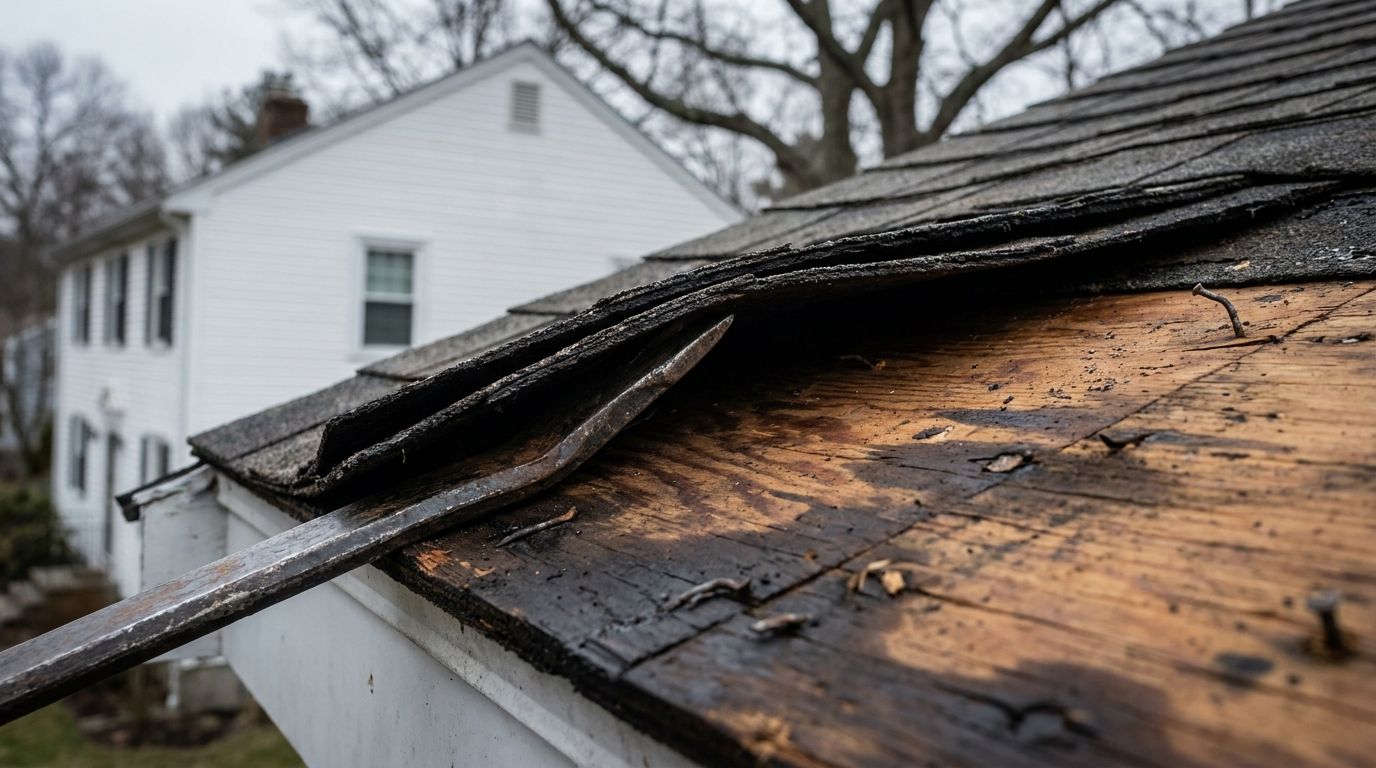
Yes — you can physically lay new asphalt shingles over an old roof, and code generally permits a second layer where only one exists now. DeSouza Roofing does not do it, on any house, at any price. Here’s the honest version of why, plus what an overlay really saves.
An overlay saves the tear-off labor and the dumpster on day one. It costs you a look at your decking, a properly bonded ice & water shield, several years of shingle life, and more money at the next replacement.
Legal is not the same as advisable
Massachusetts follows the residential code language that allows a new covering over one existing layer of asphalt shingles and prohibits a third. So a two-layer roof is usually permitted, an inspector signs it off, and contractors here will quote it. Nobody is breaking rules.
But code is a floor, not a standard — the minimum a roof can be and still be legal, not what stays watertight after eighteen New England winters. Our roof replacement specification starts with a full tear-off to bare wood, and the first reason below settles it here.
1. Ice & water shield can’t bond to old shingles
Ice & water shield is a self-adhering rubberized membrane that has to grip clean, flat decking and seal around every nail driven through it. That seal is what stops meltwater backing up behind an ice dam from finding your ceiling.
Lay it over old shingles and it bonds to the shingle, not the deck — a textured, granular, stepped surface it was never meant to stick to. And that shingle is only nailed down, so water getting past the top layer just runs along the old roof underneath. That’s exactly the path an ice dam sends it.
Massachusetts requires ice barrier protection at eave edges for a reason: ice dams here aren’t a freak event, they’re annual on any house with an underventilated attic. See why ice dams wreck Boston roofs. Giving up that layer is disqualifying on its own.
2. It hides the decking you were supposed to inspect
The only day anyone sees the sheathing under your roof is the day the old roof comes off — that’s when soft, delaminated or water-stained plywood gets found and replaced. An overlay skips that and nails a new roof to wood nobody looked at.
Rot doesn’t stop because you covered it. It keeps going, quietly, under two layers now instead of one, and your new shingles are fastened into whatever that wood has become. Compromised sheathing doesn’t hold a nail against nor’easter uplift.
The rest of the case against
- Weight. A second layer roughly doubles the dead load of the roof covering — in a region that also puts two feet of wet snow up there.
- Heat. The doubled layer runs hotter and can’t shed heat downward. Asphalt ages by temperature cycling, so a hotter roof is a shorter roof — typically by several years. See how long a roof lasts here.
- Appearance. New shingles telegraph what’s underneath. Every curled tab and uneven course reads through. From the street it looks lumpy, because it is.
- Flashing. An overlay almost always reuses existing step flashing, counterflashing and pipe boots — and reused flashing is where leaks come back two winters later.
- Next replacement. Two layers have to come off. You didn’t avoid the tear-off cost, you deferred it and added interest.
- Resale. A home inspector counts layers and writes it down. Buyers ask, and “two layers” becomes a negotiating point when you have the least leverage.
What an overlay actually saves
The case against overlays is only credible if the case for them is stated honestly. An overlay removes the stripping labor and the disposal cost — around Boston, often a tenth to a fifth of the total, and more on a steep or hard-access roof. The job runs faster and the property stays cleaner.
That saving is real. It’s just bought with the two things that make a New England roof last: a visible deck and a bonded eave membrane. See roof replacement cost in Massachusetts for the full number.
Overlay vs. full tear-off
| Overlay | Full tear-off | |
|---|---|---|
| Upfront cost | Lower — no stripping, no dumpster | Higher by tear-off and disposal |
| Decking inspection | None — covered up unseen | Whole deck walked, bad sheathing replaced |
| Ice & water shield | Can’t bond to the deck | Bonded to bare wood at eaves and valleys |
| Expected life | Shortened — runs hotter, ages faster | Full rated life of the system |
| Flashing | Usually reused | New step, counter, valley metal, pipe boots |
| Weight | Roughly double the covering load | Single layer, as designed |
| Next replacement | More — two layers to remove | Normal single-layer tear-off |
Who might genuinely consider one
There’s a narrow case. Selling within months, exactly one existing layer, decking verified sound from the attic, a simple walkable plane with no ice dam history, and a surface that’s worn rather than failing — that’s a defensible short-term call. On the older housing stock we work on in Boston, Somerville and Medford, though, a previous overlay is often exactly what we find when the roof comes off.
We still won’t do it — not because it’s unethical, but because the odds all those conditions hold are lower than most homeowners think, and whoever finds out otherwise is either you or your buyer. If your roof sits in the middle, our repair or replace guide beats a coin flip. Often the honest answer is a targeted repair.
Common questions
Is a second layer of shingles legal in Massachusetts?
Generally yes, on a roof that currently has one layer. A third isn’t permitted, and a roof already carrying two must be stripped first. But legal and advisable are different questions — code sets a minimum, not a standard for a roof that has to survive a New England winter.
How much cheaper is an overlay?
You save the stripping labor and disposal — often a tenth to a fifth of the total. It moves with size, pitch and dumpster access, so anyone quoting a firm saving before seeing the roof is guessing.
Will an overlay actually leak?
Not necessarily on a dry summer day. The failure mode is winter — meltwater backing up behind an ice dam at the eaves, where the membrane that should stop it is absent or stuck to old shingles. That, and reused flashing, is where overlay roofs let go.
How do I tell how many layers my roof has?
Look at a rake or gable edge where the layers show in profile — you can often count them from the ground with binoculars. Shingles sitting unusually proud of the drip edge are a hint. We check as a matter of course and tell you either way: (617) 721-1814.