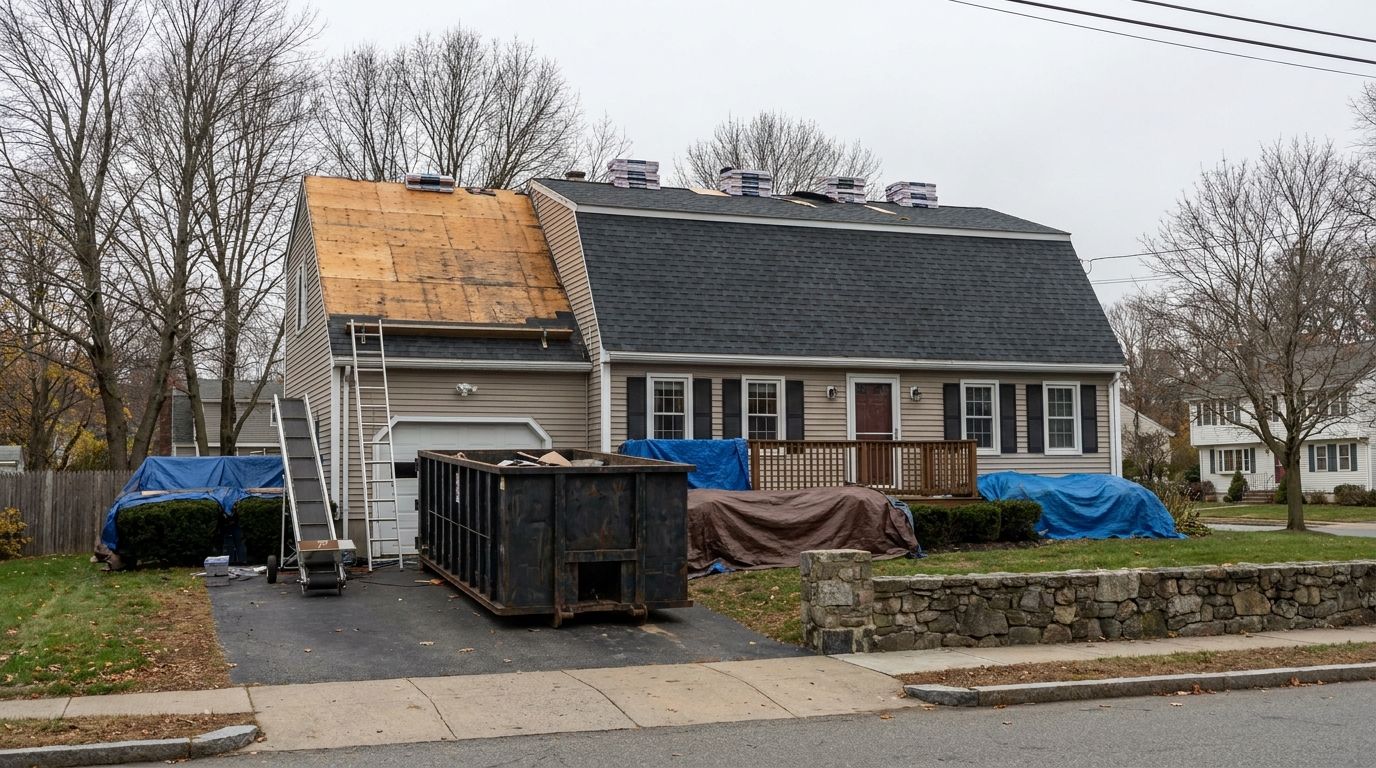
Most people have a roof replaced once, maybe twice, in their lives — so almost nobody knows what the day is actually like. Here it is from your side of the front door: what to do the night before, what the noise really feels like from inside, what happens when the old roof comes off, and what a properly cleaned-up site looks like.
Move the cars, take pictures off the walls, plan somewhere else for the dog, and go to work. Most single-family roofs here are done in one to two days. You do not need to be home, we do not need to come inside, and the driveway gets magnet-swept before we leave.
How long the job takes
Most single-family roofs across Boston’s northern suburbs are a one to two day job. A straightforward colonial or cape often comes off and goes back on in a single day. Add dormers, valleys, skylights, a third story or a steep pitch that needs staging, and it runs to two — occasionally three on the most complex roofs. Disruptive, but short.
More detail in how long a roof replacement takes, and the layer-by-layer specification in roof replacement.
Before: the night-before checklist
None of this is busywork. Every item is here because of something that has genuinely gone wrong on somebody’s job.
- Move the cars out of the driveway and off the frontage. We need the room for the dumpster and the material delivery. On street parking, move a few doors down.
- Take pictures and mirrors off the walls. Especially upstairs, and especially on walls directly under the roof. This is the one homeowners skip and then regret — tear-off and nail guns put a continuous vibration through the structure, and things that have hung on a nail for fifteen years do work loose.
- Cover or move anything stored in the attic. When the deck is stripped from above, decades of dust and debris come down between the boards. Boxes, stored furniture, holiday bins — sheet them or move them.
- Make a plan for pets. We push hardest on this one. The noise is loud, constant, and comes from directly above — the one direction an animal cannot escape. Anxious dogs and cats have a bad day. Use a friend, family or daycare if you can.
- Plan around naps and calls. If a baby naps or you work from home on calls, be somewhere else. There is no quiet hour on a tear-off day.
- Clear the perimeter. Patio furniture, grills, potted plants, bird feeders, kids’ toys — pull it well away from the walls. We tarp what stays, but nothing beats moving it.
- Flag what you care about near the drip line. A young tree, a raised bed, a septic cover, an irrigation head. Tell us before we start, not after. Where a branch overhangs the work, we will ask about trimming it.
- Talk to your immediate neighbors. In Somerville, Medford and the denser parts of Boston, houses sit close and driveways get shared. A heads-up the week before lets them plan too.
During: what the day is actually like
The noise, honestly described
Tear-off is the loudest part and it comes first. From inside it sounds like several people dragging heavy furniture across the floor above you, punctuated by shingles sliding off the roof into a metal dumpster — a bang, not a rustle. Then the nail guns start: a rapid, irregular run of sharp cracks moving across the ceiling.
The vibration is the part nobody warns you about. Not violent, but constant, and you feel it through the floor upstairs. It stops the moment the work stops.
The dumpster and the tarps
A roll-off dumpster goes in the driveway, on protection, closest to the work and where it does the least damage. Where there is no driveway — common on a two-family — we arrange street placement in advance and tell you where it will sit before the day.
Before a single shingle moves, tarps go over the shrubs, the deck, the walkways and the siding below the work, and debris netting catches what comes off the edge. A boring half-hour, and the difference between a clean job and a yard full of shingle fragments.
The deck inspection — the honest moment
This is the point where a price can legitimately change — and also the point where a dishonest contractor makes money. With the old roof off, the sheathing is visible for the first time in twenty or thirty years, and soft, delaminated or rotted boards have to come out. Nobody can see that from the outside beforehand, which is exactly why “we found unexpected rot” is such a common way to inflate an invoice at the end.
A straight contractor handles it three ways. Shrink the unknown first — we look at the underside of the deck from inside your attic at the estimate stage, so we already have a fair idea of what is up there. Tell you immediately, with a price, before replacing anything, and with photos if you are not there. And price it by measurement rather than by eye: so many sheets, at a rate agreed in writing before the job started.
“What is your price per sheet of replaced decking, and how will you tell me if you find it?” A company with a straight answer is telling you something real. Our pricing logic: what a roof replacement costs in Massachusetts. The shingle system: asphalt shingle roof replacement.
Access to the house
You do not need to be home, and we do not need to come inside — crews work off the exterior and bring their own water. All we want is a quick word before we start and your phone reachable in case the deck turns something up.
The weather rule
We will not tear off more roof than we can make watertight the same day. Not negotiable — a roof left open overnight under a New England sky is how a straightforward job becomes a ceiling repair. Underlayment and ice & water shield go down as the tear-off progresses, not at the end of it.
It also means a bad forecast moves the start date rather than stretching the job. We would rather call you two days out and push to next week than open your roof on a maybe. Late spring through fall gives the most reliable windows — see the best time of year to replace a roof in Massachusetts — but roofs get replaced here year-round.
After: cleanup and the walk-round
The magnet sweep. A replacement drives thousands of nails and drops a fair number. We run a rolling magnet over the driveway, walkways, lawn line and anywhere material was staged, then again over the heavy-traffic spots. It matters for three reasons: tires, bare feet in July, and dogs. A nail in a driveway does not announce itself until it is in a sidewall.
Debris gone the same day. The dumpster leaves when the job finishes, not the following week. Tarps up, netting down, fragments picked out of the beds by hand, gutters cleared.
The walk-round. Before we leave the street we walk the property with you — what was replaced, what we found on the deck, where the new flashing and ventilation went. If you are out, we do it by phone with photographs and in person whenever suits.
Driveway swept and magnet-run. No shingle fragments in the beds or the lawn. Tarps and netting gone. Gutters clear. Landscaping the way it was that morning. Every scrap of old material gone, dumpster included. If you are still finding debris a week later, the crew did not finish the job — they stopped doing it.
The first few weeks, and the first heavy rain
- After the first heavy rain, check the ceilings under any valley, chimney or skylight and look in the attic with a flashlight. Learn the shape of the old stains so you can spot anything new.
- A shingle that looks slightly lifted in the first weeks is usually normal — the adhesive strip seals with heat and time, which in cool weather takes a few warm days. A few granules in the gutters after the first rains is normal shedding too; a steady stream months later is not.
- Watch the attic through the first cold snap. If ventilation was part of your job, this is where you see it — less frost under the deck, less ice at the eaves. Ice dams are usually a ventilation problem.
- Anything you are unsure about, call. We would rather look at something that turns out to be nothing.
Questions homeowners ask about install day
Do I need to be home while you replace my roof?
No. Most of our replacements happen while the homeowners are at work, and crews do not need to come inside. Keep your phone reachable in case the deck inspection turns something up. If you would rather be there when the old roof comes off so you can see the decking yourself, say so and we will time it around you.
How loud is a roof replacement from inside the house?
Loud, and constant. Tear-off sounds like heavy furniture dragged across the ceiling, with shingles banging into a metal dumpster below. Nail guns are a rapid run of sharp cracks that carries through the whole structure, and you feel a steady vibration through the upstairs floor. Not noise you can take a call through, and genuinely stressful for animals — plan to be elsewhere if either matters.
Will the vibration damage anything inside my house?
Not structurally, but it does knock things loose. Pictures, mirrors, wall shelves and anything hanging on a single nail should come down for the day, especially upstairs. In an unfinished attic, expect dust and debris between the boards during tear-off, so cover or move whatever is stored there. Ten minutes of preparation the night before prevents nearly all of it.
What happens if it rains partway through the job?
We never tear off more roof than we can make watertight the same day, so there is always a dried-in surface to fall back on. If a bad forecast shows up before we start, we move the start date rather than gamble. Pushing a job a few days is a minor inconvenience; opening a roof under a New England sky and losing the bet is a ceiling.
How do I know all the nails have been picked up?
We run a rolling magnet over the driveway, walkways, the lawn line and anywhere material was staged, then go over the heaviest-traffic areas a second time. If you find a nail after we have gone, call — we will come back and sweep again. That is a normal request, not a complaint.
Before install day there is estimate day
All of this assumes you have decided. If you are still working out whether you need a replacement at all, start with repair or replace and a proper roof inspection — we do repairs as well as replacements, so “your roof has years left in it” is a real outcome here. When you are ready, request a free estimate or call (617) 721-1814 and speak to Thiago directly. We replace roofs in Boston, Somerville, Medford and across the northern corridor.