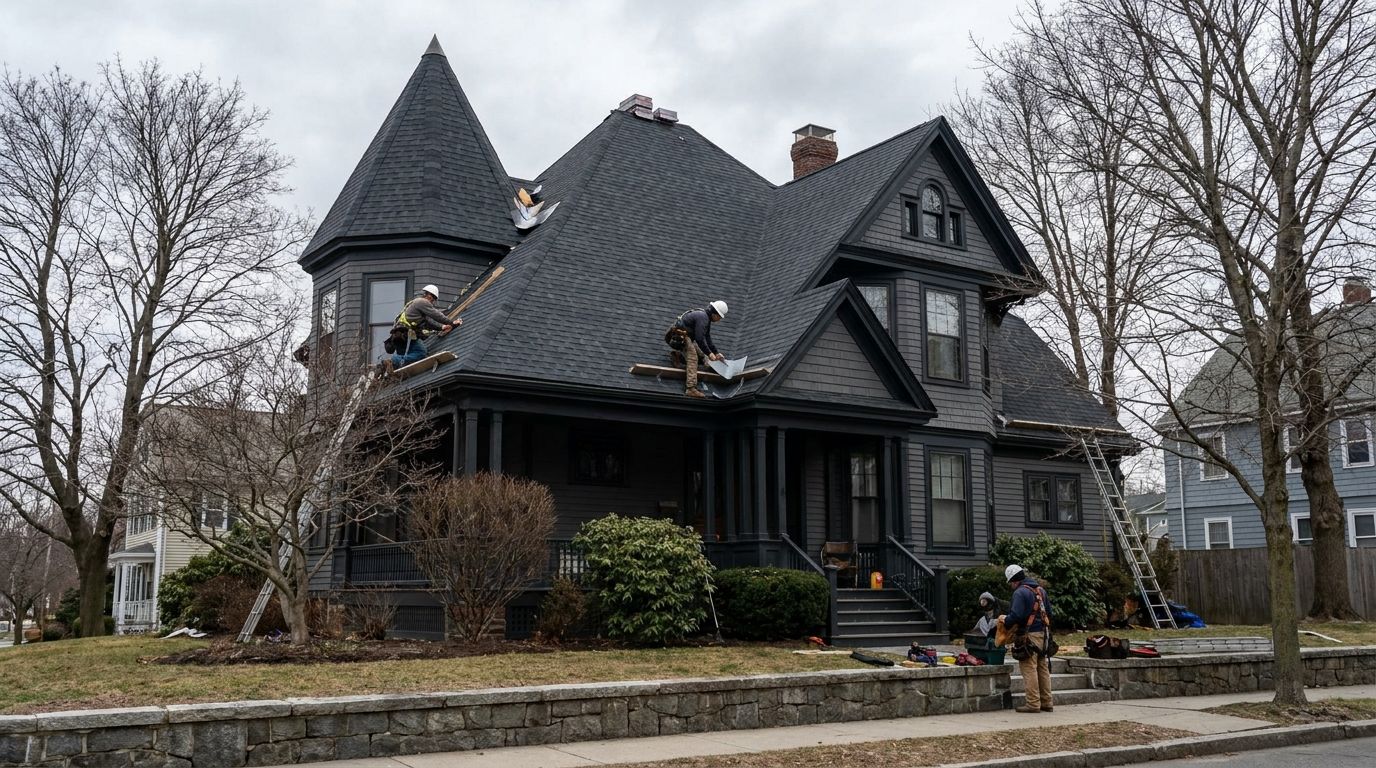
Melrose has the most complicated rooflines we work on — Queen Anne and Victorian houses with turrets, bays, three or four dormers and gables running into each other, plus early-1900s colonials that aren’t much simpler. That complexity is the whole story here. It’s why a Melrose roof costs more than a comparable house in Wakefield, and it’s exactly where a cheap quote saves its money.
“How many valleys, hips and roof-to-wall junctions are on my house, and what are you doing at each one?” A company that has actually looked can answer that. One that measured your square footage off a satellite image can’t. Call Thiago on (617) 721-1814 and ask us the same thing.
A Melrose roof is not a rectangle
Melrose filled in as a streetcar suburb between roughly 1890 and 1925, and it kept what it built: steep-pitched Queen Annes with corner turrets, cross-gabled Victorians, bay windows with their own little roofs, dormers stacked on the third floor, porch roofs dying into the wall below the second-story windows. Then the 1900–1930 colonials — simpler, but still steeper and busier than anything built after the war.
Put a tape measure on it and the field — the open planes where a roofer just runs shingles — is often barely half the roof. The rest is edges. Every place two planes meet is a valley or a hip; every place a roof dies into a wall, dormer cheek, turret or chimney is a junction. A plain gabled colonial might have two valleys. On a Melrose Victorian, fifteen is not unusual.
That matters because shingles don’t leak. Shingles shed water down a slope, and they’re good at it. Water gets into a house where the shingles stop.
Every intersection is a flashing detail — and flashing is where leaks start
Flashing is the metal that carries water across a joint: step flashing up a dormer wall, counterflashing cut into a chimney, valley metal where two planes drain together, kickout flashing at the bottom of a roof-to-wall run so water lands in the gutter instead of behind the siding. It’s slow per-piece work, and fifteen valleys can’t be done quickly.
So when three quotes come back and one is thousands cheaper, this is nearly always where the difference lives. The cheap version reuses old flashing and shingles over it, caulks a chimney instead of cutting in new counterflashing, skips kickouts, and runs roll roofing in the valleys instead of metal. None of it shows from the street on day one. All of it shows in year four.
What we’d want to see written on any Melrose estimate:
- Step flashing replaced, not reused — it’s woven in shingle by shingle, so reusing it means it never came off.
- New chimney counterflashing cut into the mortar joint. Caulk is a repair, not a roof.
- Ice & water shield in every valley, not just at the eaves, plus around dormers and chimneys.
Steep pitch means staging, not walking
The second cost driver is that a lot of these roofs can’t be walked. Victorian pitches routinely run steep enough that a crew needs roof jacks and planks, harnesses tied to real anchors, and often ground staging around a turret or third-floor dormer. That setup is labor, and it’s real — not padding. It’s also non-negotiable: if a quote is cheap because the other outfit plans to free-climb it, that’s not a saving you want. Narrow driveways and street trees mean dumpster placement gets settled before the start date.
Shade, moss and valleys that never dry out
Melrose has serious tree canopy, and a complex roof turns shade into a maintenance problem. A north plane that never sees direct sun stays damp for weeks and moss takes hold — moss holds water against the shingle and lifts the edges, unlike black algae streaking, which is only cosmetic.
Complexity makes it worse in one specific way: valleys collect. Leaves and needles wash down two planes into one channel and pack there, water backs up behind the debris, and the valley stops drying at all. We see Melrose roofs where the sunny front slope has eight years left and the shaded rear valley is finished. Neighboring Stoneham has the same canopy problem on far simpler roofs.
Ice dams: complex rooflines trap snow
Older Melrose housing tends to have modest attic ventilation by modern standards — finished third floors, knee walls, soffits never designed to move much air. Combine that with a dozen valleys and the snow doesn’t slide off. It sits in the valleys and behind the dormers, melts from below where the attic is warm, and refreezes at the cold eave. The water backing up goes under the shingles and straight into the junctions above.
Plainly: an ice dam is almost never a shingle defect. It’s a heat-loss and ventilation problem, and a new roof without corrected airflow buys you a nicer-looking version of the same February. Our ice dam guide covers what actually stops it.
Replacement, repair and siding in Melrose
| House type | What drives the job here |
|---|---|
| Queen Anne / Victorian with turret or bays | Valley and hip count, per-piece flashing, staging for steep pitch, faceted planes priced separately |
| Cross-gabled with multiple dormers | Step and kickout flashing on every dormer cheek, ice & water shield around each one |
| Either, with a slate history | Old spaced sheathing under a past conversion, and original flashing that may never have been replaced — same story as Medford |
Replacement. Full tear-off to bare deck, soft decking replaced and shown to you, ice & water shield at eaves and valleys, synthetic underlayment, new drip edge, all new flashing, architectural shingles, balanced ridge-and-soffit ventilation. On a complex Melrose roof we itemize the flashing and valley work, because that’s the part you’re actually comparing between quotes. Ranges and what moves them are in our Massachusetts cost guide.
Repair. A leak at a dormer cheek, failed chimney counterflashing, a valley worn through, storm damage on one plane — on a house with this many details a targeted repair is very often the right answer, and a proper inspection tells you which. We’d rather fix one junction than sell you a roof you don’t need yet.
Siding. Vinyl and fiber cement. Melrose houses carry a lot of trim — brackets, bay projections, porch columns, decorative gable shingles — and that detail work is what separates siding that looks right on one of these houses from siding that flattens it.
Melrose roofing questions
Why is my Melrose quote so much higher than my friend’s in a newer neighborhood?
Because you’re not buying the same roof. A post-war ranch is two planes you can walk on. A Victorian with a turret, four dormers and a porch roof can carry three times the linear feet of valley, hip and wall junction on similar square footage — every foot of it hand-detailed flashing, on a pitch that needs staging. Square footage is the least useful number on a Melrose estimate.
There’s moss on the shaded side of my roof. Is that a new roof?
Usually not on its own. Moss on a north slope or in a shaded valley is common here, and caught early it’s a cleaning and tree-trimming job. What matters is underneath — if the shingle edges are lifting or the granules are gone in that area, that plane may be finished while the sunny side has years left. Sometimes the honest answer is that nothing needs doing yet, and we’ll say so.
Can I just get the leaking dormer fixed instead of the whole roof?
Often, yes. On a complex roof most leaks are one failed detail, not a worn-out roof, and a dormer, chimney or valley repair costs a fraction of a replacement. Replace instead when the shingles are at end of life across the whole roof, or when you’d be fixing the fourth junction in three years. We’ll show you photos of what we found and give you the real choice.
Does shingle color and profile really matter on my street?
More than most — the roofline is the most visible thing about a Victorian, and the wrong shingle can make the house read cheap even when the work underneath is good. Weathered-wood and slate tones usually sit better here than flat black, and a heavier profile reads closer to the wood or slate the house was designed around. We’ll bring samples so you can see them against your own siding in daylight.