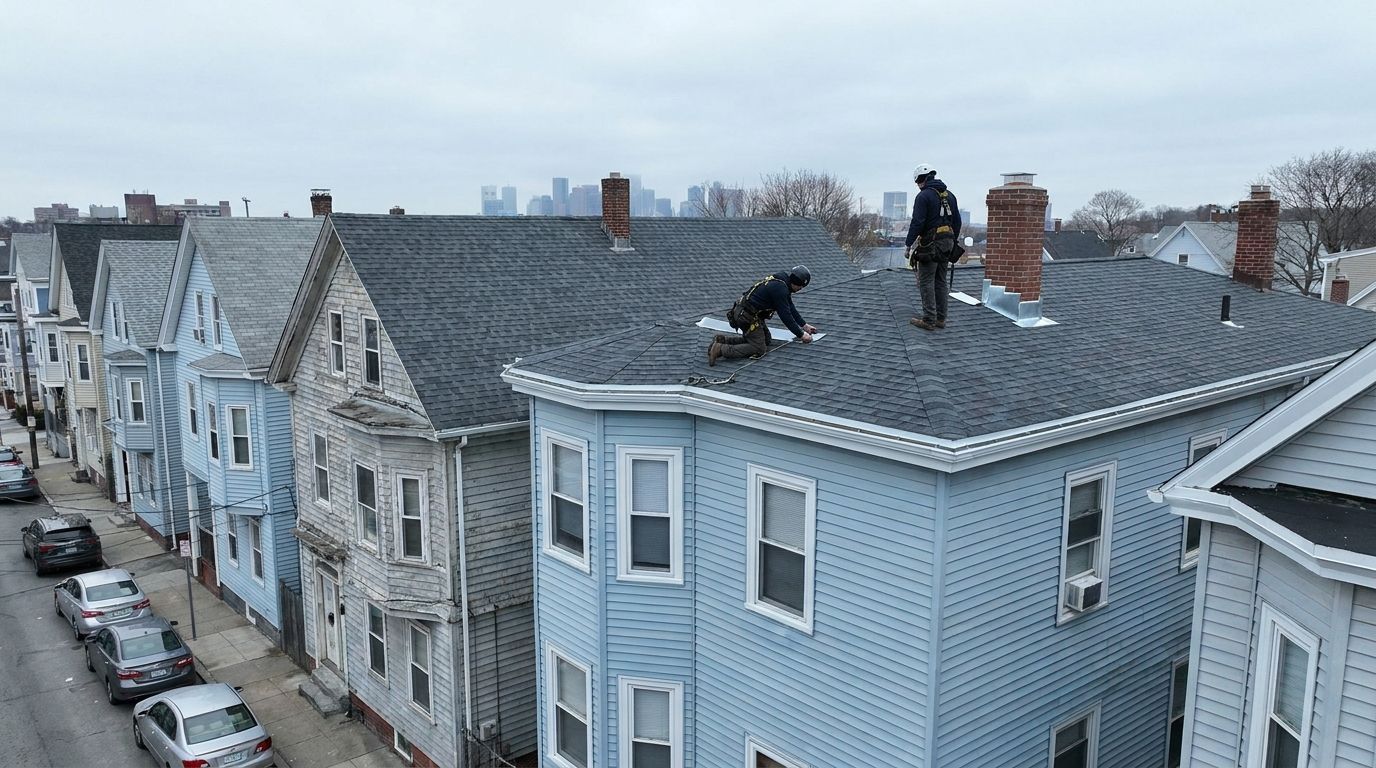
Boston is the hardest roofing city in our service area, and it isn’t the weather that makes it hard — it’s the buildings and the street. Three full stories, a flat section hiding behind a pitched one, nowhere to put the dumpster. DeSouza Roofing has spent ten years on roofs like that, and Thiago is on every one of them.
A three-decker roof is thirty-odd feet up, with a low-slope back section you can’t see from the ground and shouldn’t try to walk. Got a stain on a third-floor ceiling? Don’t go up a ladder — call (617) 721-1814. Free, and a straight answer either way.
What Boston roofs actually are
Triple-deckers and two-families
Dorchester, Roslindale, Hyde Park, Brighton, Jamaica Plain — the housing stock that built the city, and not a simple roof. The front and main body usually carries a shallow hip or low pitch. The rear ell, the porch stack and often the whole back half are low-slope or dead flat. Shingles don’t belong there. Asphalt sheds water and needs pitch to do it; on a 1:12 or 2:12 section, water sits, backs up under the courses, and you get a leak with a start date.
So a lot of Boston jobs are two roofs on one house — shingles on the pitched planes, a membrane on the flat sections, and a properly detailed transition where they meet. That transition, where pitched roof meets flat roof meets three floors of stacked rear porch, is where most leaks on these buildings start. Not the field. The junction.
Mansards and Victorian rooflines
A mansard is a trap for anyone pricing off a satellite photo. The steep face you see from the sidewalk is usually the smaller part of the job; behind and above it sits a flat deck you can’t see at all, with a full run of flashing between them. Add stacked dormers, converging planes and slate-to-asphalt conversions that left the original flashing in place: the labor is in detail work, not square footage.
Brick chimneys
Plenty of Boston’s old brick is unlined and spalling. Chimney flashing here is two parts: step flashing woven into the shingle courses, and counterflashing cut into a mortar joint. Reusing tired counterflashing on a chimney whose mortar is failing is one of the most common shortcuts in the city — nobody can see it from the street. If the brick itself is going, it needs a mason before a roofer. Out at the city edges you get gambrels and colonials on real lots with room to work, closer to the jobs we do in Medford.
Density, staging and the dumpster problem
In Wilmington we back onto the driveway and start. In Boston, access gets solved before the start date, not on the morning of.
- No driveway. On most three-decker streets there’s nowhere on the property for a dumpster or a material drop. It goes on the street, which means a street occupancy permit.
- Permit-controlled parking. The spaces we need get reserved and posted in advance, arranged ahead of the job and written into the estimate.
- Staging three stories up. A thirty-foot wall with an eight-foot gap to the next building isn’t a ladder job, and the staging sometimes only fits on one side.
- The neighbor’s property. When the only place for staging is next door, that’s a conversation to have with the abutter early — not at 7 a.m. on tear-off day.
- Historic considerations. Some parts of the city have design review that can affect visible materials. We don’t guess what applies to your address — we tell you to check it before you choose a shingle.
This is why the same roof costs more in Dorchester than in Burlington. It isn’t a zip-code surcharge — it’s height, logistics and a smaller working footprint, and we break it out line by line rather than hiding it in a lump sum. See what drives a Massachusetts roof replacement price.
Party walls and shared roof edges
Attached and near-attached buildings mean roof edges that belong to two owners at once, and the flashing where one roof dies into a neighbor’s wall or a shared parapet protects both properties. It’s usually the strip neither previous roofer wanted to own. We handle it the boring way: establish who the plane belongs to, detail the flashing so water leaves both buildings correctly, and put in writing what we are and aren’t touching on the far side of the line. If the leak is coming off the abutter’s roof, we’ll say so — even though that means a smaller job for us.
Why city ice dams are worse
Ice dams form when heat escaping into the attic melts snow up high, the meltwater runs to a cold eave, and refreezes into a ridge that ponds water behind it. Two things make city blocks worse. Shade: buildings eight feet apart create urban canyons, and a north-facing slope in one can go weeks without sun, so snow that would be gone in Wakefield sits and freeze-thaws. And the flat sections, which don’t shed snow at all — a drain that ices over turns the whole section into a shallow pond.
It’s almost never a shingle defect — it’s ventilation, insulation and air sealing. In a three-family with separately heated units and knee-wall attics that’s a harder diagnosis than in a cape, and we make it in the attic, not from the sidewalk. See why ice dams wreck Boston roofs.
The three things we do in Boston
| Service | What it looks like on a Boston building |
|---|---|
| Roof replacement | Full tear-off to the deck, decking repaired, ice & water shield at eaves and valleys, synthetic underlayment, new drip edge and flashing, architectural shingles on the pitched planes and a membrane on any low-slope section — plus the ventilation corrections that keep next winter quiet. |
| Roof repair | Most Boston calls are flashing, not field: chimney counterflashing, the pitched-to-flat transition, a rear porch roof, a valley, a skylight curb. If the roof has years left, we fix the leak and say so. |
| Siding replacement | Vinyl and fiber cement on tight lots, off staging in narrow side yards. Multi-family walls take weather with almost no overhang protecting them, so trim, corner and window detailing does the real work. |
Water coming in right now is different — that’s emergency leak repair, and the fastest route is the phone.
Boston roofing questions
My rear roof section is flat. Can you shingle it?
No, and neither should anyone else. Below roughly 2:12, shingles let water back up under the courses no matter how well they’re nailed. A flat or low-slope rear ell, porch roof or mansard deck needs a membrane system instead. Plenty of Boston buildings need both on the same house, and the detail where the two meet is the part that must be right.
There’s no driveway and parking is permit-only. Where does the dumpster go?
On the street, with the occupancy permit and posted spaces arranged before the start date. That’s our job, and it’s in the written estimate rather than added afterwards. On the tightest blocks we’ll run a smaller container and swap it mid-job instead of holding a big one for three days — a little more in hauling, and it keeps you on good terms with your neighbors.
Do you need to get onto my neighbor’s property?
Sometimes, on the tight side of a building — and we ask first. We’ll flag it at the estimate if staging has to sit next door, so you can have that conversation early. We protect abutting property the same way we protect yours, and magnet-sweep both sides every day.
Just over the line
The same building types run across the city line: Somerville has the three-decker-and-flat-rear-section problem at even higher density, and Medford shifts out of it into 1920s colonials toward the Fellsway. Full list on our service area page.
Ready to have someone look at it properly? Call (617) 721-1814 or book a free estimate. You’ll get Thiago, not a call center.