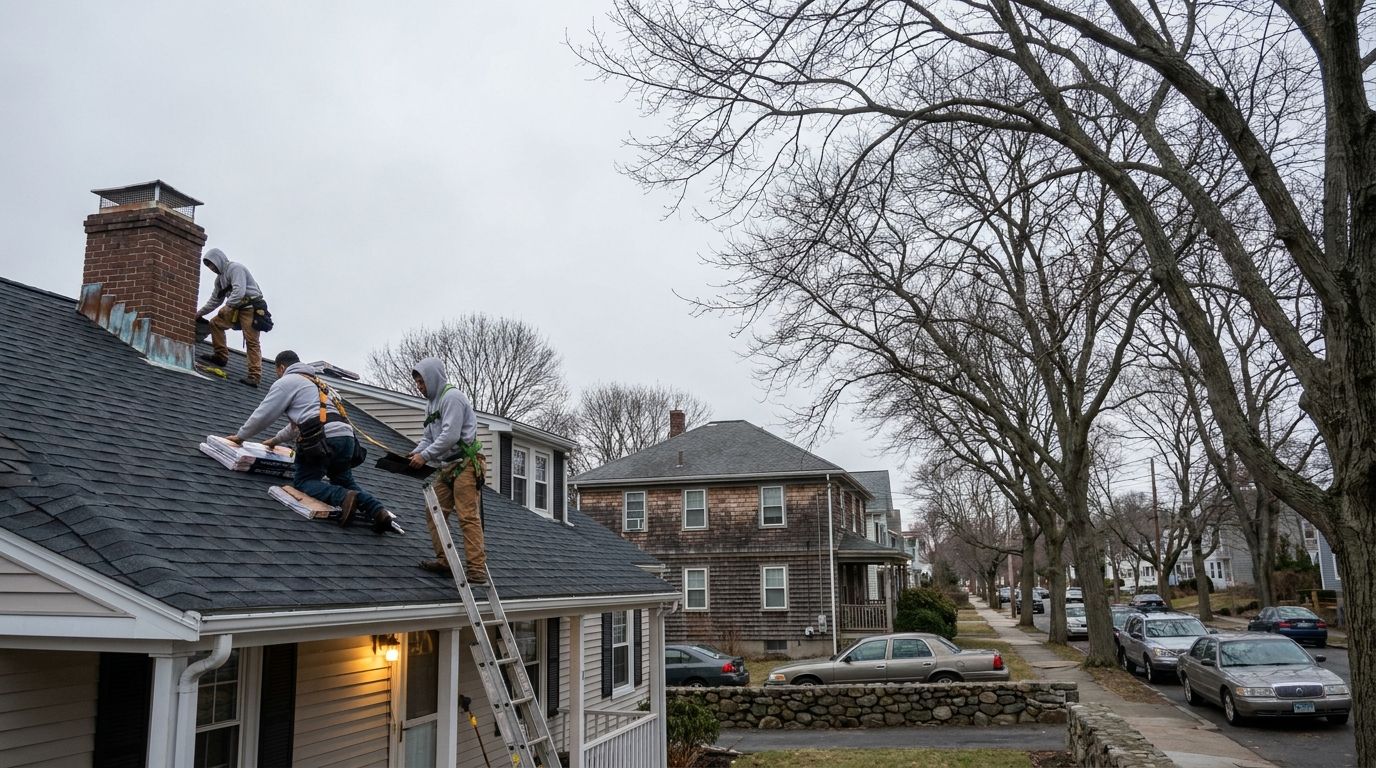
Medford has a wider spread of housing than any city we work in — dense two- and three-families near the Somerville line, big turn-of-the-century colonials in West Medford and the Lawrence Estates, post-war capes toward Wellington. Three different roofing problems inside one set of city limits. We do replacement, repair and siding across all of them, and the estimate looks different for each.
Ask each company what part of Medford your house is in and what that means for the job. If the answer is generic, the price is a guess. Call Thiago on (617) 721-1814 and describe the house — you’ll get a straight answer on whether it’s even a replacement conversation yet.
Three Medfords, three kinds of roof
Most cities in our service area have one dominant housing type. Medford has three, and knowing which you’re in tells you most of what you need to know about your estimate.
Medford Hillside and the Somerville line
Around Tufts and down through the streets that run into Somerville, the housing is dense two- and three-family — houses a dozen feet apart, many with no usable driveway, plenty converted to rentals. Here the roofing issues are access issues. Where the dumpster goes and how material gets up are settled before the shingle conversation starts, and on a three-story house that usually means staging rather than ladders.
They share the rear stack with Somerville too: pitched main roof, then a low-slope or flat section over the back porches or rear ell. Asphalt shingles don’t belong on a slope that shallow — that section needs a membrane, and the junction where pitched roof, flat roof and porch framing meet is where the leak starts. If a quote doesn’t separate the two roof types, it isn’t finished.
West Medford and the Lawrence Estates
Push north and west and the lots get bigger and the houses older and taller. Colonials, Victorians and larger single-families from the 1890s through the 1930s — steep pitches, third-floor attics, dormers, porch roofs, valleys running in several directions. On these the field is the cheap part; the labor lives in the flashing, valley metal and dormer detailing, which is exactly where a low bid finds its savings. A good number started life under slate, and some still have it.
Wellington, Glenwood and the post-war streets
South and east toward the Mystic and Wellington, and on the post-war infill streets, you get capes and ranches on simpler plans. Low, walkable, one or two roof planes, room in the driveway for a dumpster — the least expensive kind of roof to replace in Medford. The catch is underneath: original attic ventilation, low pitch, and a house now on its second or third roof. The deck matters more than the shingles.
The slate question — the decision that costs the most to get wrong
If your Medford house was built before about 1930, there’s a real chance it was slated originally. Some owners still have the slate; plenty more are living under asphalt that replaced it decades ago.
Real slate can last a century, and a slate roof shedding a few pieces is usually a repair. We’ll say that out loud, because converting to asphalt is a one-way door. What we won’t do is pretend the conversion is a simple swap. Slate is heavy, and old spaced sheathing — boards laid with gaps for slate nails rather than as a continuous deck — often has to be sheathed over before anything modern goes on. That belongs in the written estimate up front, not as a surprise on day two.
Past conversions also leave old flashing behind. Done cheaply, the original copper or galvanized chimney and wall flashing was shingled around rather than replaced — decades older than the roof over it, and the reason a “new” roof leaks at the chimney. We check before pricing.
Tree canopy — why one side of your roof is worse than the other
Medford carries heavy mature tree canopy, and it does four things to a roof:
- Leaf load in valleys and gutters. Debris packs into valleys and eaves, water backs up behind it, and in January it freezes exactly where you least want it.
- Moss and algae on shaded north slopes. A slope that never gets direct sun stays damp for weeks. Moss holds moisture against the shingle and lifts the edges; algae streaking is cosmetic, moss isn’t.
- Uneven wear. We regularly see Medford roofs where the sunny side has ten years left and the shaded side is done. Same roof, same age.
- Limbs in a nor’easter. Branches come down here every few winters, and the damage is usually punctures and broken shingles in one concentrated area — a repair, not a replacement.
Along the Mystic River and up toward the Mystic Lakes it flips. Open exposure means those houses take wind the sheltered inland streets don’t, showing up first as lifted tabs and ridge cap damage after a storm.
What each job looks like here
| Where in Medford | What drives the job |
|---|---|
| Hillside / near the Somerville line | Height, staging, dumpster placement, no driveway — plus a low-slope rear section needing membrane, not shingles |
| West Medford / Lawrence Estates | Steep pitch, dormers and valleys, possible slate history, old flashing left in from a past conversion |
| Wellington / post-war streets | Simple walkable roof, low price per square — ventilation and decking condition are the real questions |
| Anywhere under heavy canopy | Shaded slope wearing faster than the sunny side; drainage as much as roofing |
Replacement. Full tear-off to bare deck, soft decking replaced, ice & water shield at the eaves and valleys, synthetic underlayment, new drip edge and flashing, architectural asphalt shingles, balanced ridge-and-soffit ventilation. More on our Medford roof replacement page.
Repair. A chimney flashing leak, a limb strike, ice dam damage at one eave, lifted shingles after a nor’easter — those are repairs and we price them as repairs. Ice dams are a ventilation and insulation problem far more often than a roof defect, especially on the older, less-ventilated Medford stock; here’s why.
Siding. Vinyl and fiber cement. On the two- and three-families that means working around porch stacks and tight setbacks; on the older colonials it often means dealing with original wood clapboard underneath.
Medford roofing questions
I still have slate. Should I convert to asphalt?
Not automatically. Slate in decent condition with a handful of slipped pieces is a repair, and it will outlive any asphalt roof you put in its place. Convert when the slate is failing across the whole roof, when the flashing and valleys are gone, or when ongoing slate work stops making sense for how long you plan to stay. Budget honestly: conversion means removing heavy material and often sheathing over old spaced boards first.
There’s moss on the shaded side of my roof. Does that mean I need a new roof?
Usually not by itself. Moss on a north slope under Medford’s canopy is common, and caught early it’s a cleaning and trimming job, not a roofing job. What matters is underneath — if the shingle edges are lifting or the granules are gone there, the shaded slope may be worn out while the sunny side has years left. Sometimes nothing needs doing yet. Our New England roof lifespan guide covers what to expect.
My house is a tenanted two-family near Tufts with no driveway. Is that a problem?
It’s a logistics question, not an obstacle. Dumpster placement, street occupancy and staging get sorted before the start date, and they’re in the written estimate rather than added later. We schedule around tenants and clean the site daily. It does affect the price — a three-story house with no off-street space takes more setting up than a Wellington ranch — and we’d rather show you that line than bury it.
How much does a roof replacement cost in Medford?
There’s no single number, and anyone who gives you one over the phone is guessing. What moves it here: size and pitch, stories and staging, how many old layers come off, decking condition, roofline complexity, any low-slope section, and whether ventilation needs correcting. Our Massachusetts cost guide gives real ranges with the drivers explained.