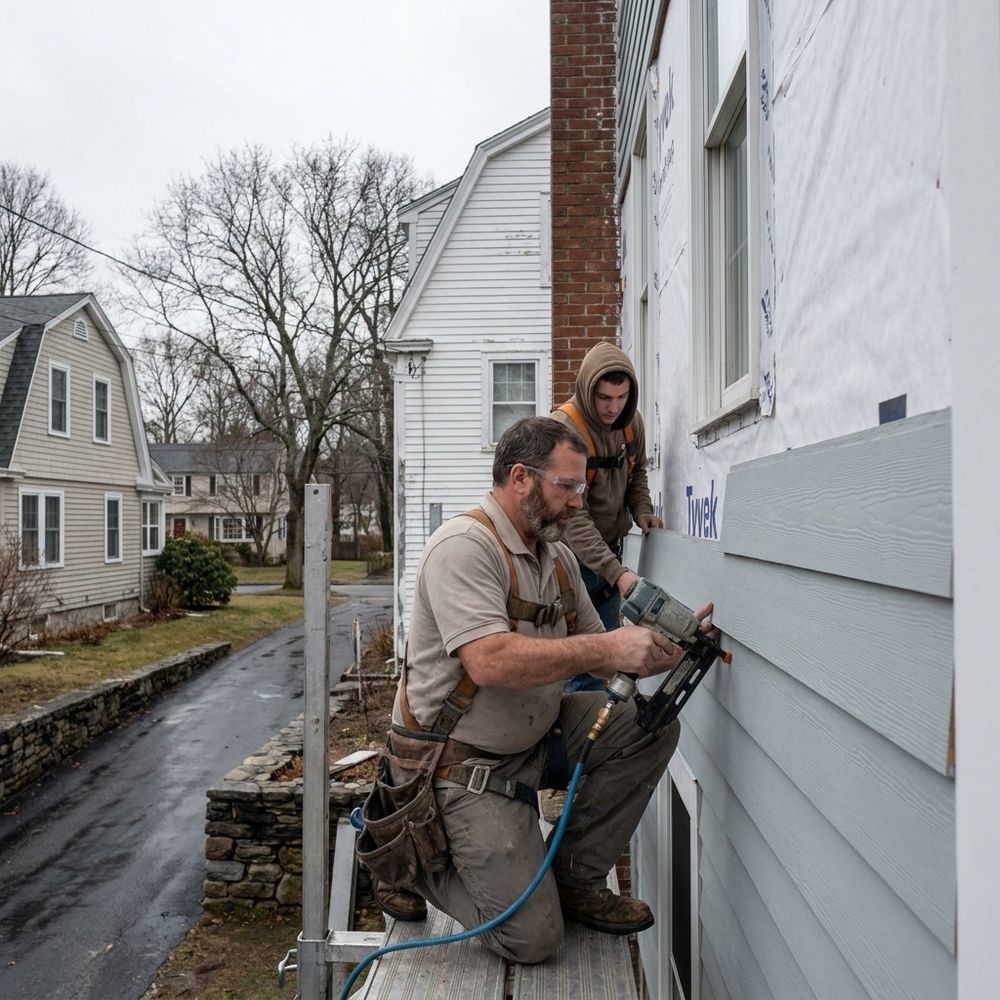
Fiber cement siding runs roughly $9 to $26 per square foot installed around Boston, and it’s the toughest cladding we hang on a New England house — non-combustible, dimensionally stable in deep cold, and good for 30 to 50 years. It’s also heavy, slow to cut, and unforgiving of a sloppy installer. Here’s what you’re actually buying.
This page is fiber cement specifically. If you’re still weighing it against vinyl, start with the siding replacement overview or the head-to-head in our siding options compared guide. We install both and we don’t have a favorite.
What fiber cement actually is
Portland cement, sand and cellulose fiber, pressed and cured into a board. No vinyl, no wood, no foam. The cement gives it hardness and fire resistance; the cellulose fiber keeps it from being as brittle as a plain cement board. Three things follow from that recipe:
- It’s dimensionally stable. A board installed on a 15°F January morning is essentially the same length in August — which is why courses stay straight and butt joints stay tight.
- It’s non-combustible. It won’t ignite and it won’t melt — which matters on the tight lots around here where houses sit twelve feet apart.
- It’s heavy. Two to three times the weight of vinyl for the same wall. That one fact drives the labor cost and half the installation rules below.
Why it suits a Massachusetts wall
Fiber cement lines up unusually well with what a house here goes through between November and April.
- It doesn’t get brittle in the cold. Vinyl stiffens as the temperature drops, and a shovel handle or ice off the roof can crack a panel in February. Fiber cement is the same hardness at 5°F as at 85°F.
- It takes an impact. Sliding snow, ice off a gutter line, a branch down in a nor’easter — the board dents about as readily as masonry does.
- It handles freeze-thaw. Cured board under a sound paint film doesn’t absorb enough water to spall through repeated freeze cycles — a real failure mode for older wood-composite sidings here.
- It holds paint for a long time. A stable substrate means the paint film isn’t stretched and compressed twice a day, so repaint intervals stretch to a decade or more.
- It won’t melt. A grill too close to the wall, a neighbor’s heat source, sun bouncing off a low-E window next door — all of these deform vinyl. None touch fiber cement.
Realistic service life here: 30 to 50 years, assuming the paint gets maintained and the water management behind it was done right. The board outlasts the paint by a wide margin.
The installation is the product
Two houses can get identical siding and end up with a 40-year wall or a 12-year wall. With fiber cement the difference is almost entirely in handling — and that’s where the price goes.
Two people per plank
A 12-foot plank is heavy and doesn’t flex to help you. It gets carried, set and fastened by two people or it ends up bowed, cracked at the fastener, or dropped.
Cut with dust control, always
Cutting this material releases crystalline silica dust — a genuine respiratory hazard, not a formality. Proper work means shears or a dust-collecting saw with a vacuum attached, cutting outdoors and downwind, respirators on. A crew dry-cutting with an open circular saw and a cloud around their heads is a crew that skips things.
Fastening and blind-nailing
Fasteners land in a specific zone near the top of the board, driven snug but not countersunk. Overdriven nails crush the board and open a water path; underdriven ones hold the course off the wall. Blind-nailing — the next course covers the fasteners — is the clean way to hang lap siding, and it’s what we do unless wind or product conditions call for face-nailing.
Butt joints, gapping, and flashing
Every butt joint gets a flashing tab behind it, and boards get a small gap rather than being jammed tight against each other or into trim. Forced-tight boards telegraph a crack the first time anything moves. Joints get staggered so you don’t build a seam line up the wall.
Keep it off the ground
The rule broken most often, and the one that costs most later. The bottom course holds a clearance above grade, above any roof plane, and above hard surfaces where water sits or splashes. Board buried in mulch or standing in a puddle wicks water, and no paint film survives that. Same on site: planks stacked flat and covered, never leaned against the house in the rain.
Pre-finished or painted on site?
This choice moves your number meaningfully, with a real trade-off either way.
| Pre-finished (factory) | Field-painted | |
|---|---|---|
| Finish quality | Baked on under controlled conditions, all faces | Depends on prep, weather and the painter |
| Up-front cost | Higher — usually the top half of the range | Lower material cost, plus a separate paint bill |
| Repaint interval | Longest — often 15+ years before it’s a question | Shorter, and the first repaint comes sooner |
| Color flexibility | Fixed palette from the product line | Any color you want, changeable later |
| Weather dependence | Installs through cold months | Painting needs a temperature window; late-fall jobs may wait for spring |
Our read: if you know the color and you’re staying put, pre-finished lap siding is worth the premium. If you want an unusual color or you’re matching trim on a period house, field-painting earns its keep.
What it costs around Boston
Installed fiber cement in Massachusetts generally lands between $9 and $26 per square foot. Wide on purpose — anyone quoting a house they haven’t measured is guessing. Here’s what moves you inside it.
| Driver | Effect on the number |
|---|---|
| Product line and thickness | Entry lap siding to premium profiles — a large share of the spread |
| Pre-finished vs. field-painted | Factory finish costs more up front and buys years of repaint interval |
| Trim detail | Corner boards, casings, frieze, rake and water table. On this material, trim is a big labor line |
| Sheathing condition | Unknown until the old siding is off. You hear the number the same hour we find it |
| Openings and flashing | Every window is a flashing detail; missing kickouts and head flashing get added |
The honest downsides
- It costs more. In product and in labor. If budget is the binding constraint, vinyl siding isn’t a consolation prize — it’s a good wall.
- It has to be repainted eventually. Long intervals, but not never. Budget a repaint cycle over the life of the wall.
- The weight is real. Slower work, more people, more staging — that’s the labor line on your estimate.
- Repairs are harder. You can’t pop out one board the way you swap a vinyl panel, and matching decade-old paint takes effort.
- It is not a DIY material. Between the weight, the silica dust and the fastening tolerances, this is the wrong material to learn on. We say that about very few things.
Fiber cement questions we get asked
How long does fiber cement siding last in Massachusetts?
Roughly 30 to 50 years for the board itself. The variable isn’t the material — it’s the paint film and the water management behind the wall. Keep it painted and keep the bottom course clear of grade and standing water, and you’ll replace it for style reasons, not failure.
Is fiber cement worth the extra cost over vinyl?
If you’re staying in the house, usually yes — a wall that doesn’t crack in the cold, doesn’t melt, takes a branch strike, and reads like painted clapboard from the sidewalk. Selling within about five years? The extra money is hard to get back and vinyl is the better call. Full comparison in our siding options guide.
Can it be installed in winter?
Generally yes — it doesn’t mind the cold the way vinyl does. The limit is painting. If you’ve chosen field-painted siding and we’re into late fall, we may hang it and come back in spring for paint, or recommend pre-finished so the finish isn’t weather-dependent.
How often will I have to repaint it?
Field-painted fiber cement typically wants attention around the 10-to-15-year mark; factory-finished goes longer. South and west elevations go first, so a partial repaint is often the right answer.
Is the dust from cutting it actually dangerous?
Yes. Cutting fiber cement releases crystalline silica, and repeated exposure is a documented respiratory hazard. A proper crew uses shears or a dust-collecting saw with vacuum, cuts outdoors and downwind, and wears respirators. How a crew handles dust tells you how they handle everything else.
Fiber cement siding across the north-of-Boston corridor
We install fiber cement on colonials, capes and two-families in Woburn, Medford, Somerville, Melrose, Boston, Stoneham, Wakefield, Burlington and Wilmington. Thiago measures the house himself and the estimate is free either way — including the version where the siding is fine and the water is coming from a roof-to-wall flashing detail that needs roof repair instead. Ask for an estimate or call (617) 721-1814.