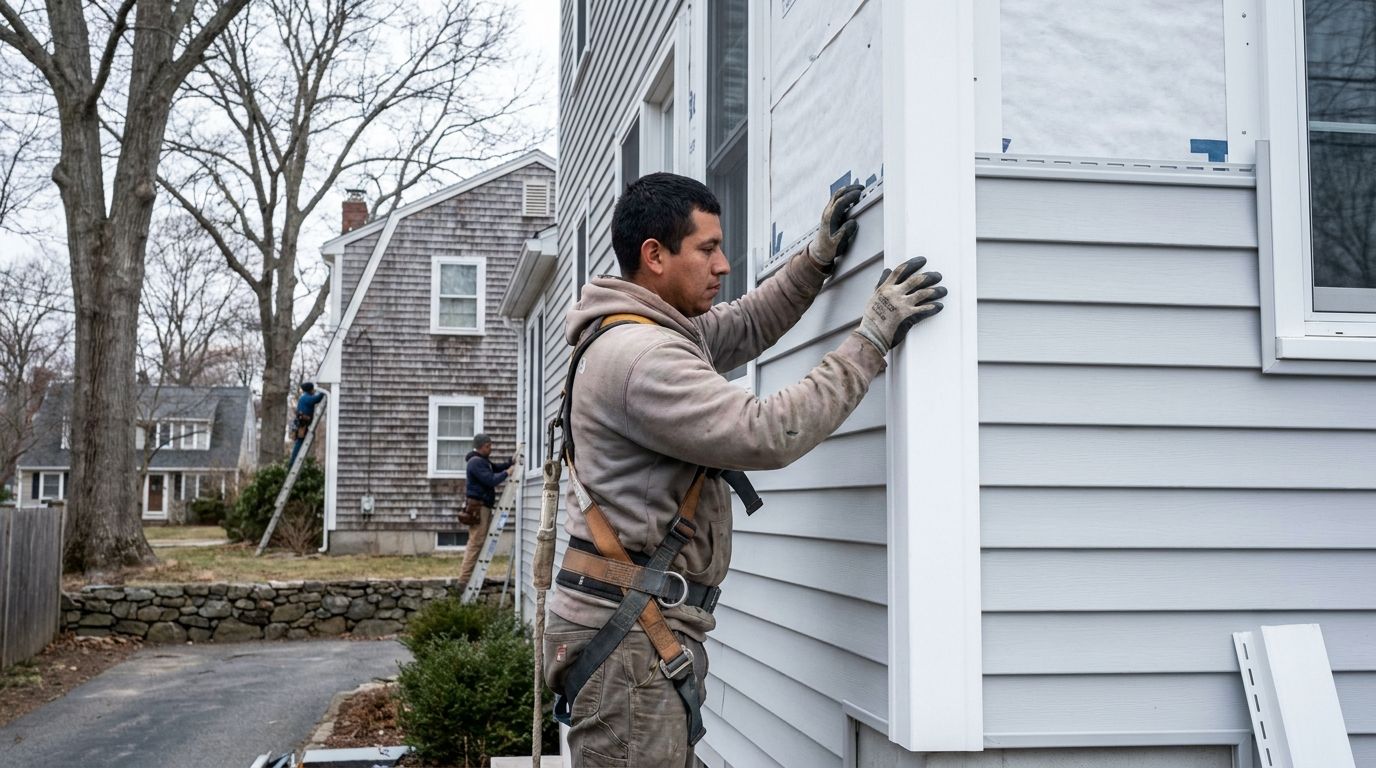
Vinyl siding installed in Massachusetts generally runs about $4 to $14 per square foot, with insulated profiles landing roughly $6 to $11 and builder-grade panels at the bottom of the band. It’s the lowest-maintenance wall you can put on a house here — and the one most often installed wrong, because vinyl has to be hung, not nailed. For the vinyl-versus-fiber-cement decision itself, start at our siding replacement page.
Vinyl grows and shrinks between a February morning at 5°F and an August wall in full sun — a twelve-foot panel can move most of a half inch. So every panel is designed to float: nails go in the center of the slot, driven straight, backed off about a nickel’s thickness so the panel slides under the head. Nail it tight and the wall buckles in July and cracks in January. Costs nothing to do right, and it’s the most common defect we find on vinyl less than fifteen years old.
What vinyl siding costs around Boston
Nobody can price a house they haven’t measured, so here’s the honest range. Standard vinyl generally lands around $4 to $9 per square foot installed; insulated vinyl about $6 to $11. The band tops out near $14 with heavy trim detail, staging, or a premium profile on a three-story two-family.
| What drives the number | Effect on price |
|---|---|
| Panel grade and thickness | The biggest lever. Thin builder panels versus a heavy insulated profile is most of the spread. |
| Insulated vs. standard | Adds roughly $2–$4 per square foot for the foam-backed version. |
| Sheathing repair | Unknown until the siding is off. Time and materials, priced the day we find it. |
| Trim package | Corner posts, J-channel, casings, frieze, rake, soffit. Wrapping trim in aluminum coil adds labor. |
| Openings, height and access | Every window is a flashing detail and a set of cuts; staging a third story slows everything down. |
| Flashing corrections | Adding head flashing and kickouts that were never there. Small line, enormous consequence. |
Partial work is legitimate. If the north and west elevations took thirty years of weather and the other two are sound, we’ll quote what the house needs — the same reasoning behind repairing a roof instead of replacing it.
Insulated vinyl vs. standard vinyl
Insulated vinyl is ordinary vinyl with contoured rigid foam bonded to the back, filling the panel’s profile. People buy it for the R-value and keep it for everything else it does.
- It stops the wave. Thin panels telegraph every dip in old sheathing and ripple in raking light. The foam backing keeps the panel flat and the shadow line straight. This is the real reason to buy it.
- It takes a hit better. Solid backing means a ladder or a stray branch dents rather than punches through. Hollow vinyl in deep cold is genuinely fragile.
- Modest R-value. Roughly R-2 to R-3 added over the wall. Real, worth having on a drafty 1950s cape, but it won’t replace what’s missing in your attic.
If someone tells you insulated vinyl will transform your heating bill, walk away. On most houses in Medford or Stoneham, air sealing and attic insulation return far more per dollar. Buy it because it looks better and takes a hit better. The R-value is a bonus.
What a good vinyl installation actually looks like
Vinyl is easy to install badly and unforgiving about it later. Here’s what we do on the wall, and what you can check on any quote you’re comparing.
Panels hung, never nailed tight
Nails centered in the slots, driven perpendicular, left about a nickel’s thickness proud so the panel slides freely. Never face-nailed. Fasteners into solid sheathing every 16 inches or so, butt joints staggered course to course. At the ends, panels are cut short of the receiving channel — more gap in winter, less in summer — so there’s room to grow.
The layers behind it
Siding is a rain screen, not a seal. Wind-driven rain gets behind lap siding; the assembly’s job is to drain it back out before it reaches wood.
- Sheathing inspected and repaired. Old siding comes off so we can see the wall. Soft or black sheathing gets replaced, not covered.
- House wrap lapped shingle-style. Upper courses over lower, seams taped, integrated with the window flashing rather than run past it. Reverse a lap and the wrap becomes a funnel pointed at your framing.
- Flashing at window and door heads. Metal head flashing above the opening, behind the wrap. Caulk is not flashing — it’s a five-year product on a fifty-year detail.
- Kickout flashing where a roof edge meets a wall. A porch roof, an ell, a dormer cheek: step flashing up the wall and a kickout at the eave end to throw water into the gutter. Missing kickouts rot more walls here than any other single detail.
- Trim first, then siding. Corner posts, J-channel at openings, starter strip snapped level — if the starter strip is off, every course above it is off.
Because we do roofs as well as walls, the roof-to-wall work inside a siding job isn’t two trades pointing at each other. If the flashing above needs attention, that’s roof repair by the same person re-siding you.
Where vinyl gives up
We install a lot of vinyl and we won’t oversell it. Here’s what it does badly. If these matter to you, read up on fiber cement siding or the full siding options comparison.
| Limitation | What it means on a Massachusetts house |
|---|---|
| Brittle in deep cold | Below about 20°F, an impact that would dent aluminum cracks vinyl — ice sliding off a roof, a shovel, a branch in a January wind. |
| Fades on high-sun walls | South and west elevations lighten over the years; deep colors show it most. A replacement panel in year 18 won’t match. |
| Can’t be repainted | The color you choose is the color you own. Painting vinyl rarely holds and voids most warranties. |
| Low grades wave | Thin panels over uneven sheathing ripple visibly in low sun. This is a material choice, not bad luck. |
The upside: when a panel does crack, a matched replacement is a cheap, fast fix — a real advantage fiber cement doesn’t have.
How long vinyl siding lasts here
Expect roughly 20 to 30 years here before the wall reads tired — longer on a heavier insulated profile, shorter on a fully exposed south wall. What ends it is usually appearance, not function: fading, chalking, a scattering of cracked panels nobody kept spares for.
What kills a wall early is almost never the vinyl. It’s water that got in somewhere else first — an unflashed window head, a missing kickout, a gutter that’s overflowed every storm for six winters. New siding over an unfixed water path is expensive wallpaper. If the source is up top, we’ll say so instead of selling you siding.
Vinyl siding questions we get
How can I tell if my vinyl was nailed too tight?
Grab a panel mid-run and try to slide it sideways an eighth of an inch. It should move. Locked solid means it was nailed tight. The visual tells: a wall that ripples in low afternoon sun, panels bowed between studs on hot days, cracks radiating from nail holes. Under fifteen years old, that’s workmanship, not the material.
Is insulated vinyl worth the extra cost?
Usually yes, but for the right reason. It runs roughly $2 to $4 more per square foot. The R-value gain is modest — buy it because the rigid backing keeps the wall flat and survives impact. On an old cape with wavy sheathing it’s the difference between a wall that looks new and one that looks wrapped.
Can vinyl siding be installed in the winter?
Yes, with care. Cold vinyl is brittle, so handling and cutting slow down, and expansion gaps have to be set for a panel that’s already contracted — get that wrong in February and the wall buckles in July. We’ll say honestly when waiting for spring is the better call.
Can a cracked panel be replaced without redoing the wall?
Yes — one of vinyl’s genuine strengths. A zip tool unlocks the course above, the damaged panel slides out, a new one goes in. The catch is color: faded siding won’t match a fresh panel, so keep a few spares from the original job in the basement.
Do you ever install vinyl over the old siding?
No. Nobody ever sees the sheathing, there’s no drainage plane, and existing rot keeps going in the dark. Tear-off is the only version we’ll put our name on — more on that on the siding replacement page.
Vinyl siding across the north-of-Boston corridor
We install vinyl siding in Woburn, Medford, Stoneham, Somerville, Boston and the rest of the northern suburbs. Thiago walks the property himself and looks at the roof and the flashing before quoting the walls. Ask for a free estimate or call (617) 721-1814 — straight answer either way.