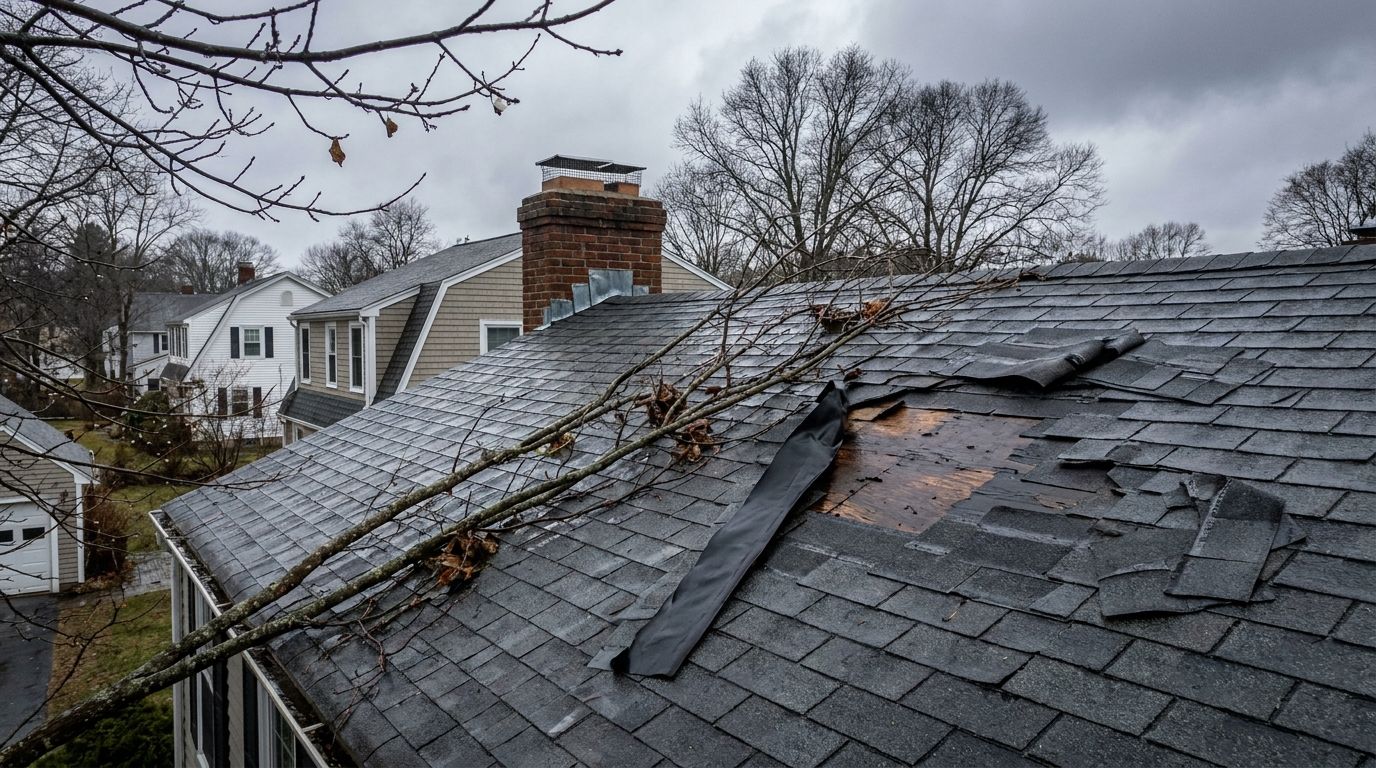
A nor’easter comes through, and the next morning there are shingle pieces in the yard and a stain on the bedroom ceiling. Storm damage repair means finding every place the wind actually got in, making the roof watertight, and writing down honestly what happened up there. We are roofers, not public adjusters, and we will not tell your insurer that a worn-out roof was hit by a storm.
Call (617) 721-1814. We stabilize first and sort out paperwork afterwards. See emergency roof leak repair for what to do in the meantime.
What storm damage actually looks like
Most wind damage does not look like a hole in the roof. It looks like nothing much from the driveway, which is why it gets missed until February.
- Missing shingles. A bare rectangle of black underlayment or gray decking where a tab used to be — usually along a rake edge, a ridge, or the windward slope.
- Lifted or creased tabs. The shingle is still there, but wind bent it back and it settled again with a horizontal crease across the face. The damage homeowners underestimate most.
- Granule loss. The grit protecting the asphalt mat from UV gets scoured off. It shows as dark, shiny bare patches on the roof face, and as coarse sand piled at the splash block under your downspout.
- Bent, torn or displaced flashing. Step flashing pulled off a wall, counterflashing lifted out of its mortar joint, buckled valley metal, a torn pipe boot. Most storm leaks start here, and none of it is visible from the ground.
- Damaged ridge caps. The capping along the ridge and hips takes the worst of a crosswind. It breaks, slides or lifts, exposing the ridge vent underneath.
- Tree limb strikes. A limb does not have to come through the roof. A branch dragging across a slope scrapes granules off in a stripe and fractures shingles that look intact.
- Punctures. Small, sharp, usually from wind-thrown debris. Easy to miss, and they put water straight through to the underlayment.
Why a creased shingle matters even when nothing is missing
An asphalt shingle is not just nailed down. It has a factory adhesive strip that the sun bonds to the tab above it, and that seal is what holds a roof together in high wind. When a gust folds a tab backwards, the seal breaks. The tab flops back and looks fine.
It is not fine. That shingle is held on by nails alone now, with a fold line that will crack open as the asphalt flexes through a freeze-thaw cycle. The next windy storm takes it off, and its neighbors with it, because their seal is exposed on one edge too. That is how a roof survives one nor’easter perfectly and loses a whole section in a milder storm six weeks later.
Creasing is genuine, insurable, storm-caused damage. It is also what a drive-by never finds, which is why we get on the roof and look at tabs individually.
What to do first, in order
- Photograph everything from the ground. Wide shots of each elevation, close-ups of anything wrong, debris in the yard, granules at the downspout. Dated phone photos are exactly what an insurer wants and cost nothing.
- Photograph the inside. Ceiling stains, wet drywall, bubbled paint, damp carpet — before you clean up, and again if it spreads.
- Check the attic with a flashlight. Look at the underside of the deck for damp patches, dark streaks or daylight. Daytime, attic light off. The most useful five minutes you can spend.
- Contain the damage inside. Move furniture, put down a bucket and a tarp. Contain it, do not repair it yet.
- Open a claim if the damage is real. Opening one is not the same as committing to it. Get the claim number and the adjuster’s contact.
- Do not climb the roof. A wet, storm-loosened asphalt roof is genuinely dangerous, and homeowners get badly hurt every year going up to look. Nothing is up there we cannot see for you — and a tarp nailed through good shingles turns a small repair into a much larger one.
What we do when we get there
- A full assessment, including the attic. Every slope, every flashing detail, the ridge and hips — then inside, to trace where water actually entered, frequently several feet uphill from the ceiling stain. See what a roof inspection covers.
- Photographs and a written report. What we found, where, and what it takes to put right. Plain language, with pictures, and it is yours — hand it to your insurer or to another contractor for comparison.
- Watertight stabilization. If the roof is open, it is dry before we leave — a proper temporary cover, or an immediate shingle and flashing repair.
- The honest repair-or-replace call. Most storm damage is a repair — eight shingles and a length of step flashing. It becomes a replacement question when the damage is spread across several slopes, or when the storm finished off a roof already at the end of its life. We do both repairs and replacements, so nothing pushes us either way. Here is how we make that call.
Insurance, handled honestly
Usually covered: sudden, identifiable damage from a specific event. Wind tearing shingles off, a limb coming down on the slope, flashing torn loose in a named storm. If you can point to a date and a weather event, you are usually in covered territory.
Usually not: age, ordinary wear, curling and granule loss from twenty-two years of sun, deferred maintenance, leaks that have clearly run for several winters. Insurers are good at telling the difference. So are we.
| What we do | What we do not do |
|---|---|
| Inspect the roof and the attic and document what we find | Negotiate or “handle” your claim for you |
| Hand you a written, photographed assessment for your adjuster | Act as a public adjuster — a licensed role we do not hold |
| Be on site when the adjuster comes and answer roofing questions | Tell you what to say to your insurer |
| Tell you honestly when damage is wear rather than storm | Describe a worn-out roof as storm damage so a claim goes through |
| Quote the repair the same way whether it is insured or not | Offer to “cover your deductible” or pad a scope to absorb it |
If a roofer offers to write up an old, worn-out roof as storm damage, be clear about what is being proposed: insurance fraud, submitted under your name and your signature. The contractor gets paid and drives away. You signed it. Be wary of anybody who raises it, and take it as a straight answer about how they do business.
For the wider picture on what policies pay for, read does homeowners insurance cover a roof replacement.
We are not a storm-chaser
After every significant nor’easter, out-of-state crews arrive in the northern suburbs and start knocking on doors. The pitch is always the same: they spotted damage from the street, they will inspect free right now, they will handle the whole insurance process, and you should sign today because they are only in the area this week.
We do not work that way. No door-knocking after storms. No “storm response” urgency campaigns. No offering to handle your insurance company, because that is not a roofer’s job. And no answer needed today — a stabilized roof will wait while you get a second opinion, and we would rather you got one. DeSouza Roofing has worked these streets for ten years, Thiago is the person on your roof, and we will still be here next winter. That is a different set of incentives from a crew that leaves the state when the claims dry up.
Storm damage questions we get asked
How soon after a storm should I have the roof looked at?
If water is coming in, immediately. If nothing is leaking but you saw shingles in the yard or your neighbors had damage, within a couple of weeks is sensible — broken seal strips worsen with every subsequent wind, and most policies expect damage reported promptly. No need to panic, but a good reason not to leave it until spring.
My roof looks fine from the ground. Could it still be damaged?
Yes, and that is the normal case rather than the exception. Creased shingles, broken seal strips, lifted step flashing and scoured granules are all invisible from a driveway. Two things you can check yourself: the attic, with a flashlight, for damp or daylight, and the splash block under your downspout for granules. Past that it needs someone on the roof. Here is the full checklist.
Will you deal with my insurance company for me?
No, and be careful of anyone who says they will. We are roofers, not public adjusters, and representing you in a claim is a licensed role we do not hold. What we do instead is genuinely useful: a full inspection, photographs, and a written assessment of what we found and what the repair involves. That document is yours. We are happy to be on the roof when the adjuster comes out, answering technical questions.
What if the storm damage is on a roof that was already old?
Then we will tell you, because your insurer will work it out anyway. A twenty-four-year-old roof with curling shingles that loses a few tabs in a nor’easter is usually a wear claim, not a storm claim. That is not necessarily bad news — it means the conversation is about planning a replacement on your terms instead of filing a claim that gets denied. What we will not do is dress it up as storm damage.
Storm damage repair across the north-of-Boston corridor
Nor’easters do not hit evenly. Exposure, tree cover and roof orientation matter more than the town line — a west-facing slope on an open lot in Wilmington takes a different beating from a sheltered three-decker in Somerville. We handle storm damage in Boston, Medford, Melrose, Stoneham, Woburn, Wakefield and Burlington too.
Call (617) 721-1814 and you get Thiago, not a dispatcher. Free assessment, written report, and a straight answer either way.