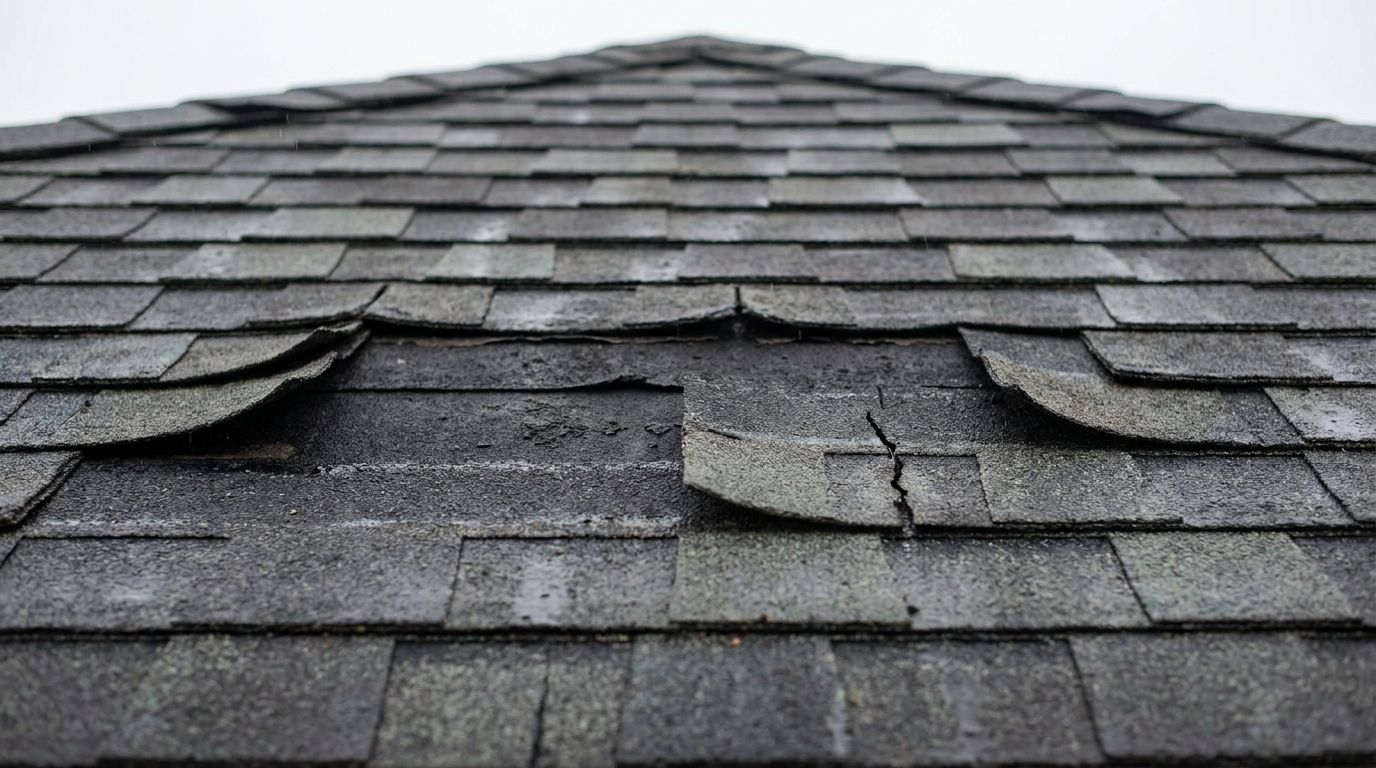
The signs are curling or cracked shingles, bald patches where the granules have worn off, grit piling up at the downspouts, missing tabs after wind, failed flashing, and — the serious one — a sagging roof line. Inside, it’s daylight or damp sheathing in the attic and ceiling stains that come back after rain.
Here’s the checklist we actually run — what you can see from the ground, and what only the attic will tell you. Twenty minutes, a flashlight and a phone. Then take what you found to the repair-or-replace decision guide for the verdict.
Every outside item below is visible from the ground with binoculars or a zoomed phone camera. Ladders hurt more homeowners every year than leaks do. Can’t see it from down there? Call (617) 721-1814 and we’ll look — free, straight answer either way.
From the ground: ten things to look for
Walk the driveway, the back and both sides. Judge each plane separately — a south slope can be finished while the north has years left.
- Curling, cupping or clawing edges. Corners lifting, the middle rising, or the center pinned while the edges flare. All three mean the mat has dried out, usually because the attic runs hot.
- Cracked or split shingles. Fine crazing or clean splits across the tab face. Our freeze-thaw swings are hard on an aging mat.
- Bald patches. Dark, shiny areas where the granules are gone and the black asphalt mat shows. That grit is the shingle’s sunscreen — once it’s off, UV finishes the spot fast.
- Granules in the gutters and at the downspouts. On a roof installed last year, loose grit washing off is normal. On a twenty-year-old roof, an annual pile you could scoop by the handful is wear.
- Missing shingles, or tabs lifted and flapping. Check wind-exposed corners and the ridge after a nor’easter. Tabs that lift in a breeze have lost their sealant strip and won’t re-bond.
- Dark streaking. Almost always algae. Cosmetic, doesn’t shorten the roof’s life, and not a reason to replace. This one gets oversold constantly.
- Moss. Different story. Moss holds water against the shingle and works under the edges, and favors shaded north slopes. A genuine concern, unlike algae.
- A sagging or wavy roof line. Sight along the ridge against the sky. A dip, bow or ripple is structural — rafters or sheathing, not surface. The one that needs prompt attention.
- Rusted, lifted or missing flashing. The chimney, the walls where a dormer meets the roof, every vent. Flashing is where most leaks we trace start, and it fails long before the field does.
- Damaged or overflowing gutters. Sagging, pulling away, or spilling over the front edge in a downpour. Water that can’t leave the roof backs up under the shingles.
From the attic: the half nobody checks
Go up on a bright day and leave the flashlight off at first so your eyes adjust.
- Daylight through the roof boards. Pinpoints around nail shanks are usually nothing. Gaps at the sheathing joints, or light where a fastener tore through, means water has a path.
- Stains or dark streaking under the sheathing. Map it. Under a valley or beside the chimney points at flashing. Spread across a whole plane points at the field, or at condensation.
- Damp, matted or discolored insulation. Wet insulation stops insulating, and makes everything above it worse. Feel it, don’t just look.
- Delaminated or soft sheathing. Plywood separating into plies, or decking that gives under a press. That section gets replaced either way.
- Dried marks from past leaks. Rings and tide lines with clean wood inside. Something leaked once; whether it still leaks is the next question.
Inside the house
- Ceiling stains that come back after rain. A stain that reappears is active. One that hasn’t grown in two years was probably fixed.
- Peeling paint near the roof line or at the top of walls — moisture is getting into the wall from above.
- Heating and cooling bills climbing with no rate change. That points at attic ventilation and insulation, the same problem behind ice dams on Boston roofs.
How many signs mean replacement?
Not the count — the spread. One or two signs you can draw a circle around is a repair. Signs across multiple planes, or in several categories at once, is a replacement.
| What your list looks like | Where it usually lands |
|---|---|
| One or two signs, one spot, attic dry | Repair. Fix the failed part and move on. |
| Several outside signs, all on one slope | Repair or partial work — inspect first. |
| Signs on multiple planes, plus anything in the attic | Replacement. The surface has stopped shedding water. |
| Any sag, dip or soft decking | Its own category. Get eyes on it promptly. |
Algae streaking on a flat, granule-covered roof is cosmetic. A couple of missing tabs on one exposed corner after a nor’easter is normal even on a young roof — that’s a repair. Granules in a first-year roof’s gutters are manufacturing excess.
Age is context, not a verdict — see how long a roof lasts in New England. If your list is long, a roof inspection covers roof, attic, flashing and ventilation, in writing.
Common questions
Do black streaks on my roof mean it needs replacing?
No. Dark streaks are almost always algae feeding on filler in the shingle. Cosmetic, no effect on how the roof sheds water, and one of the most oversold “problems” in this trade. If the shingles under them are flat and holding granules, that roof is fine.
How much granule loss is too much?
Judge it by the roof’s age. The first season after installation, loose grit in the gutters is expected. A mature roof leaving a layer at the downspout base every year, with bald patches above, is at the end of its life. Granules plus curling on the same plane is a clear replacement signal.
Should I get on the roof to check it myself?
Please don’t. Everything on the outside list is visible from the ground or an upstairs window with a zoomed camera. Walking an aged asphalt roof breaks shingles that were still doing their job — and then you’re pricing a replacement you didn’t need.