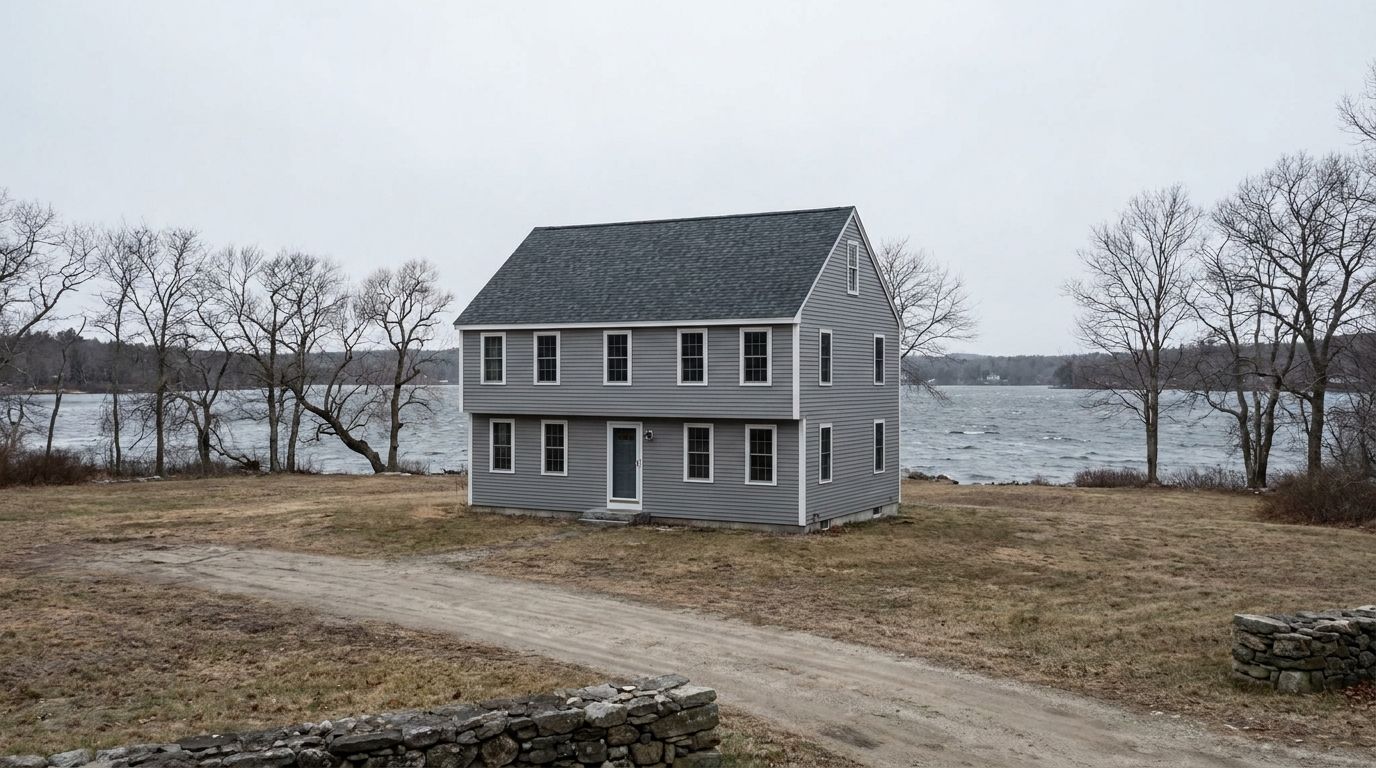
Wakefield is two different roofing towns wearing one name. Houses with open frontage on Lake Quannapowitt or Crystal Lake take wind loading that streets three blocks inland never see, while the wooded parts of town behave like anywhere else in the northern suburbs. We do replacement, repair and siding across both — and the right roof isn’t the same roof.
Before you compare three quotes, find out whether any of them looked at your exposure. On an open lot the nailing pattern and the shingle’s wind rating decide how the roof does in its first real nor’easter. On a sheltered lot they barely come up. Call Thiago on (617) 721-1814 and tell us where the house sits.
Exposure is the thing that splits this town
Wind needs a run at you, and open water gives it one. A house on the lake side of the street, with nothing upwind but the water, is loaded differently than an identical house behind two rows of houses and a stand of trees. That’s why we get called to one street after a storm and not the next one over. The failures on exposed Wakefield lots are consistent, and they’re all edge failures:
- Ridge caps go first. The ridge is the highest, most exposed line on the roof, and cap shingles are single tabs held by a few nails. Wind gets under the back edge and peels them off in a run.
- Rake edges lift. The rake is the sloped edge at the gable end. Wind coming across the gable pushes up under the starter course and takes the first shingles with it — which is why rake-edge starter and drip edge detailing matter more here than anywhere else we work.
- Field tabs let go where they were nailed high. Every shingle has a defined nailing zone. Nail above it and the nail holds nothing but the top of the shingle, with no seal below it. Inland, that mistake can sit there for a decade. On an exposed lot it shows up the first February.
- Wind-driven rain finds weak flashing. Rain moving sideways doesn’t obey the shingle’s shed direction. It goes up under courses and sideways into chimney and wall junctions that would never leak in a vertical downpour.
The plain version: on an exposed lot, the difference between a properly nailed roof and a quickly nailed one shows up in the first real nor’easter, not in year ten.
Wind rating and nailing — the two lines that actually matter
Architectural asphalt shingles carry a wind rating, and the rating is conditional. It assumes a specific nail count, nails driven in the correct zone, driven flush — not overdriven through the mat, not underdriven and standing proud — and it assumes the self-seal strip has had warm weather to bond. Miss any of those and the number on the wrapper means nothing.
So on an exposed Wakefield roof we use a six-nail pattern rather than the four-nail minimum, we hand-nail or run the guns at a pressure that seats without cutting, and we’re deliberate about starter courses at both the eave and the rake. It’s slower. It’s also the entire difference between a roof that shrugs off a January storm and one that sheds a dozen tabs.
Open exposure cuts both ways — sun as well as wind
The same lots that get the wind get the sun. No canopy means unshaded slopes bake through the summer, and UV plus heat is what drives asphalt shingles to lose flexibility and shed granules. A south or west slope on an open Wakefield lot ages measurably faster than the same slope under trees. Our New England lifespan guide goes through what actually moves that number.
Which sets up the honest trade: shade slows sun damage but holds moisture and grows moss, exposure dries the roof fast but works the edges harder. Neither is a better place to own a roof. They just fail differently, and they need different scopes.
The other Wakefield — wooded, sheltered, conventional
Away from the water, most of the town is ordinary suburban cover: mature street trees, houses screened from each other, wind broken up long before it reaches the roof. Those roofs behave like Stoneham roofs — debris in the valleys, gutters that stop draining in November, moss on the north slope, slow drying after a wet snow. If that’s your house, exposure isn’t your problem and we won’t sell you a scope built around it.
Housing stock and access
There’s a good stock of older colonials and Victorians near the common and around the lake — steep pitches, dormers, porch roofs, the kind of detail that puts Wakefield closer to Melrose on labor. Everywhere else runs to post-war capes, ranches and colonials: simpler planes, walkable pitch, far less flashing.
Access is generally good. Most houses have a driveway and enough lot to stage on, so there’s no street-occupancy negotiation and the dumpster goes where it belongs. That’s real money saved against a job in Somerville or Boston, and it should be visible in what you’re quoted.
| Where the house sits | What the roof needs |
|---|---|
| Open frontage near Quannapowitt or Crystal Lake | Six-nail pattern, high wind-rated shingle, starter at eaves and rakes, extra care at ridge caps, ice & water shield and flashing detailed for sideways rain |
| Wooded, sheltered streets | Valley and gutter drainage, moss on shaded slopes, eave detailing for ice dams — the standard northern-suburbs scope |
| Older colonial or Victorian near the common | Flashing count and steep-pitch staging drive the price more than square footage does |
Replacement, repair and siding in Wakefield
Replacement. Full tear-off to bare deck, soft decking replaced and shown to you, ice & water shield at the eaves and valleys, synthetic underlayment, new drip edge, all new flashing, architectural asphalt shingles and balanced ridge-and-soffit ventilation. On an exposed lot the nailing pattern and edge detailing get spelled out in the scope. Size, pitch, layers coming off, decking and ventilation drive the range — our Massachusetts cost guide gives real numbers.
Repair. Lifted tabs and missing ridge caps after a storm are the signature Wakefield call, and they’re repairs — one plane or one ridge line, not a roof. We handle it as storm damage repair and separate what the wind took from what was already worn out. Anyone who won’t draw that line is selling.
Siding. Vinyl and fiber cement. Exposed elevations take weather harder here too — the lake-facing wall gets driven rain, sun and wind on the same side, and that’s the elevation where you’ll see chalking, loose courses and failed caulk joints years before the sheltered sides.
Wakefield roofing questions
My house faces the lake. Do I need a higher wind-rated shingle?
It’s worth it, but the rating alone won’t save you. A wind rating is earned by the installation — correct nail count, nails in the nailing zone, driven flush, starter courses at the rake as well as the eave, and time for the seal strip to bond. A high-rated shingle nailed carelessly performs worse than a standard one nailed right. On an open lot we’d do both.
I lost shingles in a storm and my neighbor didn’t. Is my roof bad?
Not necessarily — start with exposure. If your lot is open and theirs is screened, you took a different load off the same storm. But it’s also the classic sign of a high-nailed or under-nailed roof, so it’s worth finding out which. We’ll get up there, photograph the nail line on a lifted shingle, and tell you whether you’re looking at a repair or an installation problem.
Water came in during a storm but the roof looks fine from the ground. How?
Wind-driven rain. Sideways water gets under shingle courses and into flashing joints that never leak in a normal downpour — chimney counterflashing, a roof-to-wall junction, a skylight curb, a rake edge. It’s a flashing diagnosis, not a shingle one, and it’s usually a targeted repair.
Should I replace the ridge caps on their own?
Often yes. If the field of the roof still has life and only the caps blew off, replacing the ridge — and adding proper ridge vent while we’re there, if the attic needs it — is a fraction of a replacement. If the field shingles are curling and losing granules too, we’ll tell you that instead. Either way you’ll get photos and the real choice.