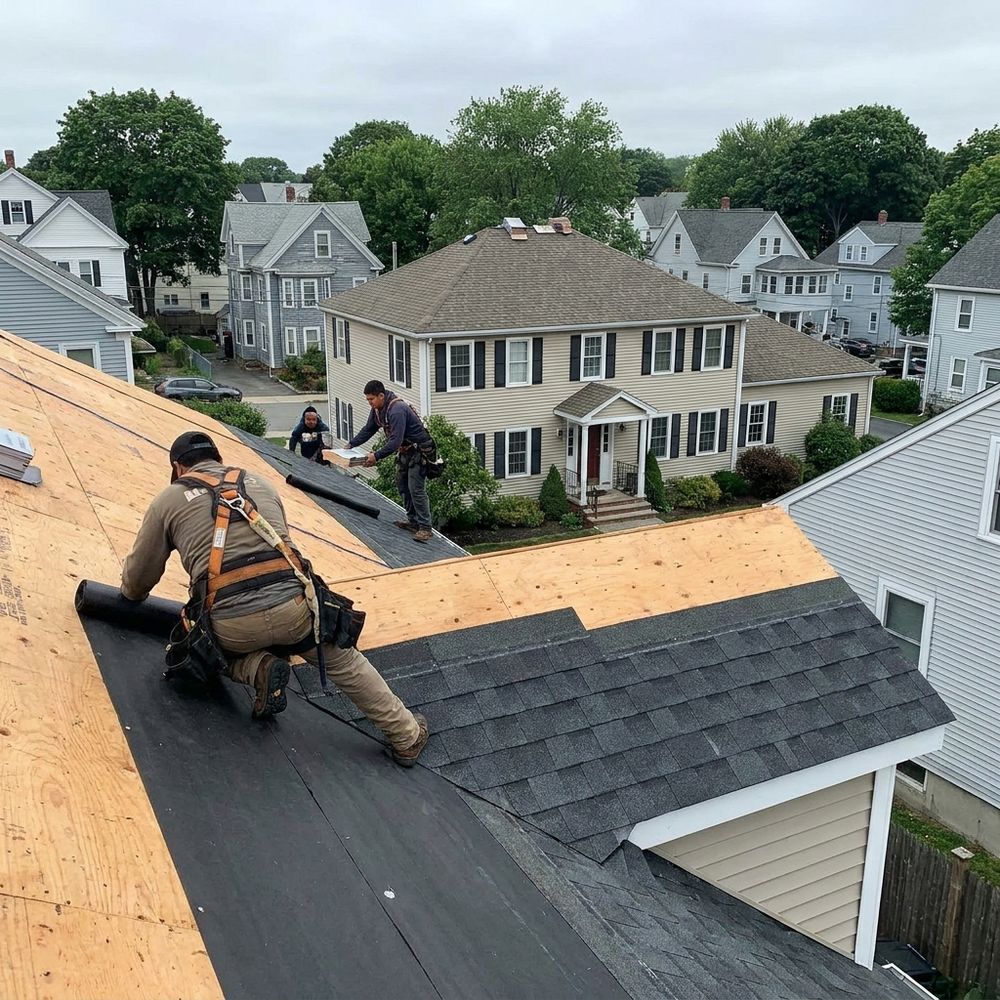
Architectural asphalt shingles go on almost every pitched roof we replace north of Boston — in this climate nothing else gives you that much weather protection for the money. Here’s architectural versus three-tab, what a wind rating really means on a nor’easter-exposed roof, how color reads on a colonial versus a cape, and why ventilation sets the roof’s lifespan more than the shingle ever will.
We don’t install three-tab shingles on a New England home — not as a budget option, not on a garage. If a contractor quoted you three-tab to hit a number, that’s the first line to question. And if you’re not sure you need a new roof yet, start with roof repair. Plenty of the roofs we get called about aren’t finished.
Architectural vs. three-tab: what actually separates them
Both are asphalt shingles — a fiberglass mat saturated in asphalt and surfaced with ceramic-coated granules. The difference is construction. A three-tab shingle is one flat layer cut into three even tabs. An architectural shingle (also called laminated or dimensional) is two or more layers bonded together, with the top layer cut in an irregular pattern so the roof reads with depth and shadow instead of a flat grid.
| Three-tab | Architectural / laminated | |
|---|---|---|
| Layers | One flat layer | Two or more bonded layers |
| Weight per square | Roughly 200–240 lb | Commonly 300–450 lb |
| Typical wind rating | Around 60 mph, sometimes 70 | Commonly 110–130 mph, installed to spec |
| Realistic life here | Around 12–18 years | Around 20–30 years |
| Appearance | Flat, uniform, repeating lines | Dimensional shadow, reads like wood shake from the street |
| At the edges | Long straight tab edges catch wind and lift | Heavier, thicker courses lie down and stay down |
The weight is what homeowners underestimate. A shingle half again as heavy is harder for wind to get under, harder for freeze-thaw to distort, and carries more asphalt — and asphalt is the waterproofing. Three-tab also ages badly here: the straight tab edges curl and cup across a whole plane at once, so the roof goes from acceptable to obviously finished in about two seasons.
The price gap is smaller than people expect. Across a whole replacement the shingle is a minority of the cost — labor, tear-off, disposal, flashing and underlayment are most of the number. Downgrading to three-tab saves a little on one line and costs you eight to twelve years of roof. That math never works, which is why we don’t offer it. Where the money actually goes is in our Massachusetts roof replacement cost guide.
Wind ratings, nor’easters and coastal exposure
Wind ratings are lab numbers, from a standardized test where shingles are installed exactly to spec on a flat deck and then blown at. Fair way to compare products. Not a promise about your house. Two things decide whether you get the rated performance:
- Nailing. Every rating assumes a set number of nails in a specific line on the shingle, driven flush and not overdriven. Four nails where six were required, or a nail an inch high in the wrong zone, and you have a shingle rated for whatever it happens to hold. It’s the most common install failure we find on blown-off roofs.
- Sealing. Shingles bond to each other with a heat-activated sealant strip. A cold-weather install needs sun, time, and sometimes hand-sealing at the vulnerable courses. A roof that never sealed down is waiting for the first real gust.
The exposure that matters here is a nor’easter — sustained wind out of the northeast for hours, usually with driving rain. Sustained is the key word. It isn’t the peak gust that lifts a roof; it’s hours of pressure working at the rakes, the eaves and the ridge. Those edges are where wind damage starts on essentially every roof we’ve repaired, which is why we run starter course at the rake as well as the eave. If your gable end faces northeast into open ground, tell us — it changes how we detail the edges, not which shingle we pick.
A high wind rating on a poorly nailed roof is worth nothing. A standard architectural shingle nailed correctly, with proper starter at the rakes and a sealed ridge, outlasts the fancier one installed carelessly. Ask any contractor how many nails per shingle and where. A vague answer tells you something.
Choosing a color that suits the house
Color is the one decision on a replacement that’s purely yours, and the one homeowners agonize over longest. Two rules: a roof is a very large surface, so the color always reads darker and more saturated on the house than on the sample board, and you’re seeing it in New England light, which is overcast much of the year. What tends to work on the housing stock we work on:
- White or light-clapboard colonial. Charcoal or a true black-gray. High contrast, crisp roofline, and it makes the trim look intentional. The safest good-looking choice in the region, and the reason half of Melrose has a charcoal roof.
- Cape with a low, close roof. On a cape the roof is a huge share of what you see from the street, so hard charcoal can make the house look top-heavy and squat. Weathered wood, driftwood gray or a mixed brown-gray blend softens the mass.
- Somerville or Medford two- and three-family. Busy facades — bays, porches, multiple entries, often mid-tone vinyl siding. A blended gray or weathered wood keeps the roof quiet. Solid black on a three-decker reads heavy.
- Brick front or a prominent chimney. Warm grays and brown-gray blends sit with brick. Cool blue-grays usually fight it.
Get a full-size sample, not a chip, and look at it against the house on an overcast day and again in late-afternoon sun. Then drive your own street — every one of these color families is already on a house within half a mile of yours, same architecture, same light. Better than any catalog. For resale, charcoal and weathered wood are the two that never date.
Twenty to thirty years — and what really sets that number
An architectural asphalt roof in eastern Massachusetts realistically gives you somewhere in the region of 20 to 30 years. Printed warranty lengths run longer; we quote the range we actually see on the roofs we tear off. Here’s the part that surprises people — moving up to a heavier, pricier shingle moves that number by a couple of years at most. Fixing the attic ventilation can move it by ten.
A badly ventilated attic bakes the underside of the deck all summer. The shingle cooks from below, the asphalt loses its volatiles faster, granules let go, the mat gets brittle. In winter the same defect runs in reverse: warm house air reaches the underside of the roof, melts the snow sitting on it, and the meltwater runs to the cold eave and refreezes into an ice dam that pushes water back up under the shingles. Same fault, two seasons — that’s the whole mechanism behind ice dams on Boston roofs.
Balanced ventilation means intake low and exhaust high: soffit vents at the eaves feeding a continuous ridge vent. The failure we find most is a ridge vent on a roof whose soffit intake is stuffed solid with insulation. Air can’t leave if it can’t get in. A ridge vent with no intake is decoration.
The other drivers, in rough order: how much sun and weather that plane takes (a south-facing slope ages faster than the north-facing one on the same house), whether the flashing was replaced or reused, whether trees keep a slope damp and mossy, and whether anyone has walked the roof carelessly in freezing weather. More in how long a roof lasts in New England.
What the shingle sits on
The shingle is the visible layer and the last one installed. Everything keeping water out of your house in February sits underneath it — ice & water shield at the eaves and valleys, synthetic underlayment across the deck, new drip edge, new step and counterflashing, sound sheathing under all of it. A premium shingle over reused flashing and a soft deck is an expensive way to leak.
We won’t repeat the full specification here because it lives on the pillar page. Read exactly what we install on a roof replacement, layer by layer — that’s the spec that goes on your written estimate before anything starts. And no, we don’t lay new shingles over old ones; here’s why we won’t roof over an existing roof.
Asphalt shingle questions we get asked
Will you install three-tab shingles if I ask for them?
No. The savings are small relative to the whole job and the cost is eight to twelve years of roof life plus a much weaker wind rating. If budget is the constraint we’d rather talk about scope — the worst plane now, or a repair that buys a few more seasons — than put up a shingle we know is wrong for this climate.
Does a higher wind rating mean my roof won’t blow off in a nor’easter?
It means the shingle can hold that wind when it’s nailed and sealed exactly to specification. Most wind failures we get called out to are installation failures, not product failures — too few nails, nails driven high or overdriven, or a starter course missing at the rake. The rating is a floor you only get if the install earns it.
Is a heavier, more expensive shingle worth the upgrade?
Sometimes, but it’s rarely the highest-value place to spend. If your attic ventilation is unbalanced, putting that money into proper soffit intake and a continuous ridge vent will add more years to the roof than a thicker shingle will. We’ll tell you which one your house needs after we’ve been in the attic.
Does a dark roof shorten the shingle’s life?
A dark roof runs warmer at the surface, but on a properly vented attic the difference in shingle life is small enough that we wouldn’t talk you out of a color you like to chase it. Ventilation does far more to the temperature under that deck than color does on top of it. Pick the color that suits the house and fix the airflow.
Can you match my existing shingle color on a repair?
Close, usually — but be realistic. Color families shift over the years, and an existing roof has weathered and lost granule color, so new shingles next to fifteen-year-old ones will show. On a small repair nobody sees, that’s fine. On a whole visible plane, we’ll say so before we start rather than after.
Where we install them
We install architectural asphalt roofs across Boston’s northern corridor, including Boston, Medford, Somerville and Stoneham. Call (617) 721-1814 and we’ll look at the roof, get in the attic, and give you a straight answer about whether it needs replacing yet.